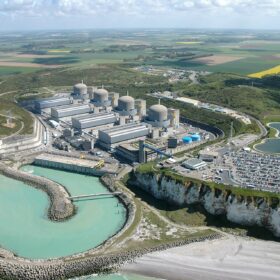
From night to noon: France’s reactors are now bending for European solar
Hourly ENTSO-E data show the summer midday-to-evening gap in French nuclear output has grown nearly eightfold since 2019. The reactors have adapted. The rest of the European power system has some catching up to do.

Solomon Islands plans first large-scale solar project
The Solomon Islands Electricity Authority and Asian Development Bank have signed an agreement aimed at developing the country’s first large-scale solar project.
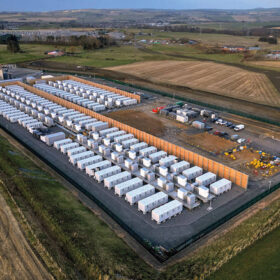
Grid-forming tech on centre stage as search for system resilience steps up
Maintaining grid stability becomes more challenging as the share of intermittent renewables grows in the electricity generation mix, but system resilience is essential to continued solar deployment. Grid-forming inverters offer a solution, and their capabilities are increasingly being tested and relied upon in key energy markets globally.

Bruges appoints independent solar broker offering free advice
The city of Bruges is offering small- to medium-sized enterprises and organizations looking to install large-scale rooftop solar free advice from an independent solar broker. The solar broker will be available to support the entire installation process, from initial calculations through to final commissioning.
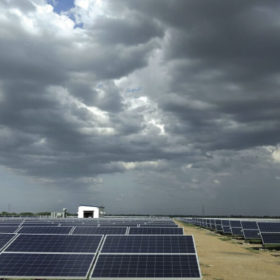
AI model uses cloud type and cover to predict solar power swings
A machine learning model uses cloud type and cloud cover to predict rapid changes in surface solar irradiance, including short-term “ramp” events that affect grid stability. When tested across 15 global sites, it showed strong generalizability, with most locations matching or exceeding the original model’s predictive performance, though extreme climates performed less consistently.
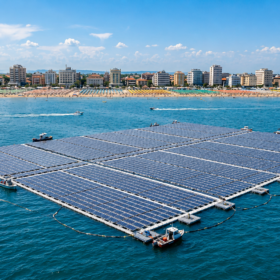
Offshore floating PV could technically meet Italy’s electricity demand
New research identified the most suitable areas for offshore floating PV deployment in Italy using a geospatial multi-criteria assessment model. The study found that exploiting just 2% of Italy’s technically feasible offshore solar area could theoretically generate enough electricity to meet the country’s annual power demand.
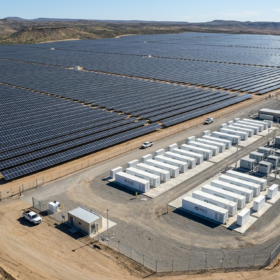
Solar approaches 3 TW, but the industry faces new challenges
Global solar PV capacity reached around 2,974 GW by end-2025, with nearly 698 GW added in 2025. The sector, however, is shifting from rapid deployment to integration challenges, as high penetration rates drive curtailment, storage demand, grid constraints, and evolving policy and market designs.
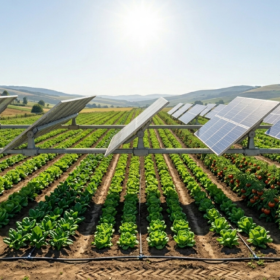
Plug-and-play control framework for adjusting panel tilt in agrivoltaics
A Cornell University research team developed a control framework that simultaneously considers past and future conditions when determining solar panel tilt angle. The researchers told pv magazine it is designed to be plug-and-play, allowing for software developers and solar operators to incorporate their optimization algorithms directly into the framework.
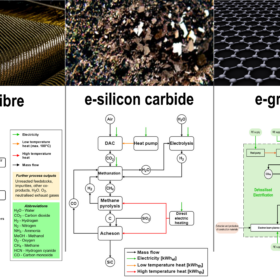
Low-cost solar PV can turn CO2 into profitable materials enabling negative emissions
Low-cost solar PV enables to turn CO2 from an unwanted burden into a precious raw material and sequestered in materials with many applications. This effectively reframes carbon capture, utilization, and sequestration as a monetizable carbon dioxide removal option. Three recent studies on electricity-based carbon fiber, silicon carbide, and graphene aimed at enabling large-scale negative emissions by 2050.
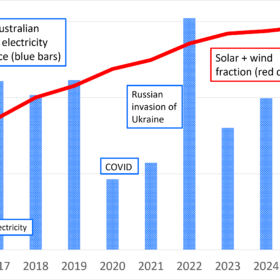
Very low cost rooftop solar and batteries slashes domestic energy cost – Part 1: Australia
Rooftop solar in Australia provides the cheapest, cleanest and most reliable domestic energy in history.
