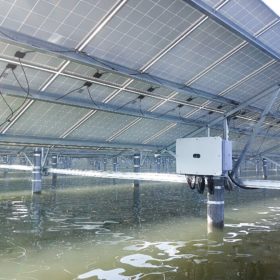
The effects of fishery photovoltaic plants on water temperature, surrounding micro-climate
Researchers in China have estimated the effects of utility scale solar parks built on fisheries and have found these facilities have an “unobvious” heating effect on the surrounding environment. They ascertained that both air and water temperature are slightly increased by the PV plant, although with a very limited impact on the local micro-climate.

Photoluminescent solar PV for greenhouses
Heliene, a solar panel manufacturer, and UbiQD entered a joint development agreement for light-optimizing, energy-producing modules designed to top agrivoltaic greenhouses.
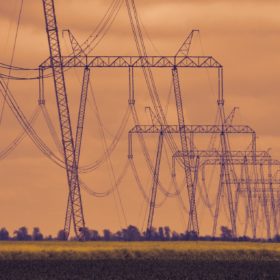
Upgrading US transmission lines could enable 27GW more renewable power per year
“Advanced conductors” can deliver more electricity than conventional transmission lines, using existing transmission towers. Renewables trade group ACORE calls for greater use of advanced conductors, “to accelerate low-cost decarbonization.”
Longi wants to challenge recent ruling in patent dispute with Hanwha Q-Cells in the Netherlands
The Chinese module manufacturer said it will now start preparation of the appeal to The Supreme Court of the Netherlands and the European Court.

Mauritius launches tenders for 140MW of solar-plus-storage
Through two different procurement exercises, the archipelago’s Central Electricity Board seeks to reduce its dependence on fossil fuels.
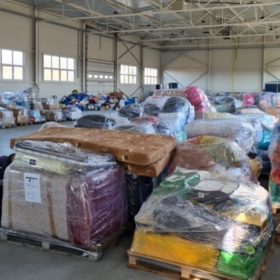
Slovakia’s first solar module factory
Slovak manufacturer Agora Solar is planning to build a 150MW factory in Vranow, in the eastern part of the country. The facility will produce glass-glass panels and may reach a capacity of 500MW by 2024.
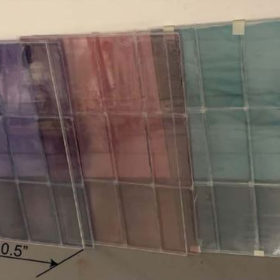
Semi-transparent organic photovoltaic filters for agrivoltaic greenhouses
Researchers in the United States have tested organic photovoltaic filters in a greenhouse hosting lettuce growth and have found the devices’ transmission spectra may help fine-tune the characteristics of the plant. They used transcriptomic analysis to assess the key modifications of the plants grown under the solar filters.
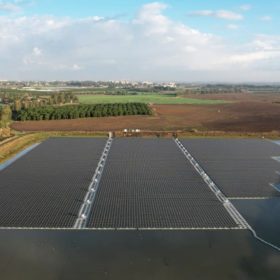
Floating solar-plus-hydroelectric project planned on Indian dam
Renewable energy developers have until April 25 to lodge interest in developing a hybrid facility combining 1.5MW of hydroelectric generation capacity and 100MW of floating solar in the state of Maharashtra.

Netherlands sets €13bn budget for 2022 SDE+ program, green hydrogen included for first time
Starting from this year, the scheme will also be open to green hydrogen facilities that are directly linked to wind or solar parks, and industrial electrification projects based on hybrid glass furnaces.
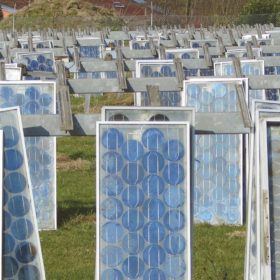
Greening US solar with end-of-life plan
The US Department of Energy’s five-year plan aims to reduce the environmental impacts of solar panels at the end of life, plus cut in half the cost of recycling the panels.
