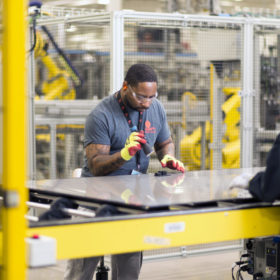
Reviewing the US solar panel value chain
From polysilicon to panels to recycling, how much domestic capacity does the United States actually have?
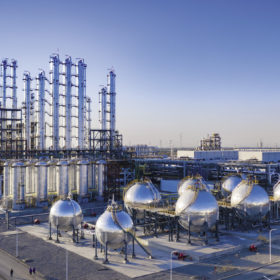
Daqo records average polysilicon price of $32.54/kg in 2022
Chinese polysilicon supplier Daqo sold 132,909 tons of polysilicon last year, from 75,356 tons in 2021.
Longi raises wafer prices as polysilicon hits $34.98/kg
The China Nonferrous Metals Industry Association (CNMIA) said that prices for monocrystalline silicon ranged from CNY 222 ($32.30)/kg to CNY 248/kg last week, up 31.37% from the middle of January. Longi, meanwhile, has raised its wafer prices by more than 15%.
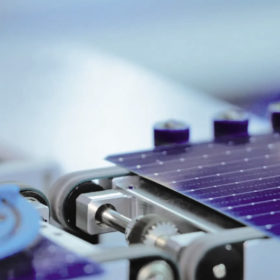
China produced 288.7 GW of modules, 827,000 MT of polysilicon in 2022
China’s Ministry of Industry and Information Technology (MIIT) says Chinese manufacturers produced 357 GW of wafers and 318 GW of solar cells in 2022.
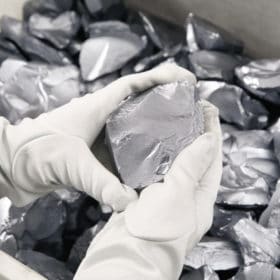
Wafer, cell prices continue to rise
Wafer prices rose by between 24% and 36% this week, according to new data from the China Nonferrous Metals Industry Association (CNMIA).
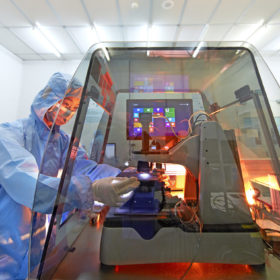
Trina Solar to expand n-type ingot capacity by 35 GW
In response to growing demand, Trina Solar has revealed plans to ramp up ingot capacity at a new factory in Xining, in China’s Qinghai province.
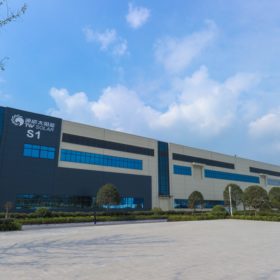
Tongwei to set up 120,000 MT of additional polysilicon capacity
Tongwei has revealed plans to set up a new polysilicon facility with a production capacity of 120,000 metric tons (MT) in Leshan, in China’s Sichuan province.
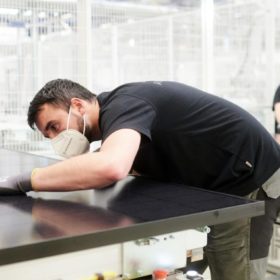
Norsun secures wafer order from Meyer Burger
Norsun, which operates a hydroelectric-powered factory in Norway, has agreed to sell wafers to Meyer Burger, which plans to expand its annual solar cell production capacity to 3 GW by 2024.

Polysilicon price rebound continues
Polysilicon prices started to rise in the second half of January, according to new data from the China Nonferrous Metals Industry Association (CNMIA).
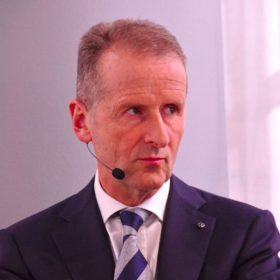
Former VW boss aims to set up 20 GW vertically integrated PV plant in Europe
In a podcast, former Volkswagen CEO Herbert Diess noted the importance of reducing reliance on China in the solar industry. But he said plans to set up production in Europe require state support and the right conditions.
