
Romania improves rebate scheme to speed up rooftop PV development
The Romanian government has changed the rules of the Casa Verde Fotovoltaice (green PV home) scheme to support residential solar installations under the country’s net metering regime. The new provisions improve the installation process and settlement of rebate payments.

Kenya launches tender to add solar to 22 diesel mini-grids
Kenyan utility KPLC wants to retrofit 23 diesel mini-grids by adding wind and solar power generators. PV is the only option available for 21 of the selected sites.

Novel catalyst produces green hydrogen from seawater via solar
Australian and Chinese researchers have developed a novel catalyst for the production of green hydrogen from seawater via solar.
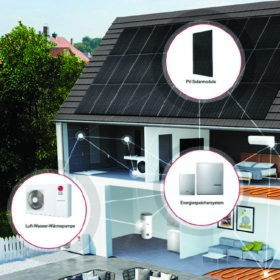
LG Electronics offers hybrid system combining heat pump, PV and storage
The system generates electricity and heat for residential houses and small businesses. An integrated energy management system should guarantee maximum self-consumption of the solar power produced.
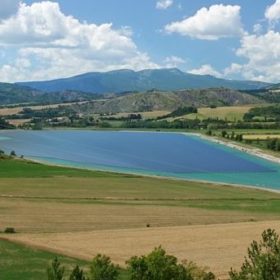
EDF begins work on 20 MW floating PV plant in France
The French energy company will build the facility on the water reservoir of the Lazer hydroelectric plant, to double its production. Construction is expected to require 13 months.
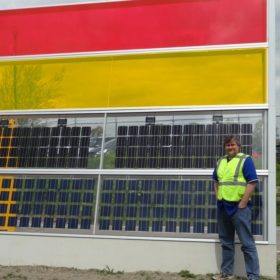
Improving PV panel performance with luminescent solar concentrators
Researchers in the Netherlands say the lack of a universal standard is preventing luminescent solar concentrators from being widely adopted as photonic devices or for improvement of PV module performance. This technology can be integrated with finished solar panels with no need of modifying their electronic structure, helping them collect high-energy photons that they fail to harvest.
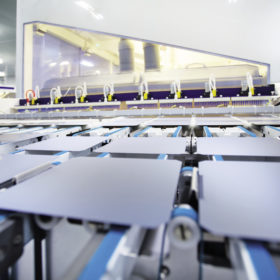
Chinese PV Industry Brief: More wafer and polysilicon capacity and new suppy deals
Wuxi Autowell has begun construction on its 50 GW wafer factory in Guangdong province and Longi and Wuxi Shangji Automation have announced new supply deals. GCL-Poly has announced it will raise the production capacity of its factory in Jiangsu from 6,000 to 10,000 metric tons – despite the company suffering a cross-default at the weekend.
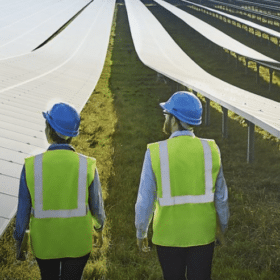
Macquarie sets up unit to build 8 GW solar project pipeline in Europe
Green Investment Group, owned by Macquarie, has launched Cero Generation, which will operate on a European scale and carry out both ground-mounted and commercial scale power generation projects. It will also provide integrated energy storage solutions.
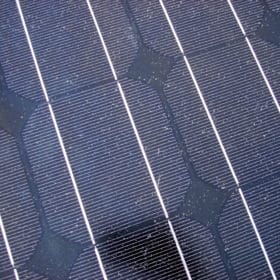
Active self-cleaning tech for PV modules
An international research team has developed a cleaning system for solar panels that combines a vibrating device with the use of hydrophilic curved rungs. The technique is claimed to be able to remove the surface contaminants through the internal flow of vibrating water droplets applied with a pipette onto the module surface and transported, under vibration, to the contaminated parts.
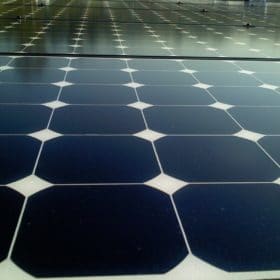
Stochastic fractal search algorithm to measure parameters of PV modules
An international research team has used, for the first time, a powerful metaheuristic and a nature-inspired algorithm to improve the estimation of the parameters of PV cells and modules. The algorithm imitates the natural phenomenon of growth and uses the diffusion process, based on random fractals.
