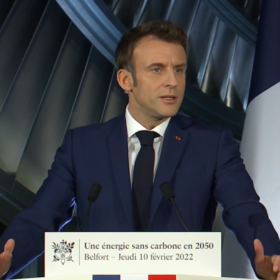
France announces 100GW solar target for 2050
France has set a new target under which it will install 5GW of new PV capacity per year.
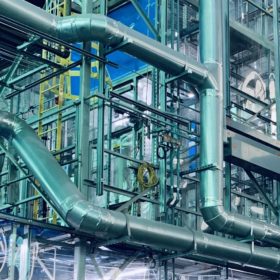
Water-based electrolyzer for green hydrogen production
Verdagy has secured a $25 million investment for its new electrolyzer technology, which provides hydrogen fuel for heavy industrial applications. The membrane-based technology uses large active area cells, high current densities, and broad operating ranges to deliver hydrogen at scale.
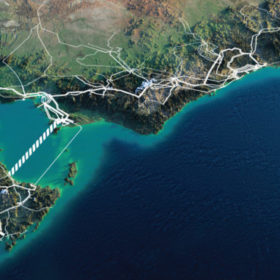
Undersea electricity interconnector to connect Australia with Tasmania
The developers of the proposed 1.5GW Marinus Link transmission project, which would link Tasmania and the Australian mainland via an undersea electricity interconnector, have launched a new engineering survey to identify the most suitable corridor for the cables.
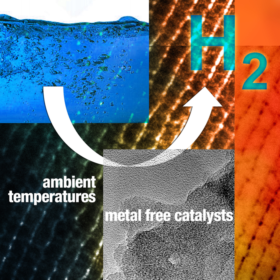
The Hydrogen Stream: New dehydrogenation process to improve hydrogen storage
The U.S. Department of Energy’s Ames Laboratory launched a new catalyst based on nitrogen and carbon to extract hydrogen from hydrogen storage materials at mild temperatures and under normal atmospheric conditions. Furthermore, South African President Cyril Ramaphosa said that the country is working on attracting new investments in electric vehicles and hydrogen and Norwegian consultancy and classification society DNV launched, together with 18 industry partners, a new Joint Industry Project (JIP) to enhance the standardization for hydrogen production systems that use renewable energy-powered electrolysis to produce green hydrogen.
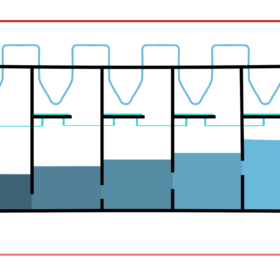
Photovoltaics for multistage flash desalinators
Scientists have investigated how utility-scale solar may be used to power multistage flashing-brine recirculation (MSF-BR) water desalination plants in Aqaba, Jordan. They found the facility would be sufficient to provide the entire city with drinking water. The proposed system configuration comprises a 30 MW solar plant and a standar MSF-BR unit.
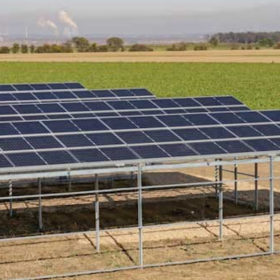
New agrivoltaic system design from Germany
Germany’s Sunfarming is testing the new project design in cooperation with research centers Jülich and the Fraunhofer ISE.
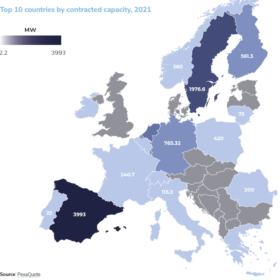
Spain largest PPA market in Europe last year with almost 4 GW of deals
According to Swiss consultancy Pexapark, around 11 GW of power purchase agreements were closed in Europe last year. For 2022, the analyst expects shorter deals and the presence of more new entrants.
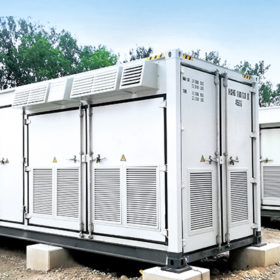
Italy’s third Capacity Market auction expected to open new opportunities for large-scale storage
The retirement of coal baseload capacity, some regulatory adjustments and high energy prices volatility could bode well for the deployment of batteries in Italy, and especially in Sicily. Problems, mostly related to the timing and the structure of the auction, remain, however. We spoke about it with Michele Scolaro, Aurora Energy Research Associate.
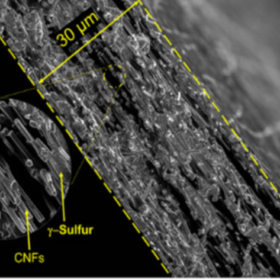
A 4,000 cycle lithium-sulfur battery
Scientists in the United States developed a lithium-sulfur battery using a commercially available carbonate electrolyte, that retained more than 80% of its initial capacity after 4000 cycles. The group used a vapor deposition process which unexpectedly produced a form of sulfur that did not react with the electrolyte, overcoming one of the key challenges for this battery chemistry.
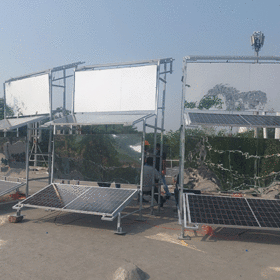
Portable, space-saving photovoltaic towers
Researchers at the Indian Institute of Technology Delhi have developed solar towers that can be moved from one place to another and can generate 20-30% more power while requiring only 50-60% space compared to conventional mounting setups.
