
Floating PV mounting structure for harsh climatic conditions
Developed by Chinese specialist Mibet, the floating PV structure can reportedly endure wind and snow loads of up to 42m/s and 1KN/㎡, respectively, in all water environments. It was recently deployed in Poland, at a location where temperatures may reach as low as 40 degrees Celsius.
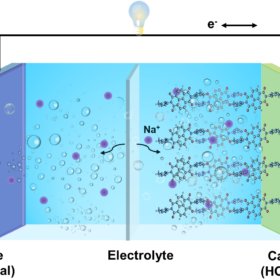
Ultra-stable sodium-ion storage via organic electrode materials
A research team at China’s Soochow University has used hydrogen-bonded organic frameworks to make sodium-ion batteries even more sustainable and affordable while prolonging their lifespan to over 10,000 cycles.
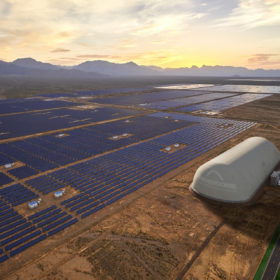
Storing solar power with compressed carbon dioxide
An Italian company has developed a system that can store energy from wind, solar and grid electricity by compressing and using CO2 without any emissions. The system draws CO2 from an inflatable atmospheric gas holder, stores it, and uses it to produce power again, when demand for stored energy arises.
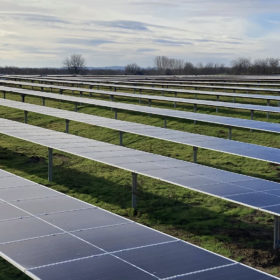
Utility scale solar goes merchant in Hungary
Photon Energy has deployed its first merchant PV project in Hungary. The company said the €1 million plant may be the first in a series selling power to the spot market. In an interview with pv magazine, Hungarian renewable energy specialist, Ferenc Kis, stated that these projects may become more frequent in the future, due to new coordinated grid connection capacity allocation.
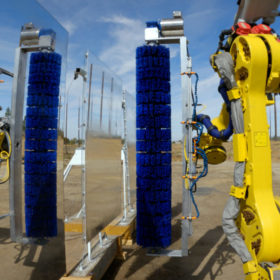
New tank design, autonomous robot for concentrated solar power plants
Two different technological developments were announced this week for concentrated solar power technology. In Australia, a consortium led by Vast Solar filed a patent for a new tank design for thermal energy storage systems. And in the United States, Heliogen announced the rollout of robots to install and clean projects.
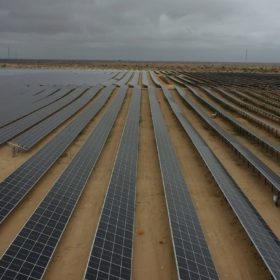
India set to record best year ever for new PV additions in 2021
India installed 7.4 GW of new solar capacity in the first nine months of 2021, putting this year on track to become one of the best 12-month periods on record for new PV installations.
Three vastly divergent US solar deployment projections
The International Energy Agency, S&P Global Market Intelligence, and Rystad Energy have issued new renewable energy projections for the U.S. market that range from a 50% decline to a year-on-year surge in deployment.
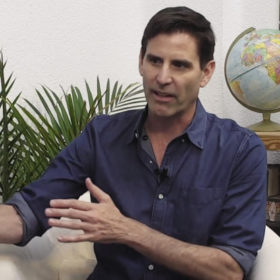
Grid stability and 100% renewables
New research from Stanford University professor Mark Jacobson seeks to remove any doubts about grid stability in a world powered entirely by renewable energy. The latest study models 100% wind water and solar powered grids across the United States, finding no risk of blackouts in any region and also broad benefits in cost reduction, job creation and land use.
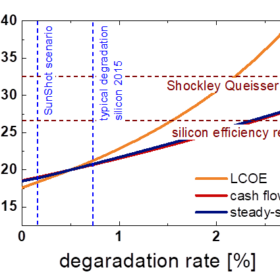
New metric for 50-year solar plant operation
A German-U.S. research group has proposed a new model to treat PV installations as permanent assets, with maintenance being performed at regular intervals. Through the new metric, it found more convenient to operate a module with 0.5% annual degradation for 35 years, and a module with 0.2% degradation, for 50 years.
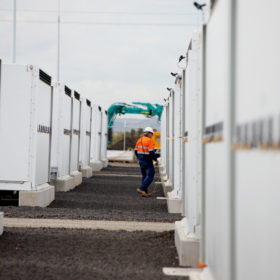
Australia switches on new storage battery
Neoen has started operating a 300 MW/450 MWh big battery in Geelong, Australia. In spite of a fire during commissioning in July, the battery has been delivered in record time, taking less than a year to build and begin operations.
