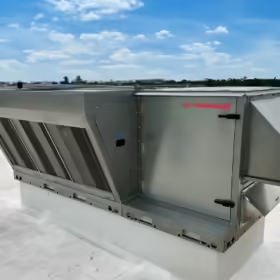
Japanese manufacturer launches dual-fuel commercial rooftop heat pump
Japanese machinery maker Yanmar says its new commercial rooftop units (RTUs) include a standard model, a dual-fuel heat pump, and a dedicated outdoor air system (DOAS) with integrated energy efficiency ratios (IEER) up to 21.3.
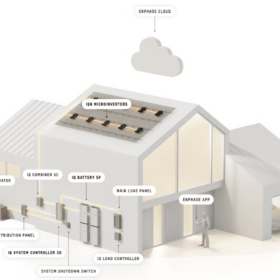
Enphase announces complete off-grid solar-storage system
Enphase Energy has introduced a complete off-grid solar and storage system that integrates batteries, microinverters, and generator control, with international rollout set for 2026.

Schneider Electric unveils 200 kWh C&I battery storage system
Schneider Electric has introduced a modular 200 kWh battery energy storage system for commercial and industrial (C&I) users, scalable up to 2 MWh across 10 units.
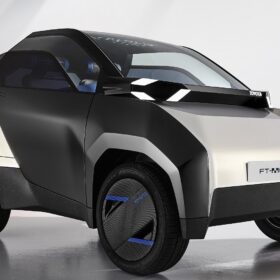
Toyota developing two-seater electric vehicle with solar roof
Toyota Manufacturing UK says it is leading a consortium to investigate the feasibility of a lightweight micro-mobility electric vehicle with a PV roof, digital connectivity, and sustainable components.

Baxi unveils high-temperature air source heat pumps
Baxi has introduced its HP60 monobloc air source heat pump series, offering outputs from 4 kW to 13 kW and a seasonal coefficient of performance of up to 5.34.
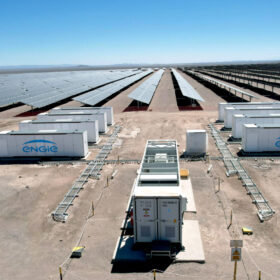
Hybrid PPA model improves PV-BESS bankability, say researchers
Researchers have modeled a hybrid financing scheme combining contracted and merchant components to improve the bankability of PV-battery energy storage system (PV-BESS) assets, using a Bayesian LSTM forecast integrated with a MILP optimization model to assess performance.
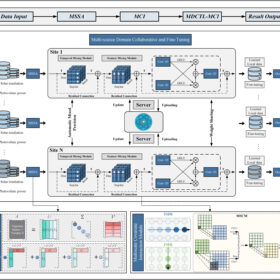
PV power generation forecast technique for solar plants with missing data
Scientists in China have developed a novel missingness-aware power forecasting method that leverages signal decomposition, multi-scale covariate interaction, and multi-domain collaborative transfer learning. The approach reportedly improves average forecasting accuracy by 15.3%.
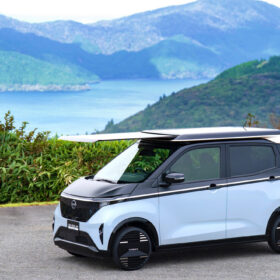
Nissan presents mini electric vehicle with expandable solar roof
The Japanese car maker announced it will show a prototype extendable solar PV rooftop onboard a Nissan Sakura Kei at an upcoming mobility industry event in Japan.

3D solar tower increases capacity factor 50%, triples solar surface area
Janta Power closed $5.5 million in seed funding to develop its vertical solar tower, with pilot programs already underway in major global airports like Dallas-Fort Worth and Munich International Airport.

Building an equitable energy transition: Insights from IRENA’s 2025 Gender Report
This week, Women in Solar Europe (WiSEu) analyzes the findings of IRENA’s latest “Renewable Energy: A Gender Perspective (2025)” report, revealing that women’s representation in the renewable energy workforce remains stagnant at 32%, unchanged since 2019. Through the voices of WiSEu ambassadors and industry leaders, this article explores the persistent barriers, pay gaps, and cultural biases that continue to limit progress and the collective responsibility to build a truly inclusive and people-centric energy transition.
