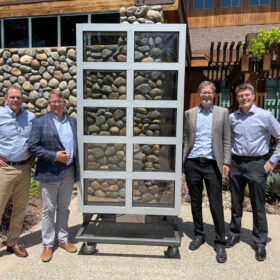
US startup secures $3 million to develop organic PV-coated windows
Next Energy Technologies has secured a grant from the California Energy Commission (CEC) to develop its organic photovoltaic coating for commercial windows.

Only5mins! – Lower electrolyzer costs crucial for green hydrogen deployment
Low electrolyzer costs, low capex, a low levelized cost of energy, and a decent capacity factor are key to developing viable green hydrogen projects. George Touloupas, senior director of technology for Clean Energy Associates, tells pv magazine about the main challenges and the current price trajectory for green hydrogen tech.
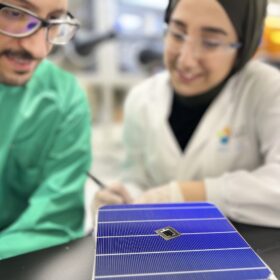
KAUST claims 33.2% efficiency for perovskite/silicon tandem solar cell
The European Solar Test Installation (ESTI) has confirmed the results of King Abdullah University of Science and Technology’s (KAUST) new perovskite/silicon tandem solar cell. KAUST researchers claim the tech is a step forward from other perovskite-silicon cells they have developed.

Only5mins! – Self-healing properties of perovskite solar
The Viperlab project is a European initiative that brings together organizations that are working on perovskite solar. pv magazine speaks with Eva Unger, Viperlab’s scientific coordinator, about the infrastructure needed to facilitate the transfer of information and technology to the industry, as well as the huge database that needs to be created to serve this purpose.
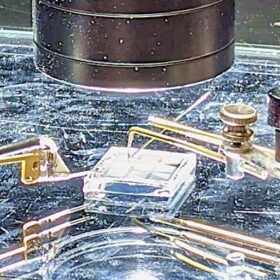
Bifacial CdTe solar cell achieves record power density via film lithography
The US National Renewable Energy Laboratory (NREL) and First Solar have used cracked film lithography (CFL) to build a bifacial cadmium telluride solar cell with a power density of 20.3 mW cm−2. They claim the cell has a higher bifacial power density than any polycrystalline absorber currently manufactured at scale.
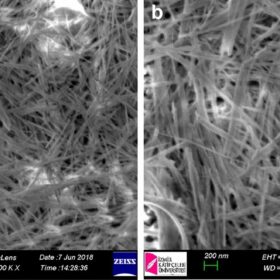
‘Natural clay’ additive promises gains in perovskite solar cell efficiency, stability
Scientists in Turkey have demonstrated that sepiolite, a naturally occurring clay substance, can be added to perovskite precursor materials, and form a scaffold layer that can improve the efficiency and stability of the cells. The scientists believe that this substance could be valuable in developing reproducible processes for the production of large-area perovskite solar cells.
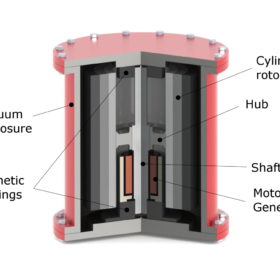
Battery hydrogen vs. battery flywheel
Scientists in Italy have looked at how flywheel storage and reversible solid oxide cells could be integrated with lithium-ion batteries in minigrids powered by solar. They found that flywheels combined with batteries could be the cheapest option for power smoothing.
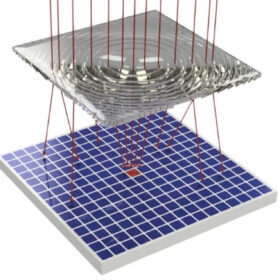
Taiwanese scientists develop high-concentration PV system
Taiwanese researchers have developed a system featuring a 2 × 2 Fresnel lens array and a solar panel made of III-V materials and polycrystalline solar cells, with low light leakage.
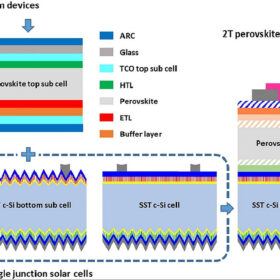
Poly-SiOx solar cell for 4T, 2T perovskite-silicon tandem devices
Scientists in the Netherlands have developed a new crystalline solar cell based on poly-SiOx passivating contacts. The poly-SiOx tech results in a 20% efficiency rating, but 4T tandem perovskite-silicon solar cells based on the poly-SiOx cell can reach an efficiency of 28.1%, and 2T tandem perovskite-silicon devices can hit 23.2%.
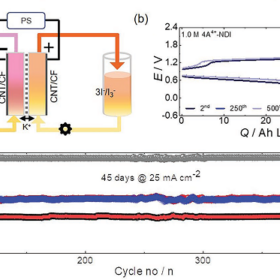
Aqueous redox flow battery based on naphthalene diimide achieves high capacity retention
Scientists in South Korea have developed a highly soluble, stable organic redox-active molecule for use in aqueous redox flow batteries. The newly developed naphthalene diimide (NDI) molecule offered higher storage capacity than existing vanadium devices.
