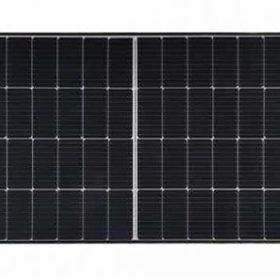
High-voltage solar panel for narrow roofs
Japan’s Xsol says its new monocrystalline PV modules offer 275 W of power output and an efficiency rating of 20.3%. They measure 1,760 mm × 768 mm × 30 mm and can be installed in two-panel rows.
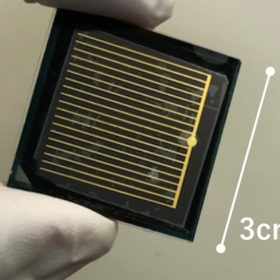
Three-junction III-V solar cell with 29.3% efficiency
Japanese researchers have built an InGap-GaAs-CIGS solar cell that purportedly has the potential to reach an efficiency of 35%. The device has already achieved an efficiency of 31.0%, an open-circuit voltage of 2.97 V, a short-circuit current density of 12.41 mA/cm2, and a fill factor of 0.80.

Chinese PV Industry Brief: Daqo secures 46,200 MT polysilicon order
Daqo has secured another big polysilicon order and GCL Technology said it expects a profit of CNY 12.7 billion ($1.76 billion) from its solar materials business in the third quarter. Wafer manufacturer Wuxi Shangji Automation, meanwhile, has secured an order from TOPCon panel maker Da-Solar.
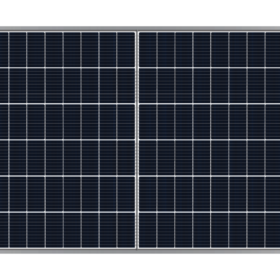
RenewSys unveils 590 W bifacial solar module
India’s RenewSys has released its DESERV Extreme series of bifacial PV modules, with front-side power outputs ranging from 565 W to 590 W. The modules are built with half-cut, monocrystalline PERC cells.
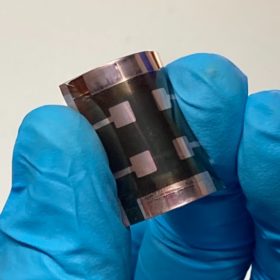
Flexible all-perovskite tandem solar cell with 23.8% efficiency, improved voltage
A Chinese-Swiss research group claims to have overcome two major challenges for the development of flexible all-perovskite tandem solar cells – voltage losses and the deposition process for the cell’s functional layers. They built a device with a high open-circuit voltage of 2.1 V.
IEA-PVPS expects polysilicon prices to stabilize by end of 2023
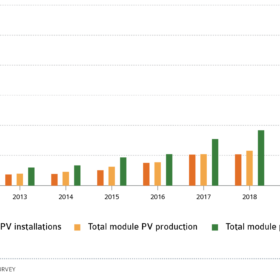
The International Energy Agency Photovoltaic Power Systems Programme (IEA-PVPS) recently published a report on trends in PV applications for the 2021-22 period. Prices for polysilicon, wafers, cells and modules rose, while production capacity expanded in China and beyond.
Global polysilicon capacity could hit 536 GW by end of 2023
Clean Energy Associates said in a new report that it expects polysilicon production capacity to exceed PV installations next year.

‘Footstep tech’ for solar module cleaning
Scientists in South Korea have used a triboelectric generator and an electrodynamic dust shield to develop a panel-cleaning system that can be activated by footsteps. They said the system can remove more than 70% of accumulated dust with the pressure of just 12 footsteps.
PV production equipment sales soaring in Europe
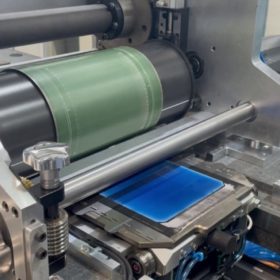
According to VDMA, a German engineering association, there are now more orders coming in for German production equipment from Europe than from China. Nevertheless, shipments to Asia remain dominant.
Selenium solar cell with optimized energy bandgap
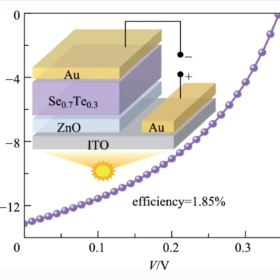
Chinese scientists have built a selenium solar cell with an alloyed selenium-tellurium absorber, which reportedly reduces interfacial defects. Under standard illumination conditions, the device has an efficiency of 1.85%.
