Microwave heating for glass separation in end-of-life solar modules
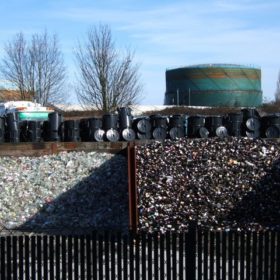
Scientists in Thailand have used microwaves to separate broken glass from PV panels. The process can be performed at temperatures ranging from 45 C to 55 C.
India launches second phase of solar production incentive scheme
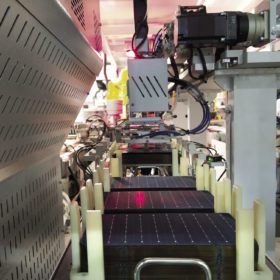
Solar Energy Corp. of India (SECI) has started accepting applications from solar manufacturers under the second phase of the production-linked incentive (PLI) scheme, with an outlay of about $2.4 billion.
NREL updates interactive chart of solar cell efficiency
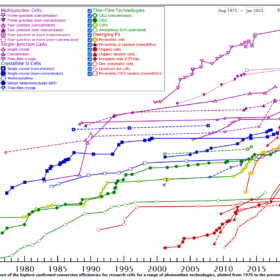
The US National Renewable Energy Laboratory (NREL) has released a new, interactive version of its research cell efficiency chart for a range of PV technologies.
CIGS-perovskite tandem solar module with 21.1% efficiency
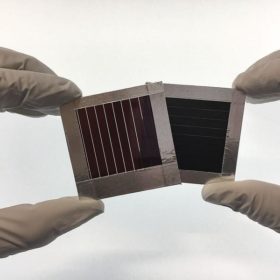
German scientists have built a tandem perovskite-CIGS panel measuring 9 square centimeters, with organometallic perovskites for the top module.
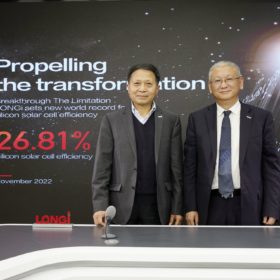
Longi claims world’s highest efficiency for silicon solar cells
Longi said it has achieved a 26.81% efficiency rating for an unspecified heterojunction solar cell, as confirmed by Germany’s Institute for Solar Energy Research Hamelin (ISFH).

China Brief: SNEC postponed to May
SNEC, the world’s biggest solar event, has been postponed for the third time this year. Yingfa Group, meanwhile, inaugurated a 20 GW cell factory in Sichuan province and GCL Tech said it plans to produce raw materials for EV batteries.
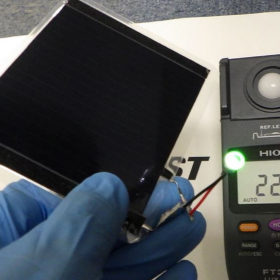
Roadmap to achieve CIGS solar modules with efficiencies above 20%
Japanese scientists have described the steps that need to be taken to improve the average efficiency of CIGS solar modules, from around 18.5% at present to more than 20%. They presented all of the critical technical factors that are currently holding the tech back from broader market adoption.
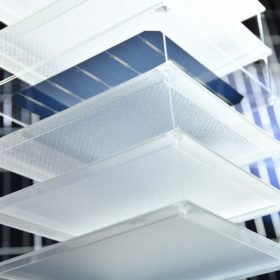
Taiwanese consortium develops easily recyclable solar module
The Industrial Technology Research Institute (ITRI) and United Renewable Energy (URE) have developed a solar panel that can be easily dismantled to simplify the recycling process. They claim that 96% of the materials in the panel can be recovered, including all of the solar cells and front glass.

1Komma5° to enter solar module business with full-black TOPCon product
Germany’s 1Komma5° says it will exclusively use polysilicon from Europe or the United States to make the TOPcon solar cells for its full-black modules. It is aiming for market launch in the second quarter of 2023.
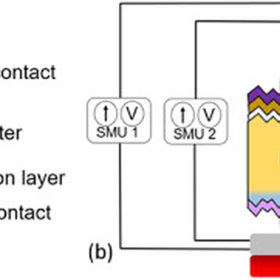
Assessment of hydrogen-induced contact resistance in TOPCon solar cells
Researchers have looked at how hydrogen-induced contact resistance could help to reduce changes in series resistance, in either TOPCon or PERC solar cells. They said degradation occurs purely at the n-type silicon-to-silver (Ag) contact on both cell architectures.
