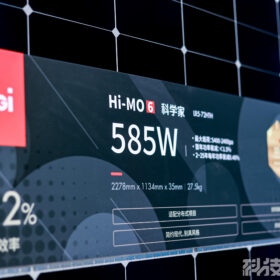
Longi betting on back-contact solar cell tech
Longi Chairman Zhong Baoshen said last week that that the company’s hybrid passivated back contact (HPBC) technology will dominate its production capacity in the future.
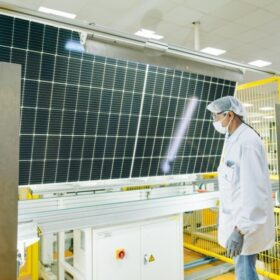
Tata secures $425 million from US development bank for 4.3 GW solar fab
Tata Power’s greenfield 4.3 GW solar cell and module manufacturing plant in the Indian state of Tamil Nadu is expected to start PV module production by the end of this year.
How to build, finance product stewardship scheme for photovoltaic panels
Researchers in Australia have provided a series of recommendations to set up regulatory frameworks for PV module recycling and reuse. They said that, as a rule of thumb, landfill bans, tracking of the panels’ serial numbers, and a clear definition of ownership should always be included in the legislation for end-of-life solar products.
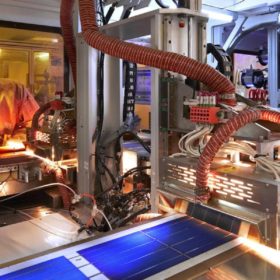
Chinese PV Industry Brief: Trina buys 40 GW of factory lines from Robotechnik
Trina Solar said it will use the equipment at its factories in Huaian, Yangzhou, Dongtai, and Tinghu, which are all in Jiangsu province.
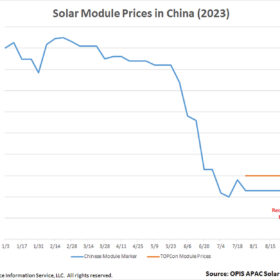
China solar module prices dive to record low
In a new weekly update for pv magazine, OPIS, a Dow Jones company, provides a quick look at the main price trends in the global PV industry.
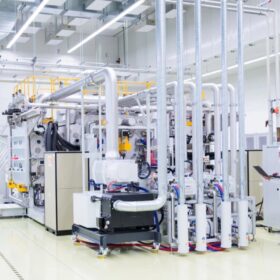
Ascent Solar hits 15.2% efficiency in production trials for CIGS cell
Ascent Solar has achieved a 15.2% efficiency for a copper indium gallium diselenide (CIGS) cell in production trials by replacing cadmium sulfide with a new material in the manufacturing process.

Inverted perovskite solar cell based on methyl-substituted carbazole HTL achieves 20.1% efficiency
Indian scientists built an inverted perovskite PV device that uses a self-assembled monolayer to suppress nonradiative recombination at the interface between the perovskite absorber and the hole transport layer. The cell achieved remarkable efficiency and was also able to retain the initial efficiency rating for 3,00 h.
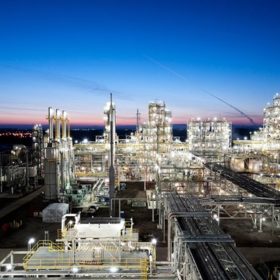
Qcells to sign $3 billion supply agreement for US-made polysilicon
Hanwha Qcells will make sizable prepayments to help restart the REC Silicon plant in Moses Lake, Washington, by Nov. 1, with a goal of reaching full capacity by the end of 2024.
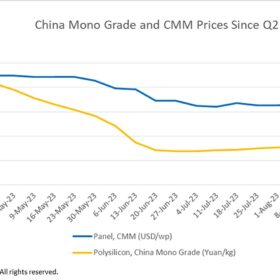
China polysilicon prices rise for the eighth consecutive week
In a new weekly update for pv magazine, OPIS, a Dow Jones company, provides a quick look at the main price trends in the global PV industry.
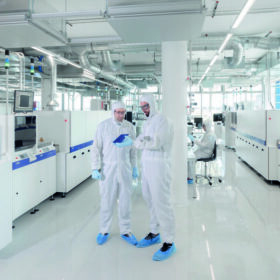
Fraunhofer ISE helping Holosolis to build Europe’s largest solar factory
Fraunhofer ISE is helping Holosolis to build Europe’s largest PV factory – a 5 GW solar plant in France – by 2025. The German research institute is providing support in technology selection and factory planning.
