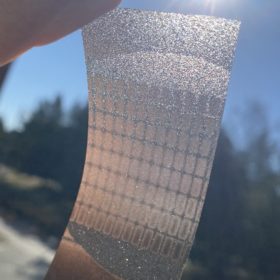
Monograin layer solar cell with 6.4% efficiency
The lightweight and flexible cell was built by Estonian researchers with microcrystalline powders. The device is claimed to be the most efficient solar cell fabricated with a semiconductor compound known as Cu2CdGe(SxSe1−x)4.

Commercial HJT solar cells could hit 26% efficiency by 2030
Arvind Shah, a professor at École polytechnique fédérale de Lausanne, and Meyer Burger former Chief Innovation Officer Sylvère Leu recently spoke to pv magazine about the future of heterojunction PV modules. They said the tech is mature and can now compete on cost with PERC panels in projects – particularly in hot, humid environments.
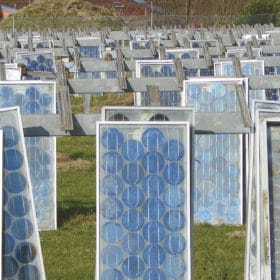
Managing solar PV waste in India
A new report compares the regulatory frameworks of the European Union and India to manage end-of-life solar panels. It also assesses and analyzes the PV waste market and processing capacities in India, while sharing recommendations for Indian stakeholders.

Australia may host GW-scale PV module factory
Australia’s Sun Cable is planning a factory that could produce PV modules for the world’s biggest solar+storage project – the Australia-ASEAN Power Link.
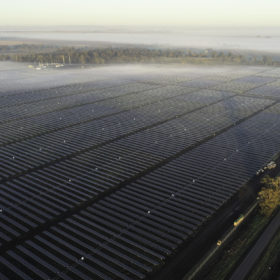
Chinese PV Industry Brief: More module and glass capacity
Risen Energy is planning to add 6 GW of module capacity to its factory in Jiangsu province and Flat Glass wants to add six production lines to its facility in Zhejiang. Meanwhile, JA Solar says it shipped 15.88 GW of solar products last year.

German start-up develops anti-reflective film claimed to improve PV module performance by 10%
German start-up Phytonics has developed the film by taking inspiration from nanostructures in plants. In solar cells, the film enables a broader absorption spectrum and a higher angle of light-incidence tolerance.
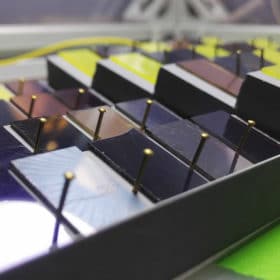
MIT scientists reveal method to identify stable perovskites
U.S. researchers are using a data fusion approach to identify the most stable perovskites for PV cells. Their machine-learning method combines perovskite test results with first-principles physical modeling to identify the best candidates.

OCI increases production capacity at Malaysian polysilicon factory
OCI has revealed plans to invest $55 million to expand production at its Malaysian manufacturing facility from 30,000 to 35,000 metric tons.
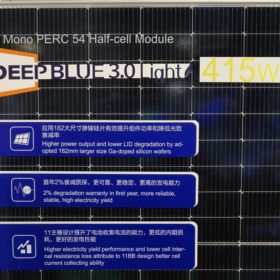
JA Solar unveils 415 W solar module with 21.3% efficiency
The module can be used for residential and commercial PV projects. It is available in five versions with power outputs claimed by the company of 390-415 W and reported efficiencies of 20.0-21.3%.

US government wants to cut solar costs by 60% in 10 years
The US Energy Department set a goal of achieving 2 cents/kWh by 2030, and announced an initial $128 million in funding to support technology development.
