
Noise-based technique to test crystalline silicon solar cells
The proposed technique is said to be able to connect directly to the microscopic and medium scale defects in the solar cell materials. It is based on three kinds of noises that science has thus far been able to identify in PV devices.
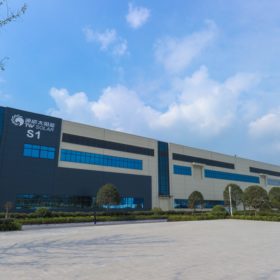
Chinese PV Industry Brief: Another big polysilicon deal and rising wafer prices
Risen will sell 50,000 metric tons of poly to Shangji Automation and Zhonghuan Semiconductor has raised the prices of all its wafer products.
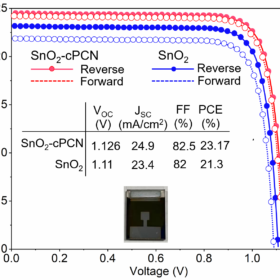
Perovskite solar cell with larger grain size and 23.17% efficiency
The result was achieved for a small area device with the size of 0.1 sq cm. The cell was fabricated with a Tin(IV) oxide electron transport layer modified with crystalline polymeric carbon nitrides (cPCN).

Hair! Coming to a next-generation PV cell near you
Scientists have found that a human hair derivative can protect, stabilize and enhance the performance of perovskite solar cells.
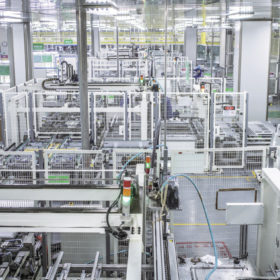
Jinko shipped 18.7 GW of modules in 2020
The Chinese module manufacturer saw its net profit rise only slightly last year, despite a larger increase in turnover and shipments. It expects to almost double its shipments to up to 30 GW of PV modules in the current fiscal year.
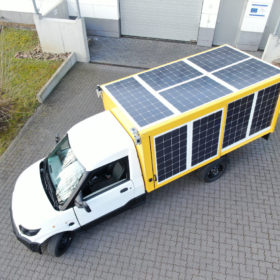
Vehicle-integrated PV for light commercial vehicles
A German consortium is building a light commercial truck prototype powered by 10 PV modules featuring Meyer Burger’s heterojunction cells. Initial estimates suggest that the panels could cover more than 25% of a vehicle’s total annual driving distance, and researcher Robby Peibst told pv magazine that the vehicle-integrated photovoltaic market could hit 5 GW by 2030.

PCM-based passive cooling for BIPV systems
Indian scientists tested four kinds of phase change materials (PCMs) for solar module cooling in building-integrated photovoltaics. The PCMs were encapsulated with the PV system and the building envelopes and were also found to be beneficial to the thermal comfort inside the buildings.
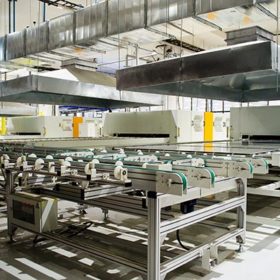
Tata Power Solar expands cell, module capacity
Tata Power Solar, a PV manufacturer and EPC contractor, has added new lines to its factory in Bangalore, India. It is widening its product range to include half-cell and bifacial mono PERC panels.
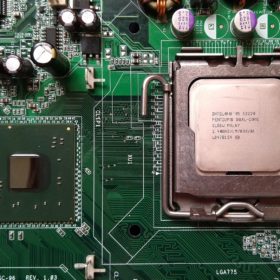
PV rides through semiconductor chip shortage
Many industry sectors across the world are currently being hit by a semiconductor chip shortage as major manufacturers are unable to meet demand. According to Cormac Gilligan, an associate director at IHS Markit, solar and energy storage manufacturers are being less affected. In general, the solar and energy storage industries have learned lessons from being impacted by semiconductor components, for example, transistors, capacitors and resistors in prior years, Gilligan told pv magazine.
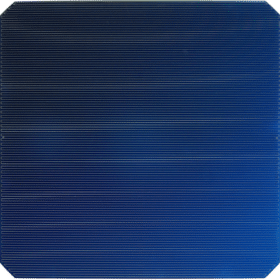
P-type TOPCon solar cell with 21.2% efficiency
Fraunhofer ISE scientists have identified the best metallization pastes to help reduce contact resistivity and contact recombination in p-type TOPCon solar cells. They applied a silicon nitride layer through plasma-enhanced chemical vapor deposition onto both sides of a cell.
