
An 18.12%-efficient perovskite solar cell with reduced hysteresis
Researchers in Japan have modified the tin(IV) oxide layer of a perovskite device with a fullerene-derivative-based self-assembled monolayer to produce a cell they claim offers stability and a reduction in the hysteresis effect which makes predicting power output so tricky.

Innovation promises cheaper solar cell glass manufacturing
Scientists have developed a hybrid production method combining metal mesh and a metal-oxide layer over a glass substrate which they say brings down production cost by 80% compared to the tin-doped, indium oxide-based technology currently in use.
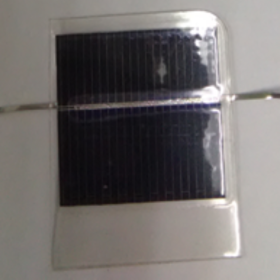
Pouch lamination technique for solar cell encapsulation
Scientists in India have used a pouch laminator to encapsulate a polycrystalline solar cell. The resulting device, the researchers claim, showed better UV photon absorption than solar cells treated with a polymer surface coating.
New method to measure cell voltages in operational PV modules
Scientists in Japan have proposed a new model to estimate cell voltages in solar modules by irradiating the cells with a weak modulated laser light. The method could be used to detect hot spots and other panel-degradation issues, such as potential induced degradation (PID) peeling, cracking, and poor contacts.

A pressure-assisted technique to increase perovskite solar cell efficiency
Researchers in the United States claim to have significantly increased the efficiency of a perovskite solar cell by applying a range of pressures to the device. According to them, pressure-assisted processes such as lamination, cold welding and rolling/roll-to-roll processing can be used to improve interfacial surface contacts in perovskite cells.

A gigawatt solar factory in Europe? Why it must be in France
With Swiss solar equipment company Meyer Burger laying plans for a module fab in North Rhine-Westphalia and Norwegian panel maker REC Group mulling a fab in Sarreguemines, northeastern France, Xavier Daval – from French renewables association the SER – says it is time Europe resumes its path to a stable solar manufacturing industry, not least because of the rising proportion of solar module costs accounted for by shipping.

Flexible, 22.6%-efficient perovskite cells for indoor use
The developers of a perovskite device designed for use under illumination of 100-500 lux say it could be manufactured for $78-108 per square meter.
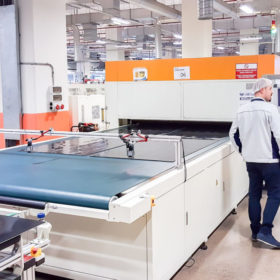
Solar module quality control measures in an age of Covid-19
Asier Ukar, director of the Spanish unit of German technical advisory PI Berlin, tells pv magazine about his experiences of conducting quality control inspections in Chinese factories during the global pandemic.
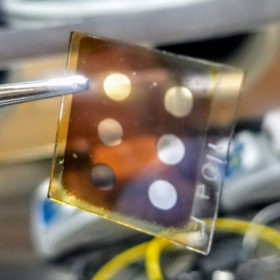
A flexible perovskite solar cell with 11.8% efficiency
U.S. researchers have created an inorganic mixed halide perovskite solar cell which they claim shows no thermal degradation even at 200 degrees Celsius for three days. The device can be used in tandem junction cells and is designed for use in real-life environments with high solar irradiation.
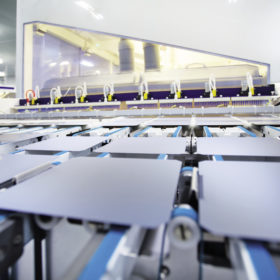
Chinese PV Industry Brief: Financials, a new GW-scale factory, and big hydrogen
Longi and Sungrow both announced solid financial results last week. Module maker China Solar delayed the resumption of trading on the Hong Kong stock exchange, and polysilicon producer GCL-Poly unveiled plans to raise up to US$16.8 million by issuing shares. Coal miner Baofeng Energy, meanwhile, announced the construction of what it claims will be the world’s largest PV-powered hydrogen plant, and Seraphim and Lu’An Solar revealed that they will open a 5 GW PV panel factory in China’s Jiangsu province.
