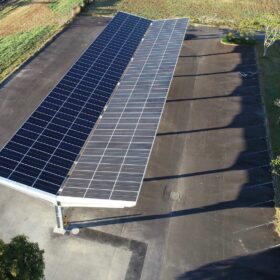
GoodWe offering carport solar panels in Australia
China’s GoodWe has introduced specialized carport solar panels to the Australian market. The panels are designed to address concerns related to water drainage and wiring.
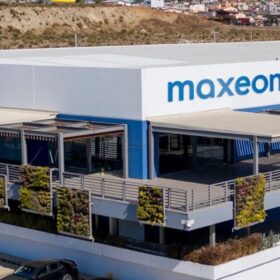
Maxeon to acquire shingled cell solar patents from Complete Solaria
Maxeon is set to buy shingled cell solar patents from Complete Solaria. Along with its solar panel patent portfolio, Maxeon will also acquire Complete Solaria’s dealer channel operations and contracts.
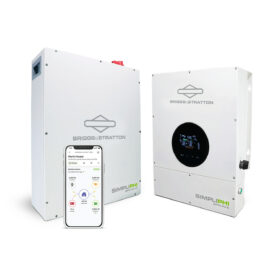
Briggs & Stratton launches new lithium iron phosphate battery packages
The battery packages include a battery, an inverter and a control system. The US manufacturer claims its storage systems have a lifespan of over 10,000 cycles and a depth of discharge of 80%.

How solar tariffs destroyed tens of thousands of jobs in Germany
Calls for barriers and duties are resurfacing in Europe as solar module prices sharply fall. German PV analyst Karl-Heinz Remmers recalls the 2009-13 period, when the European Union introduced anti-dumping and anti-subsidy duties. This drove the loss of 80,000 jobs in the solar industry, despite or perhaps because of the tariffs on PV modules and raw materials.

China solar cell prices hit record lows
In a new weekly update for pv magazine, OPIS, a Dow Jones company, provides a quick look at the main price trends in the global PV industry.
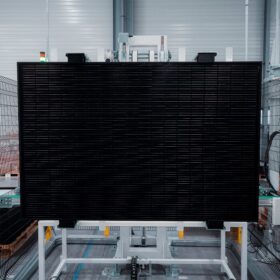
European Solar Manufacturing Council urges EU to adopt law against forced labor in PV industry
The European Solar Manufacturing Council (ESMC) is urging the European Union to adopt legislation against forced labor in the PV industry, by explicitly calling for measures to prevent solar products produced with forced labor from entering the European market.
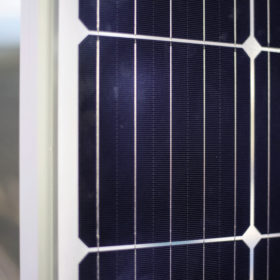
P-type solar products may be phased out by 2026 as n-type tech ‘rapidly’ expands
The rise of cost-effective TOPCon cell technology last year led to a ‘surge’ in production demand for solar n-type cell technology, with leading industry analysts TrendForce prophesying PERC cell capacities ‘may’ be phased out in two to three years. The company’s experts, however, warn that oversupply for p-type cells and modules may increase the price gap between n-type and p-type products in the upcoming months.
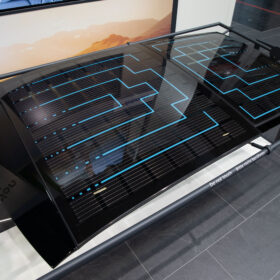
Vehicle integrated PV system for retractable car-roofs
At a recent automobile industry event, Germany-based Webasto announced its retractable vehicle integrated PV system for car-roofs was integrated into a new electric sports utility vehicle (SUV) by an undisclosed US equipment manufacturer.
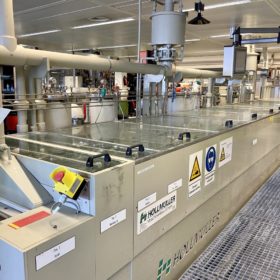
Hyet Solar raises capital for building solar factory in Netherlands
Dutch thin film silicon manufacturer, Hyet Solar, has raised €29 million ($31 million) with Invest-NL contributong €14.5 million of venture debt financing in the round. The company will use the funds to deploy a 40 MW production line at its facility in Arnhem, Netherlands.

Gautam Solar introduces n-type TOPCon solar module series
The Indian manufacturer released product lines for residential, commercial, and utility-scale applications.
