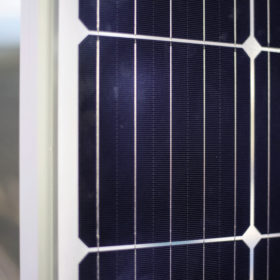
Powering up PERC-perovskite tandem cells
Perovskite-silicon tandem cells offer one of the surest pathways to much higher solar efficiencies, one that has moved close to commercialization in the past few years. Much of the work getting to this stage has naturally focused on developing a viable perovskite top cell. Optimizations to the silicon layer underneath, however, will also be important to the overall device function and efficiency. Scientists in Germany examined five different silicon cell concepts similar to those in mass production today, finding that with a few optimizations these could reach efficiencies up to 30.4%.
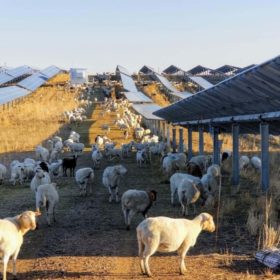
Grazing animals increase carbon sequestration by up to 80% in PV projects
Temple University researchers have found that managed sheep grazing on an acre of recovering agricultural soil with native plants may sequester 1 ton of carbon per year, which could accumulate for 12 to 15 years before reaching saturation.
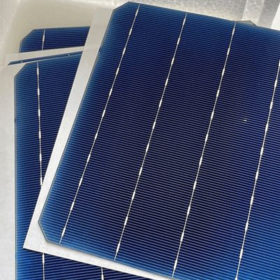
German consortium develops 19.7%-efficient PERC solar cells made of recycled silicon
Led by German research institute Fraunhofer ISE, the consortium has built the solar cells with 100% crystalline silicon recycled from end-of-life photovoltaic panels. The silicon is recycled through a technique conceived by German specialist Reiling GmbH & Co. KG and the Fraunhofer Center for Silicon Photovoltaics CSP.
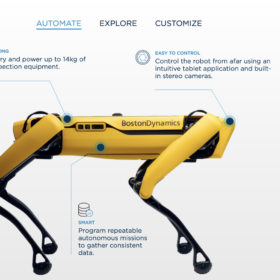
Robot dog for PV plant monitoring
Spanish renewable energy company Acciona is using a robot dog, instead of drones, to monitor a solar park in northern Chile. The device has a built-in thermal vision system that generates thermographic reports on the status of the different PV plant components, as it walks between the panel rows following a programmed route.

Taiwan sets solar FITs for 2022
The new feed-in tariffs range from NT4.0031 ($0.14) to NT5.8952 ($0.21) per kWh. PV systems of all types will be applied a grid tariff of NT0.0656 ($0.002)/kWh and the funds raised through this fee will be used to set up a PV module recycling scheme.
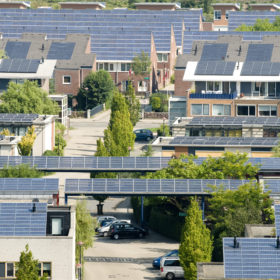
Italian region devotes €22 million to ‘energy communities’
Italy’s Lombardy region will use €22 million to build up to 6,000 “energy communities,” for a total installed capacity of up to 1.3GW.

Photovoltaics for curved surfaces
Researchers in Japan have used heat-shrinkable polymers to laminate organic photovoltaics onto curved surfaces. The process improves efficiency while minimizing damage to photovoltaic components.
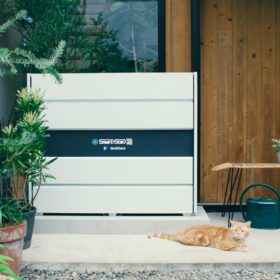
Itochu starts leasing new residential battery in Japan
Itochu’s new 13.4kWh storage system is equipped with AI-based software for optimal battery control. It can be used for grid-connected and offgrid projects and has a charging feature for electric vehicles.
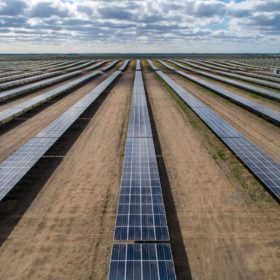
Investors submit 34GW of wind, solar, storage for renewables zone in Australia
The New South Wales state government in Australia has revealed that more than 34GW of new solar PV, wind and energy storage projects have been proposed for the South-West Renewable Energy Zone.

US government extends Section 201 tariffs on imported PV panels, cells
The Biden administration has upheld an exclusion for bifacial panels in its new extension of Section 201 tariffs, while ramping up the annual tariff rate quota for cells to 5GW.
