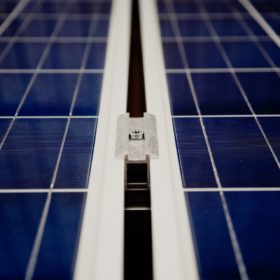
‘There is no clear best module configuration under partial shading’
A Slovenian research team has analyzed the behavior of a full-size cell PV module and several 1/6 cell panels under partial shading and has come to the obvious conclusion that the cell cut panels suffer fewer energy losses. They also found, however, that the orientation of the cells connected in series should be aligned as much as possible with the shade shape to lower the losses and to minimize reverse cell voltage.
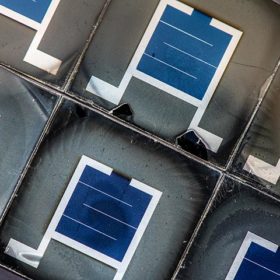
The state of the art in perovskite tandems
A new paper from scientists in China and Canada examines the recent progress in the development of perovskite-silicon tandem cells, finding a technology that’s poised for rapid commercialization, with a few research challenges still to overcome. These are primarily related to ensuring the perovskite layer can match the lifetime of the silicon cell underneath.
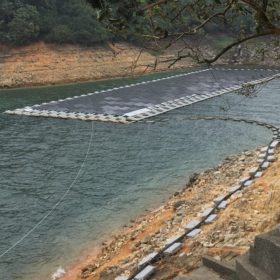
India to host ‘world’s biggest floating PV plant’ within two years
The 2,000ha installation, which will surpass in scale a 150 MW plant in China’s Anhui province, will reportedly require a INR3,000 crore ($409 million) investment.
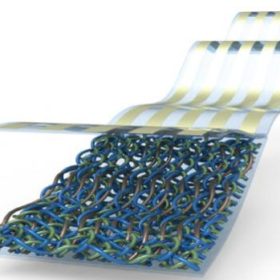
Herbicide may improve organic cell efficiency by up to 1.6%
Researchers in Saudi Arabia claim to have increased the efficiency of organic PV devices with diquat, a compound used in herbicide. The molecular diquat dopant increased optical absorption and the lifetime of electrical charges when light was absorbed.

Could agrivoltaics feed demand for clean energy?
Agrivoltaics could result in more food, more energy, lower water demand, lower carbon emissions, and more prosperous rural communities, says an Oregon State University researcher. He plans to build a farm to prove the point.
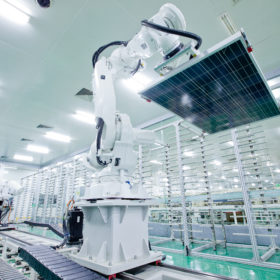
JinkoSolar claims 24.9% efficiency for n-type monocrystalline cell
The result was confirmed by Germany’s Institute for Solar Energy Research (ISFH).
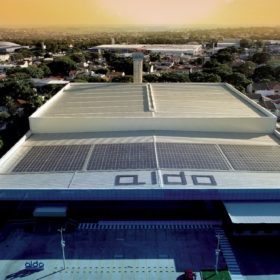
Brazil may add 9 GW of distributed solar over next two years
Brazil may see the deployment of 4 GW of new distributed generation solar capacity this year and another 5 GW next year, according to Aldo Pereira Teixeira, the CEO of Brazil’s largest PV product distributor and system integrator. In an interview with pv magazine, he explains why and how this huge growth could materialize.
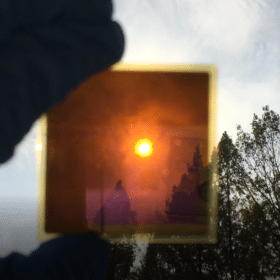
Semitransparent bifacial CIGS cell with 10.5% efficiency
The solar cell was developed by Korean scientists for power-generating window applications. They built the device with transparent conducting oxide (TCO) rear contacts and a textured polydimethylsiloxane (PDMS) layer with light-scattering and antireflection properties.
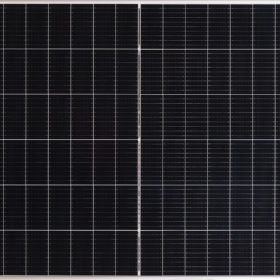
Vikram Solar launches 505 W module
The Indian manufacturer has unveiled new mono-PERC modules in 120, 144, and 156 half-cell versions with claimed efficiency between 18.34% and 21.02%.
Chinese PV Industry Brief: more manufacturing capacity from Trina, GCL Integration and Eging PV
Plans to set up new cell and module capacities have been announced by the three manufacturers. Trina intends to add 10 GW of cell capacity to its manufacturing site in the Sichuan province, while GCL Integration wants to build an 8.5 GW monocrystalline solar cell factory in the Jiangsu province.
