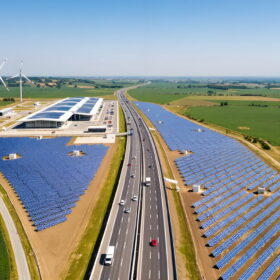
Chinese PV Industry Brief: PowerChina launches 31 GW solar procurement
China Power Construction Corp. (PowerChina) has launched a 31 GW solar module tender for 2026 projects, split across n-type tunnel oxide passivated contact (TOPCon), heterojunction (HJT) and back-contact (BC) technologies as part of a wider 97 GW renewables and grid equipment program.

Italy clears 710 MW of solar in Puglia, challenges regional PV rules
The italian government says it is fast-tracking utility-scale solar, approving about 710 MW of mainly agrivoltaic projects in Puglia while moving to curb regional limits on where PV plants can be built, sharpening tensions over land use and energy policy.
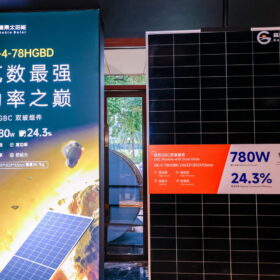
Gokin Solar launches new back-contact solar module series
Gokin has launched back-contact solar modules ranging from 480 W to 780 W for residential, C&I and utility-scale projects. The series supports 1,500 V systems and reaches efficiencies of up to 24.8%.

Germany brings world’s first supercapacitor STATCOM online
Germany has connected the world’s first supercapacitor-based STATCOM to the grid, with Siemens Energy and transmission system operator TenneT positioning it as a blueprint to replace fossil-fuel generators in providing instantaneous reserve and reactive power.

China National Petroleum Corporation achieves 25.05% efficiency for inverted perovskite solar cell
The Chinese energy and oil company said the cell can be used as a top device in perovksite-silicon tandem configurations. The result was confirmed by the Shanghai Institute of Microsystem and Information Technology (SIMIT).
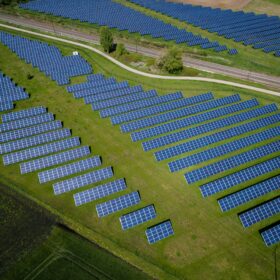
French renewables tender awards all 507.7 MW to solar
The French government says PV swept its latest technology-neutral auction, with 36 projects totaling 507.7 MW awarded in the fourth round as prices fell and agrivoltaics gained ground.
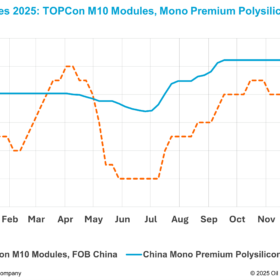
China module market watches 2026 export rebate signals as polysilicon consolidation platform company is registered
In a new weekly update for pv magazine, OPIS, a Dow Jones company, provides a quick look at the main price trends in the global PV industry.

Interspace single-axis agrivoltaics has lowest environmental impact in Europe
A group of scientists has simulated fixed vertical, interspace and overhead single-axis as well as overhead dual-axis agrivoltaic systems for 30 years and has found interspace single-axis system emerged as the most environmentally favorable configuration in Europe.
Italy assigns 1.1 GW in PV auction open to projects with ‘non-Chinese’ modules
The procurement exercise, the second solar auction under Italy’s Fer X incentive scheme and first to exclude the use of Chinese solar modules, cells and inverters for projects above 1 MW in size, concluded with a final average price of €0.06637/kWh.
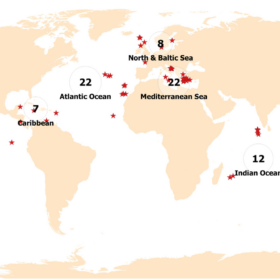
Small islands, big impact: the role of solar PV for the tropics
Low-cost renewables provide an opportunity for tropical islands to drive a sustainable, secure and self-sufficient economy. Solar PV emerges as the bulk energy provider, driven by excellent resource conditions and fast-improving economic attractiveness. The anticipated momentum of solar PV in tropical islands can best be characterised as a Solar-to-X Economy.
