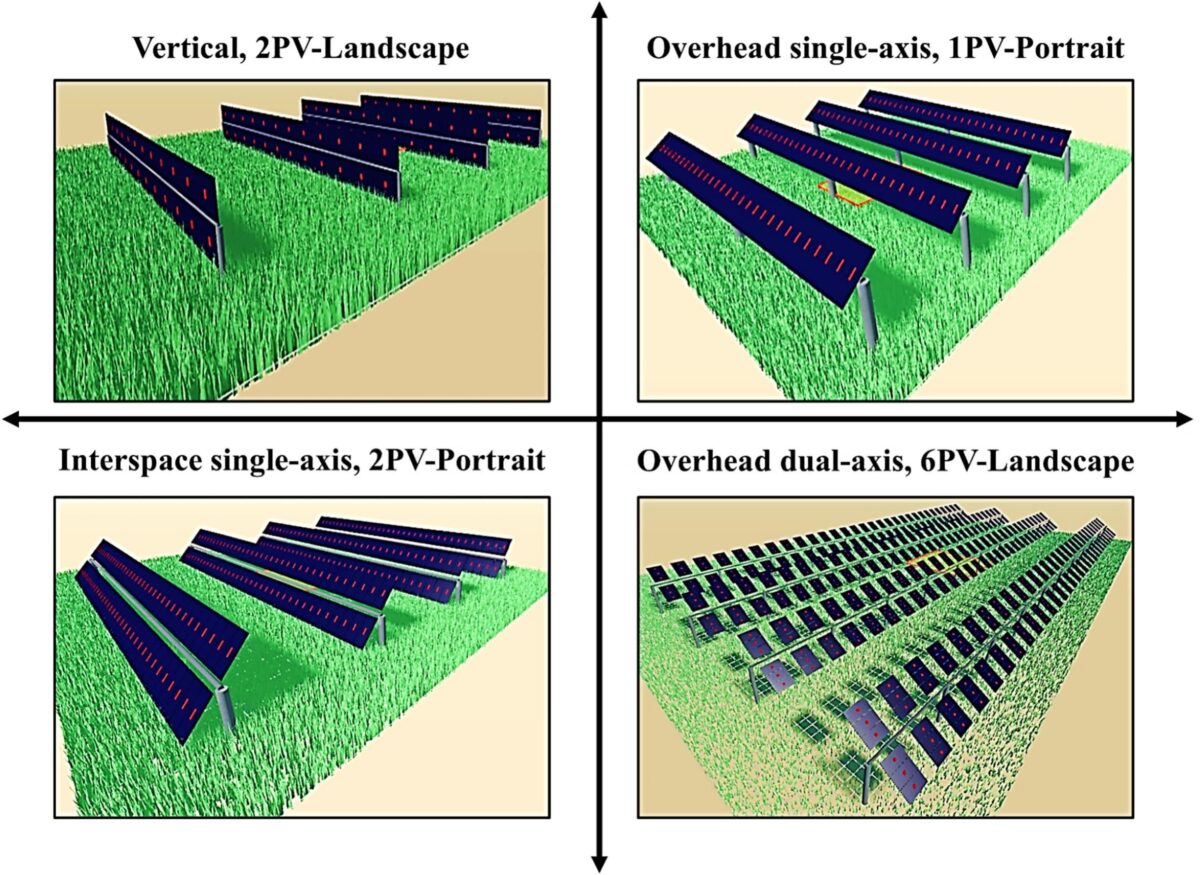





A research group led by scientists from Italy and Sweden has conducted a life cycle assessment (LCA) of various types of bifacial agrivoltaic (APV) systems.
LCA is a method for assessing the environmental impact of a system throughout its life cycle, in this case from cradle to end-of-use, excluding the end-of-life phase.
“This work focused on the quantification of the environmental impacts of four APV designs, including fixed vertical, interspace and overhead single-axis as well as overhead dual-axis systems under the attributional method for PV components and the consequential approach for crops, all in a single study,” corresponding author Amirhossein Nik Zad told pv magazine. “All APV systems are benchmarked against a conventional ground-mounted PV (CGMPV). Monte Carlo uncertainty analysis was performed for all APV systems against CGMPV.”
The system was simulated to operate at four distinct European locations: Kärrbo Prästgård in Sweden, Jeggeleben in Germany, Piacenza in northern Italy, and Agrigento in southern Italy. The simulation was built using typical years derived from large-scale climate datasets for 2000 to 2024, and the corresponding LCA was compared with national grid mixes across the relevant countries. Seven crop types were considered with their respective equations and models: C3 cereals, berries, maize, grain legumes, fruits, root crops, and forage.
Across all locations, the APV systems had a capacity of 1 MW, and the projects were assumed to operate for 30 years. Each plant was made of 450 W bifacial modules with 21.13% efficiency and a 75% bifaciality factor. Each weighs 29 kg, degrades by 0.5% annually, and has a surface area of 2.13 m2 (2.13 m × 1 m). The albedo of all plants was assumed to be 0.2, and soiling and wiring losses were accounted for at 2% of the total system losses.
The fixed vertical system had module rows aligned north-south, with modules facing east on one side and west on the other. The tracking systems had north-south-aligned rows and rotated from east to west to follow the sun’s path: the overhead single-axis trackers had a 55 ° rotation range, and the interspace single-axis trackers had a 45 ° rotation range along the north-south axis. Dual-axis trackers rotated along both the north-south and east-west axes to fully track the sun. The CGMPV had east-west aligned rows with modules facing north-south at a fixed tilt angle specific at each location: 35◦ for Agrigento, 40◦ for both Piacenza and Jeggeleben, and 45◦ for Kärrbo Prästgård.
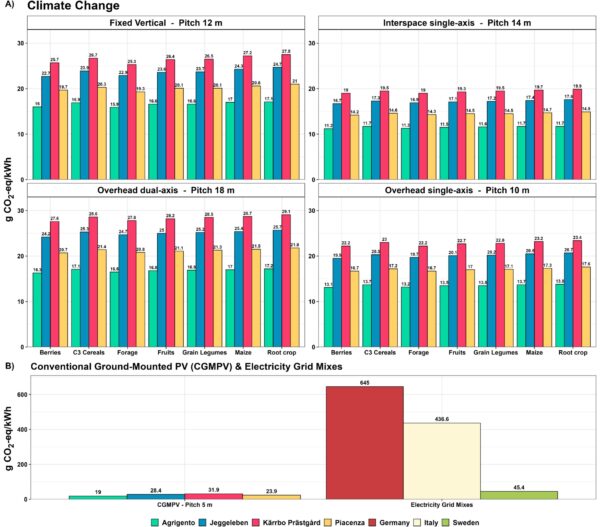
Image: Life cycle assessment of various agrivoltaic systems across Europe, Sustainable Production and Consumption, CC BY 4.0
According to Nik Zad, material data for all APVs were obtained directly from industry sources, and the research presents the first structural material inventory of the vertical APV system. The PV components were analyzed using the attributional method across 10 environmental impact categories: climate change, ozone depletion, respiratory inorganics, photochemical ozone formation, acidification, terrestrial eutrophication, freshwater eutrophication, marine eutrophication, resource use of minerals and metals, and resource use of fossil fuels.
“The interspace single-axis system emerged as the most environmentally favorable configuration, achieving the lowest greenhouse gases (GHG) emissions, 57% lower particulate matter, 48% lower acidification, and 27% lower eutrophication compared to other APV designs,” Nik Zad said. “The overhead dual-axis system showed the highest environmental impacts, driven primarily by its substantial steel requirements for elevated mounting structures.”
The analysis also showed that all APV systems exhibited 3.5–9.6 times higher mineral resource consumption than electricity grid mixes, highlighting the importance of material-efficient designs for sustainable deployment. In addition, all APV systems significantly outperformed national electricity grids across nine impact categories, achieving environmental impacts 8–111 times lower.
“However, an important nuance emerged – APV systems do not always outperform national grids in every region and impact category. In Sweden, where the electricity grid is predominantly low-carbon, the overhead dual-axis APV system actually showed slightly higher photochemical ozone formation potential than the Swedish grid,” Nik Zad noted. “This occurs because the combination of high material intensity in dual-axis structures and low solar irradiance at northern latitudes inflates the normalized environmental burden per kWh produced. This finding highlights that APV deployment strategies must be regionally tailored.”
The research's findings were presented in “Life cycle assessment of various agrivoltaic systems across Europe,” published in Sustainable Production and Consumption. Researchers from Italy’s Catholic University of the Sacred Heart, the Italian National Agency for New Technologies, Energy and the Environment (ENEA), and Sweden’s Mälardalen University have participated in the research.
This content is protected by copyright and may not be reused. If you want to cooperate with us and would like to reuse some of our content, please contact: editors@pv-magazine.com.

By submitting this form you agree to pv magazine using your data for the purposes of publishing your comment.
Your personal data will only be disclosed or otherwise transmitted to third parties for the purposes of spam filtering or if this is necessary for technical maintenance of the website. Any other transfer to third parties will not take place unless this is justified on the basis of applicable data protection regulations or if pv magazine is legally obliged to do so.
You may revoke this consent at any time with effect for the future, in which case your personal data will be deleted immediately. Otherwise, your data will be deleted if pv magazine has processed your request or the purpose of data storage is fulfilled.
Further information on data privacy can be found in our Data Protection Policy.