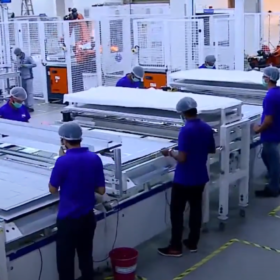
Emmvee sets up 3 GW solar cell and module factory in India
Planned to be located in Dobaspet, Karnataka, the manufacturing facility will be Emmvee’s second solar factory in the Indian State.
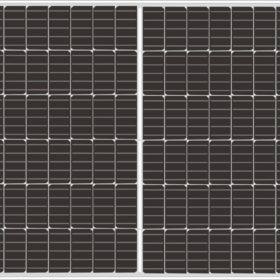
Indian manufacturer unveils 375-410 W half-cut modules with 20.4% efficiency
Pixon Energy has launched mono PERC half-cut-cell modules with output capacities ranging from 375 Wp to 410 Wp. The five-busbar modules can be used in all types of PV installations, including off-grid, residential, commercial and industrial, and utility-scale projects.
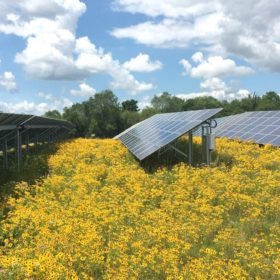
Large-scale solar can cool nearby areas
An international team of scientists observed a cooling effect in a large radius around solar arrays. The cooling may have implications for local ecosystem management.
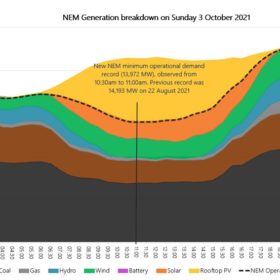
Australia breaks more solar records
On Sunday, Australia set a new record for minimum operational demand, with the national grid dipping below 14 GW. Renewables met 55% of that, while rooftop solar accounted for 34%.
Rate of Indian commercial and industrial solar installation fell 34% in the second quarter
The nation’s C&I solar segment saw just 332 MW of generation capacity added in April-to-June, compared to 501 MW in the first three months of the year, as lockdowns in multiple states slowed installation activity.

Building perovskite solar cells with waste toner carbon
Scientists in China have fabricated 11.78%-efficient fully printable perovskite solar cells by using an electrode made of waste toner carbon from printer cartridges. The cell achieved an open-circuit voltage of 0.88 V, a short-circuit current density of 24.64 mA cm, and a fill factor of 54.56%.
Solar secures 236 MW of capacity in Brazil’s A5 auction, with average price of $0.03109/kWh
The Brazilian authorities have allocated 860 MW of power capacity in the country’s latest procurement exercise, including 20 solar projects.

New ‘matrix’ layout for shingled solar cells
German equipment supplier M10 and research institute Fraunhofer ISE will unveil a new prototype stringer for shingled module layouts at the Intersolar Europe trade show later this week. Employing an offset layout for the shingles, the approach promises a relative efficiency gain of up to 6%, compared to a conventional half-cell module.
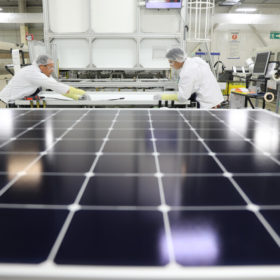
PV industry veteran warns of looming supply chain disruptions in Australia
Australia’s PV module supply landscape could experience a supply shock as legislation emerges to stamp out the use of forced labor. Chris O’Brien, VP for the APAC region at Maxeon Solar Technologies, says that measures that have left modules stranded at the U.S. border could very well occur in Australia soon.
Interconnecting US solar to the grid – an opaque process
New documents reveal how renewables have improved publicly available power grid data in the United States, and show how solar and wind are footing the bill for U.S. power grid upgrades.
