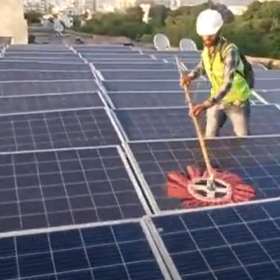
Handheld dry-cleaning tool for solar modules
The handheld, cordless cleaning tool is a cost-effective and efficient alternative to automated cleaning robots that are usually limited in operation by panel inclination.
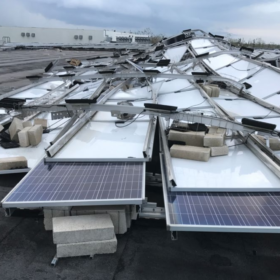
Storm damages shine spotlight on ways to mitigate impact of wind on PV arrays
Hurricane-force wind gusts hit New England during a late-October storm, damaging at least one rooftop solar array and leading Commercial Solar Guy to offer a few pointers.
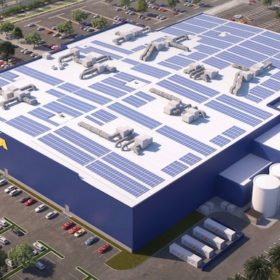
Control platform takes commercial PV off grid so it can sell services, energy back to network
EleXsys Energy’s technology allows the controlled flow of excess energy from distributed rooftop-solar generators to help stabilize global grids as they increasingly transition to renewables. The world could feel the positives of mass transition to solar within five years.

Greece launches Gr-Eco Islands Initiative with €100 mlllion pot
Greece’s government gathered today on the Aegean island of Halki to inaugurate a local community energy project and also launch its Gr-Eco Islands Initiative, which aims to green the country’s archipelago.

The Hydrogen Stream: ZF reactor tech for hydrogen production via steam methane reforming
Big plans for hydrogen development were announced this week in Germany, Namibia, Italy, Spain, Norway, Australia and the United States.
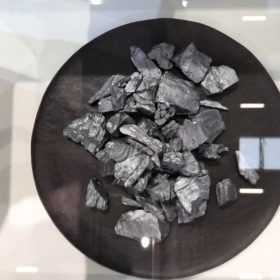
Chinese PV Industry Brief: TBEA wants to set up 400,000 MT metal silicon production
TBEA unveiled a plan to build a 400,000 MT metal silicon factory in Baotou City, in the Inner Mongolia province. Furthermore, EnergyTrend reported polysilicon prices increased slightly this week.
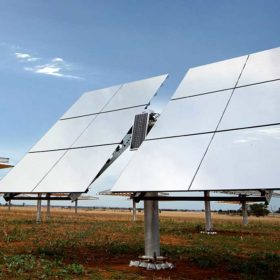
Australian massive solar+storage project combines sun-tracking mirrors, gallium arsenide modules and thermal storage
Dutch renewables company Photon Energy is teaming up with Australian technology provider and project developer RayGen Resources to develop a facility that will deliver 300 MW of solar generation and 3.6 GWh of energy storage. The technology used is claimed to have an LCOE of less than $0.072/kWh.
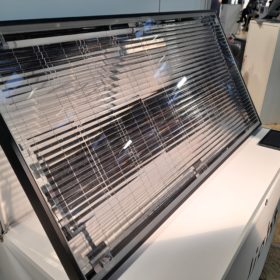
Insolight unveils 20.1%-efficient translucent photovoltaic panel for agrivoltaics
Insolight has developed a translucent monocrystalline solar panel with a nominal power of 106 W and a power conversion efficiency of 20.1%. The solar cells are covered with protective glass and optical lenses to concentrate and direct sunlight onto them at around 100 times the intensity of standard solar glass.
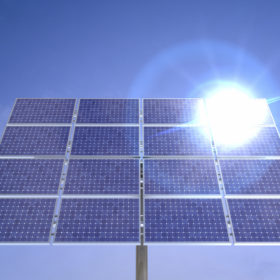
Utility scale solar reaches LCOE of $0.028-$0.041/kWh in the US, Lazard finds
Lazard’s newly released Levelized Cost of Energy Analysis 15.0 and Storage 7.0 reports that solar and wind are the most competitive electricity sources in the US energy market. According to the investment bank’s 2021 study, gas combined cycle has the lowest LCOE of $0.045-$0.074/kWh among the conventional sources and that of coal and nuclear is $0.065-$0.152/kWh and $0.131-$0.204/kWh, respectively.

US officials detained 40.31 MW of Longi solar products, claims company
U.S. border agents have confiscated PV modules from Longi Green Energy. The panels accounted for roughly 1.59% of the company’s total 2020 export sales volume to the U.S. market.
