
An aluminum battery that can charge in a fraction of a second
Scientists in China and the United States investigated the inner workings of aluminum-ion batteries. With new insights into mechanisms at work within the battery during cycling, the group was able to demonstrate a battery capable of ultrafast charging, with the highest capacity so far reported for an aluminum battery.

Guyana launches series of tenders for off-grid and hybrid solar
The government of the South American nation is seeking to electrify with solar-plus-storage several remote communities through eight different tenders.
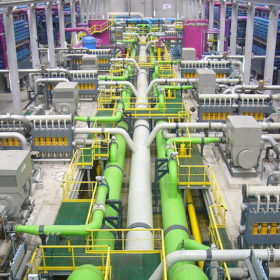
Floating PV for desalination
Spanish water-treatment specialist Emalsa has teamed up with Instituto Tecnologico de Canarias ITC and Universidad Europea de Canarias to study the feasibility of a 1.53 MW floating solar plant that could potentially power the Piedra Santa desalination plant in Gran Canaria.

Saipem wants to set up green hydrogen production in Italy, Albania and Morocco
The Italian gas contractor started to develop three green hydrogen projects in the southern Italian region of Apulia and has identified land for potential projects in Albania and Morocco.
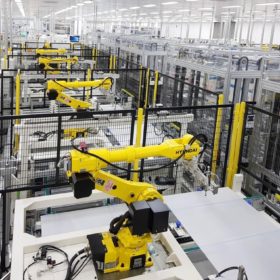
Hyundai builds 1.37 GW solar cell factory in South Korea
The first 650 MW production line will be deployed by the end of June. The cells produced at the manufacturing facility will be used exclusively for Hyundai’s module production.

Meyer Burger to start PV cell, module production in May
Swiss solar manufacturer Meyer Burger is now looking for people to work at its new factories in Freiberg and Bitterfeld-Wolfen, Germany. The two facilities are scheduled to start production in May.

Neoen secures first approval for hybrid wind-solar-storage project in Australia
Neoen has secured planning approval for the first stage of its gigantic $2.3 billion Goyder South project in Australia. The French renewables company has also revealed plans to exceed 10 GW of global capacity by 2025.
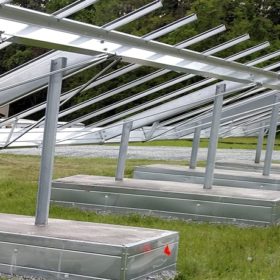
Nextracker settles PV patent infringement lawsuit
Solar FlexRack will pay Nextracker royalties on qualifying sales revenue from Solar FlexRack’s TDP 2.0 solar tracker and related products, services, and components.
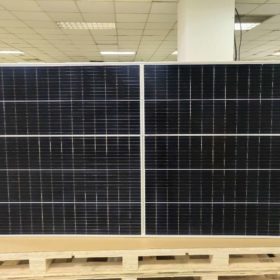
Trina launches 670 W solar panel
The latest product in the Vertex series from the Chinese manufacturer has a power conversion efficiency of 21.6%.

Adding solar to offshore wind
Scientists in the Netherlands conducted a feasibility study for adding floating solar to a planned 752 MW offshore wind installation in the North Sea. The study finds that the two could realistically share a single connection to an onshore grid, with minimal curtailment as well as technical and economic benefits for both technologies.
