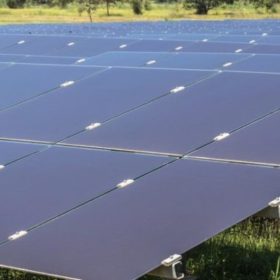
Made-in-USA solar for stable supply chains, lower emissions, fair labor
Toledo Solar founder Aaron Bates joined pv magazine USA to explain the benefits of US-made solar and cadmium telluride technology.
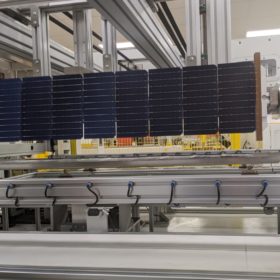
Behind-the-scenes look at solar panel production shines light on Australian manufacturing
With the International Energy Agency leading calls to diversify the world’s solar PV supply chain, Australia’s only solar panel maker Tindo Solar has released a video following the manufacturing process at its new $7.6 million production facility in Adelaide.

Slovakia restarts rebate program for residential PV, heat pumps
The authorities in Slovakia are offering rebates to cover up to 50% of the cost of buying and installing solar water heaters, PV systems with generation capacities of up to 10 kW, heat pumps, biomass systems, and solar-thermal collectors.
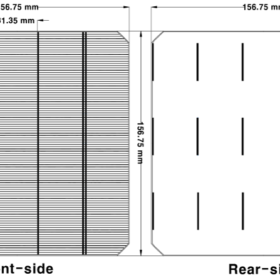
Novel busbar-free cell design for shingled solar modules
South Korean scientists have fabricated a busbar-free solar cell for shingled modules that uses 60% less silver than its busbar counterparts. A module with the new cells had almost the same performance as a reference shingled panel built with a conventional cell design.

Indian state of Gujarat tenders 1.5 GW of solar
Solar developers have until Aug. 23 to bid for the rights to build up to 1.5 GW of grid-connected solar projects under 25-year power purchase agreements.
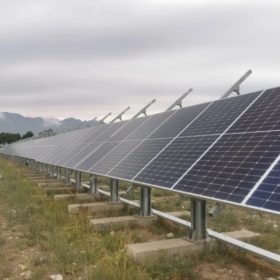
JA Solar reveals results of year-long n-type, p-type tests
JA Solar said that tests have shown that n-type modules have a 3.9% higher power yield than their p-type counterparts. TÜV Nord has confirmed the results.
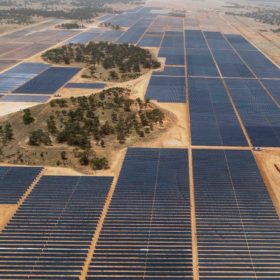
Octopus acquires Australia’s largest operational solar park
Octopus Investments Australia has launched two renewable energy investment vehicles.
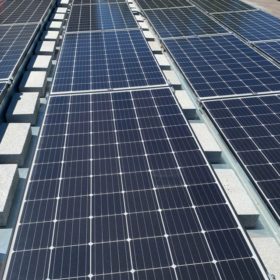
Rollout solar racking collects rainwater, cuts land-use requirements
Roll-A-Rack has developed a gutter-like racking system that collects rainwater for irrigation.
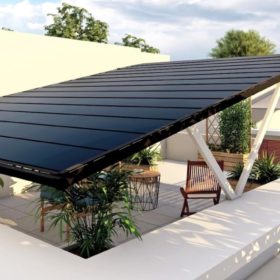
Integrated solar rooftop, gazebo solutions for residential applications
India’s SunEdison has partnered with US startup Arka Energy to provide the Arka collection of solar roof and gazebo solutions in India.

German-Dutch consortium to build 500 kW offshore solar pilot in North Sea
Germany’s RWE is partnering with offshore PV specialist SolarDuck to build a 0.5 MW floating solar plant near an offshore wind farm in the North Sea.
