
Pure solid state batteries from Switzerland
Swiss Clean Battery is set to start commercial production of its pure solid state batteries in Switzerland. The batteries are based on a protected electrolyte made of a solid ion conductor, which helps to maintain internal resistance and capacity. The fixed ion conductor is formed in the battery cell itself, similar to a multi-component adhesive.

Fortescue buys cattle stations for 5GW renewable energy hub
Fortescue Future Industries has purchased three cattle stations in Western Australia on which it plans to build a renewable energy hub to decarbonize its mining business and export green hydrogen and green ammonia.
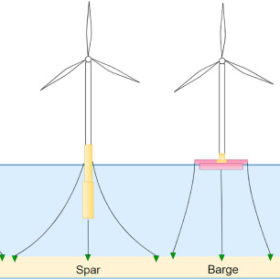
Renewable offshore floating hydrogen production
Scottish Development International and J-DeEP are developing a floating offshore hydrogen production plant off the coast of Scotland. Research shows the combination of large-scale offshore renewables and floating hydrogen production could soon become viable, depending on the project configuration.

Could ‘hot carrier’ solar cells break the theoretical efficiency limit?
Up to 50% of the energy absorbed by a solar cell is lost as heat. Scientists are now developing a third generation of “hot carrier” solar cells that take advantage of this heat, potentially breaking the Shockley-Queisser limit of silicon-based PV.
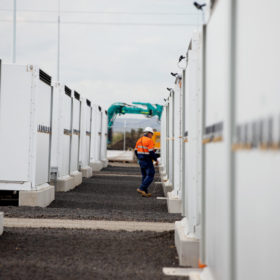
Australian battery storage market passed 1GWh in 2021
Australian deployment of battery storage remained steady in 2021, according to market research firm SunWiz, bringing cumulative installations to 1,089MWh.
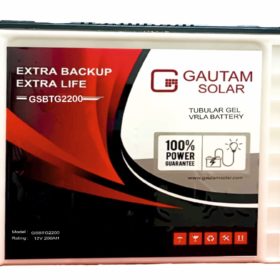
Gautam Solar releases gel battery solution for solar storage
India’s Gautam Solar says its gel batteries provide a safer, cost-effective, and long-lasting alternative for the energy storage space.
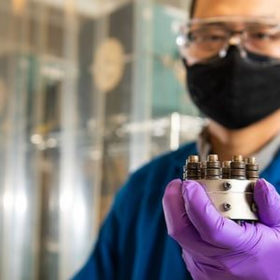
Aluminum-nickel molten salt battery for seasonal renewables storage
US scientists have developed a battery that can retain 92% of its initial capacity over periods of 12 weeks, with a theoretical energy density of 260 W/hour per kg. It was built with an aluminum anode and a nickel cathode, immersed in molten-salt electrolyte.
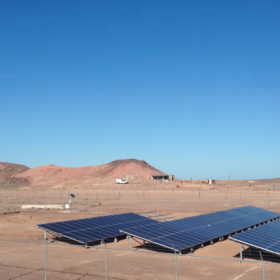
Power-to-gas-to-power designs to incorporate hydrogen in solar-wind microgrids
Researchers in Mexico have looked at integrating hydrogen-based power-to-gas-to-power into an existing rural microgrid. They said this solution could become competitive if electrolyzer, fuel cell and hydrogen tank costs are halved, or if diesel prices keep rising.
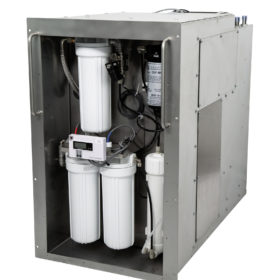
Modular electrolyzer for residential, commercial applications
Germany’s Ostermeier H2ydrogen Solutions has developed an electrolyzer that works with tap water, with bottles to store hydrogen and a fuel cell or a Wankel engine to produce electricity. The system has a capacity ranging from 1kW to 100 kW, which corresponds to hydrogen production of 0.2-20 Nm3/h.
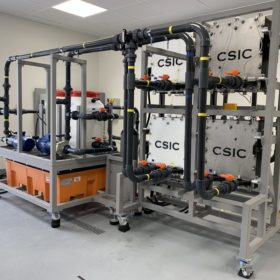
Vanadium redox flow battery prototype from Spain
Researchers in Spain have assembled a 10kW/20kWh vanadium redox flow demonstrator that paves the way for a 50kW battery.
