
Global renewable energy pathfinding
Australia is tracking towards 75% electricity from solar and wind in 2030, which makes it a global energy transition pathfinder. Pathfinders are important because they learn to solve new problems and disprove misinformation and disinformation.

Green hydrogen remains ‘prohibitively’ expensive in Africa
A European research team has assessed the levelized cost of hydrogen across 31 African countries and has concluded that importing green hydrogen from Africa to European is economically unfeasible by 2030, with prices ranging from $10.2/kg to $3.8/kg.

Optimizing endless PV-driven heat pump scenarios for costs, self-sufficiency
Researchers have used mixed-integer linear programming-based multi-objective optimization to optimize 30,912 unique scenarios showing heat pumps operating in combination with PV power. The optimization modeling was conducted under day-ahead spot market prices terms.

Simultaneous optimization of plant design and control unlocks cost-competitive green hydrogen
Achieving cost-competitiveness for green hydrogen produced via water electrolysis using intermittent renewable energy sources remains a significant challenge. Researchers from LUT University in Finland have shown that considerable cost reductions can be achieved by simultaneously optimizing plant control and design, based on specific hydrogen demand targets and local weather conditions.

Evert launches wallbox with bidirectional EV charger, PV inverter
Evert has unveiled technical and availability details of its new power management unit, a wallbox that integrates a 22 kW bidirectional DC electric vehicle charger, a 20 kW PV inverter, and a home energy management system. The Norwegian startup targets residential users seeking integrated EV and solar energy solutions.

CSP-driven multigeneration system combines hydrogen generation with compressed air, pumped hydro storage
Researchers have designed a novel multigeneration energy system that provides five outputs, namely electricity, hydrogen, cooling, heating, and hot water. The system is mainly powered by a solar heliostat system and incorporates compressed air and pumped hydro storage technologies for storing surplus power.

China’s XYZ launches 261 kWh immersion-cooled commercial battery
Immersion-cooled batteries submerge cells in a special liquid as a fire-protection measure, as XYZ executive Zha Qing explained to pv magazine at May’s Intersolar Europe trade show.
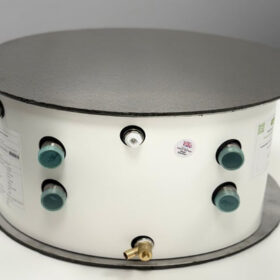
Hewer launches pre-assembled unit for heat pump retrofit, installation
The UK-based heating solutions provider has developed a pre-engineered and ready-to-install unit compatible with most of the residential heat pumps available in the market. It can be placed underneath a standard hot water cylinder and transfer heat from the pump via a plate exchanger to the central heating indirectly.

GE Appliances unveils residential hybrid heat pump water heater
The U.S. manufacturer said its new heat pump water heater can provide up to 60% more hot water than standard electric water heaters. The system is available in 240 V and 120 V options and with a capacity ranging from 160 L to 190 L.
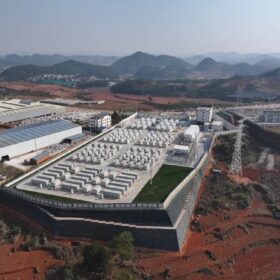
China launches world’s first grid-forming sodium-ion battery storage plant
The Baochi Storage Station in Yunnan integrates lithium and sodium-ion technologies at scale, a global first, aiming to stabilize renewable energy and cut costs as China accelerates its energy transition.
