
Spanish researchers developing rear-side concentrated PV modules for agrivoltaics
Researchers at University of Jaén in Spain have demonstrated a semi-transparent crystalline silicon solar photovoltaic module with rear-side optical concentrators for agrivoltaics applications.

Plenitude tests perovskite-silicon tandem solar modules in utility-scale installation pilot
The Italian renewable energy company said it will validate Swift Solar’s 28% efficiency perovskite-silicon tandem technology in a utility-scale project.

Longi achieves 33.35% efficiency for flexible perovskite-silicon tandem solar cell
The Chinese manufacturer said the tandem device was developed through a dual-buffer layer strategy that improves interfacial adhesion while preserving efficient charge extraction. The efficiency result was certified by the US Department of Energy’s National Renewable Energy Laboratory (NREL)
South Korea sets 2030 goal for perovskite-silicon tandem solar panels
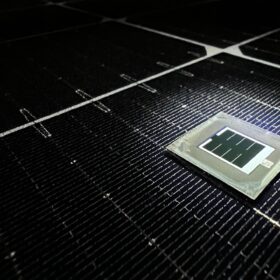
South Korea has allocated KRW 33.6 billion ($22.8 million) for R&D on perovskite-silicon tandem solar technology with a goal of commercializing 28%-efficient modules by 2030, according to the Ministry of Economy and Finance.

Photonic curing could accelerate transition to copper-metallized solar cells
Researchers in the United States have developed a photonic curing technique using laser sintering to rapidly heat and cure copper pastes on temperature-sensitive solar cell substrates without causing thermal stress. The process purportedly produces dense, low-porosity copper layers with strong adhesion to indium tin oxide, achieving low bulk and contact resistivity.

Naturgy, BlueNewables build 1 MW offshore solar plant in Spain
Naturgy and BlueNewables are developing a 1 MW floating solar installation off Spain’s Mediterranean coast, with two 500 kW units designed for open-sea operation and scheduled to begin testing in 2026.

PV topics dominated the International Solar Energy Society’s Solar World Congress 2025 in Brazil
In its latest monthly column for pv magazine, the International Solar Energy Society (ISES) promotes the biennial Solar World Congress (SWC), which took place in Fortaleza-Brazil in November 2025, a few days before the COP30. The SWC scientific program has traditionally been dominated by presentations on solar radiation and solar thermal applications, but this year, photovoltaics was the focus of most of the presentations. This reflects the massive adoption of PV all over the globe, which, at the current pace, will dominate the electricity mix by the end of the decade.
Finland’s Polar Night to build 250 MWh sand battery for district heating provider
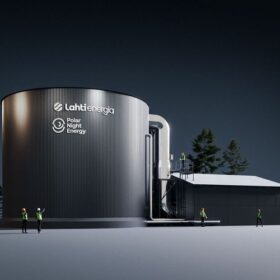
Only months after inaugurating the world’s largest sand battery – a 1 MW/100 MWh thermal storage system – Polar Night has committed to building a project twice its size.

Perovskite solar cell based on Mxene achieves record-breaking efficiency of 25.75%
A research team in Spain has built what it claims to be the world’s most efficient perovskite solar cell using MXenes or any other type of 2D-materials. The device relies on a Mxene interlayer that suppresses non-radiative recombination and improved charge extraction at the interface between the perovskite absorber and the electron transport layer.

When solar meets next-gen nuclear
Scientists in China have proposed a novel scheduling framework for microgrids based on hybrid PV and a small modular nuclear reactors. The framework uses multi-objective distributionally robust optimization with a real-time reinforcement learning mechanism and is reportedly able to reduce operational costs by 18.7%.
