
Building the perfect perovskite, one layer at a time
A University of Cambridge-led team of researchers have demonstrated precisely controlled layer-by-layer epitaxial vapor growth of two-dimensional halide perovskite films in an industrially compatible process. Their findings could help develop more thermally stable perovskite solar cells.

New ultra-reflective color steel promises big efficiency gains for bifacial rooftop PV
Dongkuk CM has introduced an ultra-high-reflectivity color steel sheet designed to boost the performance of bifacial rooftop PV systems, increasing solar reflectance to 80–85. The new material also offers enhanced corrosion resistance, long-term durability, and added cooling benefits thanks to its advanced plating and dual-layer design, according to the manufacturer.

California lawmakers urge CPUC to enforce utility interconnection timelines
A coalition of 18 California legislators has formally urged the California Public Utilities Commission (CPUC) to enforce regulations under “Rule 21” regarding the interconnection of customer-sited solar and energy storage systems.

More than 100,000 applications for UK heat pump subsidy
Latest boiler upgrade scheme (BUS) data reveals more than 100,000 applications for heat pump grants have been made since support scheme launched in May 2022. Demand has significantly increased in 2025, and the scheme was expanded in early November to include an air-to-air heat pump grant.

JinkoSolar achieves 34.76% efficiency for perovskite-silicon tandem solar cell
JinkoSolar says it has increased the efficiency rating for its perovskite-silicon tandem solar cells from 34.22% to 34.76%, confirmed by China’s National PV Metric & Testing Center (NPVM).

Enerin offers industrial heat pump delivering heat up to 250 C
The Norwegian industrial heat pump specialist said its HoegTemp system has a heat supply capacity of 0.2 MW to 5 MW and a coefficient of performance above 2 at high lifts.
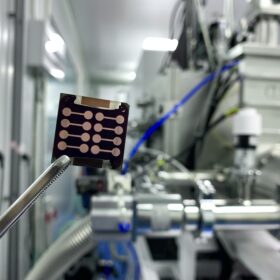
All-perovskite tandem solar cell with dipolar passivation achieves 30.1% efficiency
Researchers in China have developed a dipolar passivation method that reduces defects and improves charge transport in solar cells based on narrow-bandgap tin lead perovskite. The approach has enabled the fabrication of all-perovskite tandem solar cells with efficiencies of around 30% and enhanced stability,

Historic icons, modern energy: Why heritage buildings need solar roofing
Heritage buildings face mounting pressure to cut carbon emissions, but traditional solar panels often clash with their historic appearance and face public resistance. Building-integrated photovoltaics (BIPV) offer a discreet alternative, blending solar technology into roofing materials and enabling wider adoption across protected sites. As UK policy increasingly supports solar on historic buildings, BIPV presents a scalable solution that reconciles climate action with architectural preservation.

NTPC commissions solar-hydrogen-based microgrid in India
NTPC has developed a standalone solar microgrid system that uses hydrogen as the storage medium to deliver 200 kW of round-the-clock power throughout the year. Designed to replace diesel gensets at off-grid Army locations, the system provides a reliable and sustainable power supply even in harsh winter conditions, where temperatures can drop to –40 C at an altitude of 4,500 meters.

Trina Storage launches AC-coupled battery for utility-scale applications
Offered primarily as a 10 MW unit, the new product is also available in a 5.5 MW version for customers with specific requirements.
