PERC solar products hard to sell due to falling TOPCon module prices
Prices for tunnel oxide passivated contact (TOPCon) solar panels continue to fall. pvXchange.com founder Martin Schachinger explains how this will affect the sale of PV modules based on passivated emitter and rear cell (PERC) cells.
China’s solar dominance set to continue amid price slide
With solar module oversupply triggering a price freefall in 2023 and no recovery in sight, market consolidation, inventory pile-up, technology shifts, and challenges to reshoring PV manufacturing are set to affect all levels of the solar supply chain.
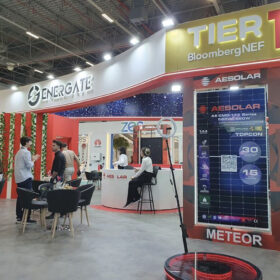
Turkey’s solar ambitions range beyond its borders
The number of module assembly businesses in Türkiye continues to rise but, despite protectionist moves to support domestic manufacturing, consolidation appears likely. Ambitions abroad, expansion at home, and interest from Chinese suppliers, were all on show at the recent SolarEX trade fair in Istanbul.
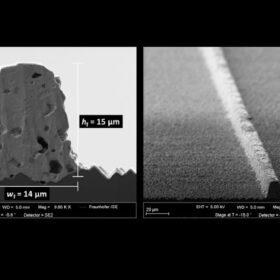
Fraunhofer ISE develops 23.4%-efficient PERC solar cells with limited silver amount
A team from Germany’s Fraunhofer Institute for Solar Energy Systems has reduced silver consumption in the fabrication of PERC solar cells by screen-printing ultra-fine metallization lines measuring just 14 μm. The resulting solar cell offered remarkable efficiency levels, which were confirmed by Fraunhofer ISE CalLab.
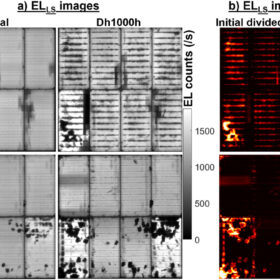
UNSW researchers warn of surprising TOPCon solar module vulnerabilities
Researchers at the University of New South Wales claim to have identified three TOPCon panel failure types that are absent in PERC products. They explained that these failures may occur when the modules are exposed to high humidity and contaminants before encapsulation.

Astronergy presents TOPCon busbarless solar modules with 23% efficiency
The Chinese module manufacturer announced the first shipments of its new ASTRO N7s ZBB-TF modules to Europe. The product has a power output of up to 460 W and a temperature coefficient of -0.29% per C.

Weekend Read: Famine to feast – China’s solar market in 2023
China’s solar industry rebounded in 2023 after years of pandemic-related sluggishness. As the year draws to a close, pv magazine looks back at key highlights of 2023 and considers the prospects for 2024.

The solar module surplus: EUPD Research considers Europe’s warehouse woes
As solar module prices continue to drop to record lows, amid global oversupply, questions are being asked about how much inventory is sitting in European warehouses and when normal levels will return. With numerous estimates and assumptions swirling, EUPD Research’s Markus A.W. Hoehner and Ali Arfa have looked closely at the numbers in an attempt to provide a transparent view of the issue.
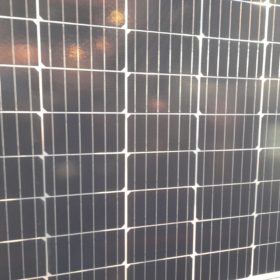
PERC inventor discusses the future of the technology
University of New South Wales academic Aihua Wang is the first female recipient of the United Kingdom’s Queen Elizabeth Prize (QEPrize) for Engineering, after sharing the 2023 award with Andrew Blakers, Martin Green, and her husband Jianhua Zhao for their work developing the passivated emitter rear contact (PERC) solar cell. pv magazine caught up with her to ask about the achievement.
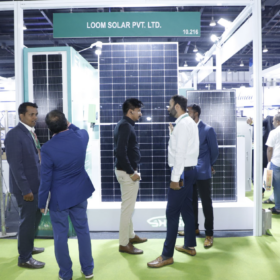
Loom Solar unveils 16BB bifacial TOPCon module
India’s Loom Solar has launched new bifacial TOPCon solar modules with peak power output of 575 Wp and a front-side conversion efficiency rating of up to 22.3%.
