210mm wafer achieves highest energy yield, finds Trina Solar

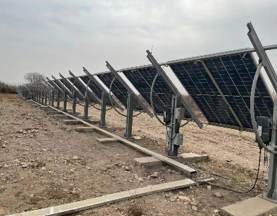
The introduction of larger wafer/cell formats has been one of the biggest recent trends in module technology. With two different sizes – the 210mm ‘G12’ introduced by Zhonghuan Semiconductor, and the smaller 182mm ‘M10’ format produced by Longi – now well established in manufacturing, the industry is looking for ways to differentiate between the two.
Results from various field tests published throughout this year have been able to demonstrate an advantage for either format. New findings published this week by Chinese manufacturer Trina Solar reveal that the 210mm format, used in the company’s Vertex module series, achieved an energy yield as much as 1.6% higher than products based on the 182mm product, over a six month period.
The modules were tested at a site in Yinchuan, China, which has a dry, temperate climate, and a second site in Changzhou, China, where conditions are subtropical with hot, rainy summers and high humidity. At the Yinchuan site, data from April to September 2021 showed a 1.2% energy yield advantage for the Vertex modules, based on monofacial modules installed on fixed-tilt racking at a height of 1 meter. For bifacial modules, the advantage increased slightly to 1.3%. And at the Changzhou site, the Vertex modules reached a yield 1.6% higher than the 182mm products.
Trina Solar’s analysis of the results found that better performance in low-irradiance conditions (200 watts per square meter) was key to the Vertex module’s advantage.
Operating temperature
Higher currents in the larger format products are one of the key differences between the two products, and earlier results presented by JA Solar (which is backing the 182mm format) found that this resulted in a higher operating temperature, and therefore lower energy yield, for the 210mm products. This was not the case in Trina’s field testing, however, with no measurable temperature difference between the two at either site.
Closer analysis of the two test system layouts and components would be needed to understand the reasons for the different operating temperatures (the JA Solar test site is also located in Yinchuan, with similar conditions). For the time being, modules based on both wafer formats will be available on the market. Further field testing, as well as standardization and the development of other system components to suit the characteristics of either format and optimize costs, will show whether either has a real advantage overall or in particular applications.
This content is protected by copyright and may not be reused. If you want to cooperate with us and would like to reuse some of our content, please contact: [email protected].

Please login to comment

[…] begins to increase exponentially. Longi also tested a 3.1 square-meter module – the size of a large-format Trina 210 mm solar cell module – which failed at 4,600 […]
[…] moment begins to increase exponentially. LONGi also tested a 3.1 m2 module – the size of a large format Trina 210 mm solar cell based module – which failed at 4,600 […]
[…] Dschang University, in Cameroon, have tested the solar modules of three Chinese manufacturers – Trina Solar, Canadian Solar, and Felicity Solar – in water-based photovoltaic-thermal […]
[…] Dschang University, in Cameroon, have tested the solar modules of three Chinese manufacturers – Trina Solar, Canadian Solar, and Felicity Solar – in water-based photovoltaic-thermal […]
[…] formats have been completed, test installations are underway – and the backers of both formats claim an energy yield advantage in the field. Since it requires fewer changes and therefore lower risk in system design, the 182mm […]
[…] This year has seen several of the largest PV manufacturers make their first moves into n-type technology, which promises significant advantages in efficiency and reliability over the p-type PERC cells that make up the largest share of solar production today. Meanwhile, PV manufacturing continues to be split into two camps regarding wafer size, with products based on both 182mm and 210mm formats beginning to be produced at scale, and proponents of both claiming an advantage in performance. […]
[…] This year has seen several of the largest PV manufacturers make their first moves into n-type technology, which promises significant advantages in efficiency and reliability over the p-type PERC cells that make up the largest share of solar production today. Meanwhile, PV manufacturing continues to be split into two camps regarding wafer size, with products based on both 182mm and 210mm formats beginning to be produced at scale, and proponents of both claiming an advantage in performance. […]
[…] This year has seen several of the largest PV manufacturers make their first moves into n-type technology, which promises significant advantages in efficiency and reliability over the p-type PERC cells that make up the largest share of solar production today. Meanwhile, PV manufacturing continues to be split into two camps regarding wafer size, with products based on both 182mm and 210mm formats beginning to be produced at scale, and proponents of both claiming an advantage in performance. […]
[…] 20% of the lines and output will be TOPCon products by the end of 2022.Personally, I am for large-size wafers because they increase conversion rates. I am against large power modules like 700 W or even 800 W […]
[…] formats have been completed, test installations are underway – and the backers of both formats claim an energy yield advantage in the field. Since it requires fewer changes and therefore lower risk in system design, the 182mm […]