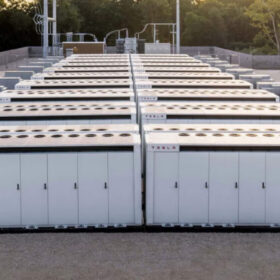
Octopus acquires 500 MW/1 GWh battery project in Australia
Octopus Investments Australia, a subsidiary of UK-based Octopus Group, has purchased the largest battery installation in the Australian state of Queensland – the 500 MW/1 GWh Blackstone project – just outside of Brisbane.

Sri Lanka launches 25 MW solar tender
Sri Lanka’s Ministry of Power and Energy is now welcoming expressions of interest for the development of ground-mounted or floating solar PV projects – ranging from 1 MW to 5 MW – at three substations in the country. Selected developers will secure a 20-year power purchase agreement.

India needs more PV capacity to reach 2027 target of 186 GW
India needs to expand its PV capacity to achieve its 2027 energy target of 186 GW. As of March 31, 2023, the country had already installed 66.7 GW of solar, including an additional 12.9 GW added during the 2023 fiscal year.
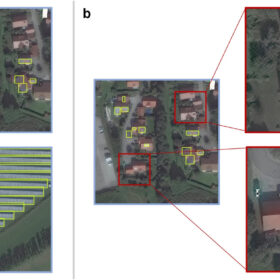
High resolution satellite imagery for residential PV system detection
US-based Maxar Technologies used satellite imagery imagery with resolution of 31 cm to 15.5 cm to identify rooftop PV systems in southern Germany. The company claims its new approach was able to identify 97.8% of the solar arrays with high confidence.
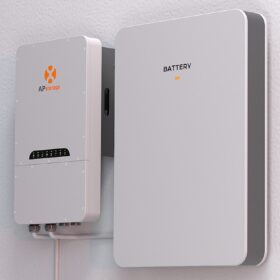
APsystems releases AC-coupled residential battery charger
APsystems has developed an AC-coupled residential battery charger, offering the ability to connect up to four batteries in parallel, for up to 20 kWh of storage capacity.

EU cross-border solar auction largely oversubscribed
The first tender under the European Union’s new €40 million ($41.8 million) multilateral solar scheme – targeting 5 MW to 100 MW projects based in Finland and providing energy to Luxembourg – has been ‘oversubscribed’ with bids ‘significantly exceeding target volumes’, the European Commission’s Directorate-General for Energy recently announced.
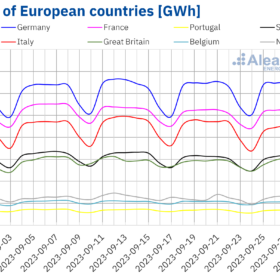
Higher demand, lower wind energy prices boost European electricity market prices
In the last week of September, European electricity market prices rose from the previous week. For a majority of prices the weekly average was above €100/MWh and, in several markets, some hourly prices were above €200/MWh. The rise in gas prices, the decrease in wind energy production and higher demand favored this behavior. Brent futures continued to rise, reaching their highest level since November 2022 on September 27.
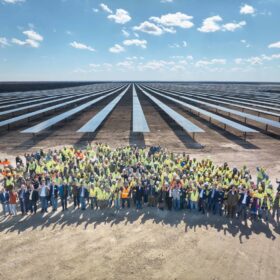
US solar construction costs fell amid pandemic, says EIA
PV module prices have fallen since the start of the pandemic in 2020, reaching a global two-year low in April 2023, according to the US Energy Information Administration (EIA). In the first two months of this year, average PV module prices in the United States stood at $0.36/W (DC), down 11% on a quarterly basis.
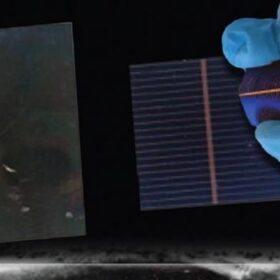
Researchers build 20-μm-thin monocrystalline solar cell with 21.1% efficiency
The scientists built the device by depositing multiple metal nanofilms on both sides using plasma-enhanced chemical vapor deposition. The cell achieved an open-circuit voltage of 684 mV, a short-circuit current density of 38.2 mA/cm2 and a fill factor of 80.8%.
The Hydrogen Stream: Mattiq developing iridium alternatives for PEM electrolyzers
Mattiq says it is evaluating “millions of combinations” of different alternatives to iridium for PEM electrolysis, while Hystar, Air Liquide, and Trillium Energy Solutions have revealed plans for the North American hydrogen market.
