
NTPC, Engineers India agree to partner on CCUS, green hydrogen
NTPC’s NETRA R&D center and Engineers India Ltd. (EIL) have agreed to collaborate on carbon capture, utilization and storage (CCUS), green hydrogen, and green ammonia.

Organic flow battery developer secures $106 million growth investment
CmBlu says it has has obtained funds to scale up its long-duration energy storage systems.
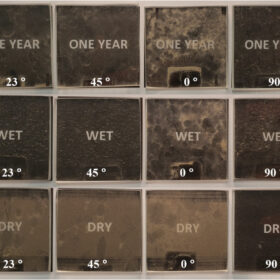
The impact of soiling on PV module transmittance
A European group has looked into the soiling impact on PV modules in Oman. They have collected 60 samples, based on season, month and tilt angles.

Acciona, Stanwell sign offtake deal for 380 MW of solar in Australia
Stanwell Corp. has signed a long-term offtake agreement with Spanish renewable energy developer Acciona Energia to purchase 100% of the output from the proposed Aldoga Solar Farm in Australia. It will use the electricity to power a 3 GW green hydrogen project in the state of Queensland.

Construction starts on Sweden’s largest solar farm
Neoen and Alight have started building the 100 MW Hultsfred solar farm in Sweden, which will purportedly be the country’s largest solar installation upon completion.

Israel temporarily waives 600 KWh energy storage permits due to war
The Israeli planning regulator says that some storage facilities will not need permit approvals over the next 18 months.
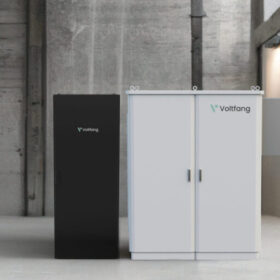
Voltfang launches ‘New Life’ commercial storage system with 45 KWh capacity
The battery storage system has 30 percent more power and capacity when compared to the German company’s previous model. The solution is particularly suitable for use in charging infrastructure, food-retail and commercial areas with high power peaks, the company claims.
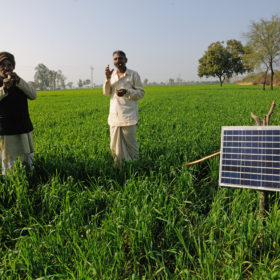
Solargis notes potential inaccuracies in tropical solar irradiance data
Solargis, a Slovakia-based solar data provider, claims that the difference between modeled solar irradiance and real measurements is more significant in tropical regions than in subtropical zones. It argues that enhancing ground-based measurement stations and forecasts can enhance data accuracy and accelerate PV project delivery.
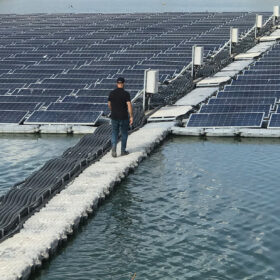
Caribbean could become offshore floating solar PV giant, researcher says
Land is scarce but water is abundant for the Caribbean’s 700 islands. Solar economy professor Christian Breyer tells pv magazine that the region’s archipelagic makeup is not a drawback but a benefit for renewable energy generation, with the ocean potentially serving as the area’s floating solar PV backbone.
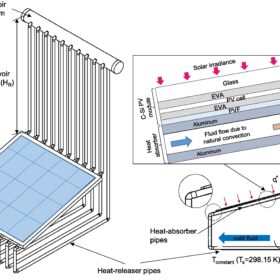
Passive cooling technique for floating PV systems
An international research team has built a cooling tech consisting of heat absorber pipes that are thermally connected to the PV module, heat releaser pipes that exchange heat with the water body, a series of connecting pipes, and a coolant reservoir. The system claims to create a continuous fluid flow that dissipates heat from the PV cells to the surroundings.
