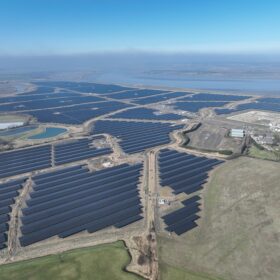
UK solar on track for record CfD deployment in 2026
Total number of UK PV plants backed by contracts for difference (CfD) could more than double in 2026, if developers hit deadlines. Latest investment report from scheme contract company reveals solar holds the greatest number of contracts of any generating technology.
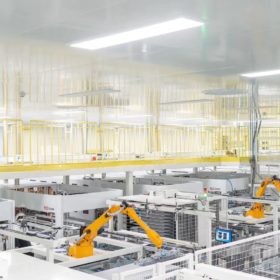
China solar manufacturer Eging faces potential exit from flagship PV project
A regional government authority in eastern China is weighing whether to unwind a multibillion-yuan manufacturing joint venture with Eging PV after construction delays and funding disruptions, underscoring mounting strain across the country’s solar supply chain.
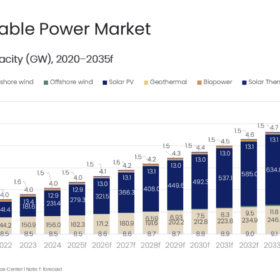
US market on course to hit 737.8 GW of solar by 2035
GlobalData’s latest analysis says the U.S. will add between 41 GW and 52 GW of solar annually until 2035.

China wafer leaders lift quotes as 2026 module prices may hit CNY 1/W
China’s top wafer makers raised prices on key n-type formats, signaling potential module price rises toward CNY 1 ($0.14)/W in 2026 amid efforts to curb loss-making competition.

Nepal issues tender for rural solar home system monitoring
Nepal’s Alternative Energy Promotion Centre (AEPC) is searching for a consultant to undertake monitoring and quality assurance of rural renewable energy installations, including solar home systems. The deadline for expressions of interest is Jan. 14, 2026.

New digital twin for floating PV application uses artificial intelligence
Scientists have developed a floating PV digital twin system, trained on data from 155 physical experiments, using a two-tier artificial neural network (ANN) with a high-fidelity model and a reduced-order model. Predictive performance reached R2 values of 0.9996 for PV surface temperature and 0.9189 for power output.

Bangladesh seeking contractors for 220 MW solar project
Electricity Generation Co. of Bangladesh (EGCB) has issued a procurement notice for a forthcoming 220 MW solar project near its existing 75 MW Sonagazi facility. Once completed, the installation will be the country’s largest solar plant to date.
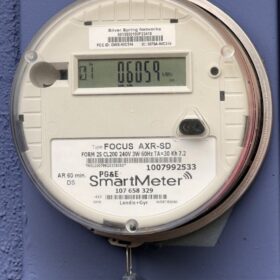
Utilities risk penalizing efficiency by shifting to fixed charges
Shifting utility costs from usage rates to fixed monthly fees may penalize efficiency and fail to provide the financial incentive necessary to drive widespread electrification.
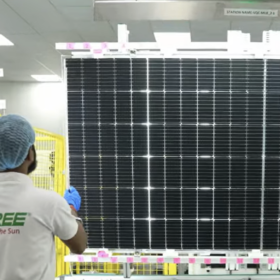
Waaree Energies tops 20 GW as India’s largest ALMM-approved PV maker
Waaree Energies crossed 20 GW of approved solar module manufacturing capacity after its Chikhli plant was added to the Indian Ministry of New and Renewable Energy’s (MNRE) Approved List of Models and Manufacturers (ALMM), strengthening domestic supply for utility-scale projects.
US state orders utility to enable flexible grid connections for community solar
Regulators in the US state of Colorado have ordered Xcel Energy’s local utility to introduce a flexible interconnection option aimed at lowering grid costs for community solar and energy storage projects.
