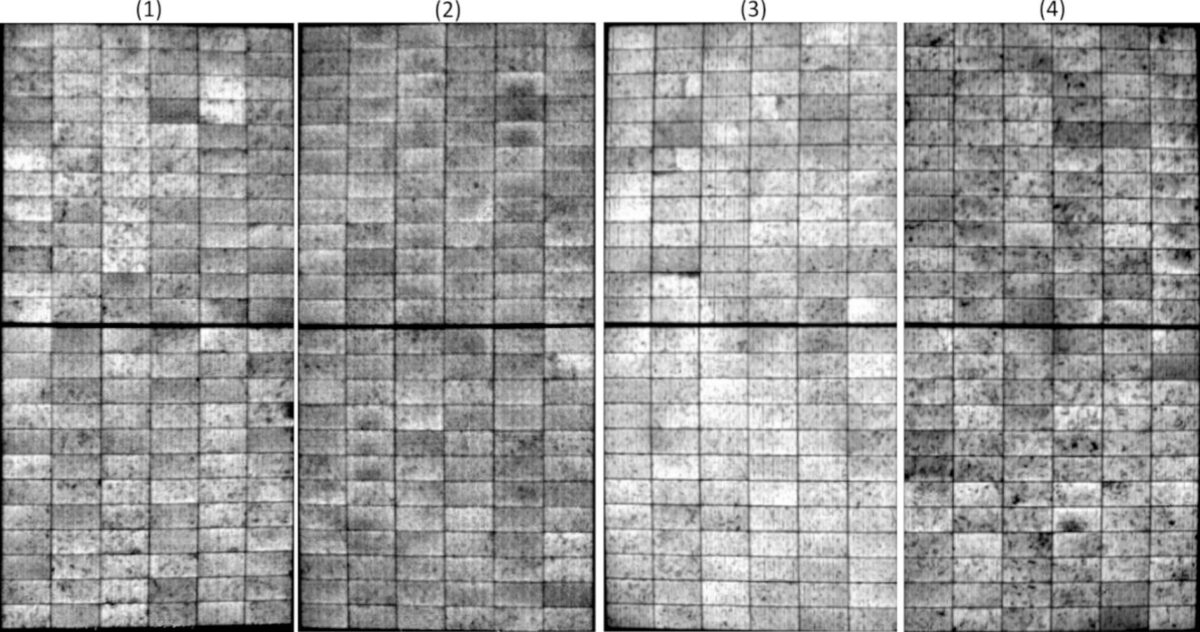





A research team from Spain’s University of Valladolid has created a novel self-powered daylight electroluminescence (dEL) method for PV system inspections.
Usually, dEL requires power sources like generators or bidirectional inverters to inject current during a string inspection. However, the novel methodology is self-powered by using other PV strings in the plant to supply the necessary current.
“Within PV diagnostics, dEL has emerged as a promising solution, enabling EL inspections during daytime with high quantum-efficiency (QE) infrared cameras (e.g., InGaAs) and ambient light filtration,” the group said. “However, it still requires current injection, which presents logistical and economic challenges. This work introduces a new self-powering method for dEL inspections using other PV strings to supply current. This minimizes external power needs, reducing costs and environmental impact.”
The methodology labels the string that powers as SP and the string to be measured as SM. SP should have a greater number of modules in a series to inject the required current for an EL image, that is, in the range 80–100% of the short circuit current (Isc). Conducting simulations in the LTSPice software, the effect of removing one, two, three, and four modules from an initial 30 modules of SM was simulated. Per the results, in such a configuration, no more than two modules should be removed.
Following the computerized simulation, the group conducted experimental tests at two commercially operating 50 MW solar PV plants in Spain.
The first plant had c-Si modules of 435 W and an efficiency of 19.7%, while the second had mc-Si modules of 345 W with an efficiency of 17.4%. The first had 12 strings per combiner, with 28 modules per string, whereas the second had 30 modules per string and 24 strings per combiner. In both cases, the whole string consisted of modules in two rows, mounted on tables with an automated mobile axis.

Image: Universidad de Valladolid, Solar Energy, CC BY 4.0
“A device called an electronic switching device (ESD) is connected between the SP and SM strings. This device, developed by our research group, acts as a switch that cuts the current between the two sets of strings (SP and SM), obtaining two states on SM: ON state and OFF state,” the scientists explained.
“Measurement consists of taking a number of images with the InGaAs camera, alternatively electrically connecting (ON state) and disconnecting (OFF state) the set SP to SM, which is performed by means of the switching and control device. Our system involves synchronised switching between current injection (via ESD) and exposure of the InGaAs camera.”
The measurements were taken throughout the year, with irradiance ranging from 200 W/m2 to 1,000 W/m2, and temperature ranging from 4 C to 37 C. To analyze the quality of the dEL images, some of the modules were disassembled and sent for detailed inspection using high-resolution Si cameras in controlled darkroom environments.
“The comparison of the dEL images against lab-EL images shows a significant difference in image quality (lower in the dEL), which originates from multiple technical factors: sensor resolution limitations, dual-module simultaneous imaging requirements, and field measurement complexities under high-irradiance operating conditions,” the group concluded. “Nonetheless, comparative assessment against lab-EL standards reveals acceptable diagnostic performance with effective defect detection capabilities.”
The new methodology was presented in “Electroluminescence inspections of PV modules and strings by a self-powering configuration in daylight mode,” published in Solar Energy. Scientists from Spain’s University of Valladolid, Cobra Installations and Services (Cobra Instalaciones y Servicios), and University of Burgos have participated in the study.
This content is protected by copyright and may not be reused. If you want to cooperate with us and would like to reuse some of our content, please contact: editors@pv-magazine.com.

By submitting this form you agree to pv magazine using your data for the purposes of publishing your comment.
Your personal data will only be disclosed or otherwise transmitted to third parties for the purposes of spam filtering or if this is necessary for technical maintenance of the website. Any other transfer to third parties will not take place unless this is justified on the basis of applicable data protection regulations or if pv magazine is legally obliged to do so.
You may revoke this consent at any time with effect for the future, in which case your personal data will be deleted immediately. Otherwise, your data will be deleted if pv magazine has processed your request or the purpose of data storage is fulfilled.
Further information on data privacy can be found in our Data Protection Policy.