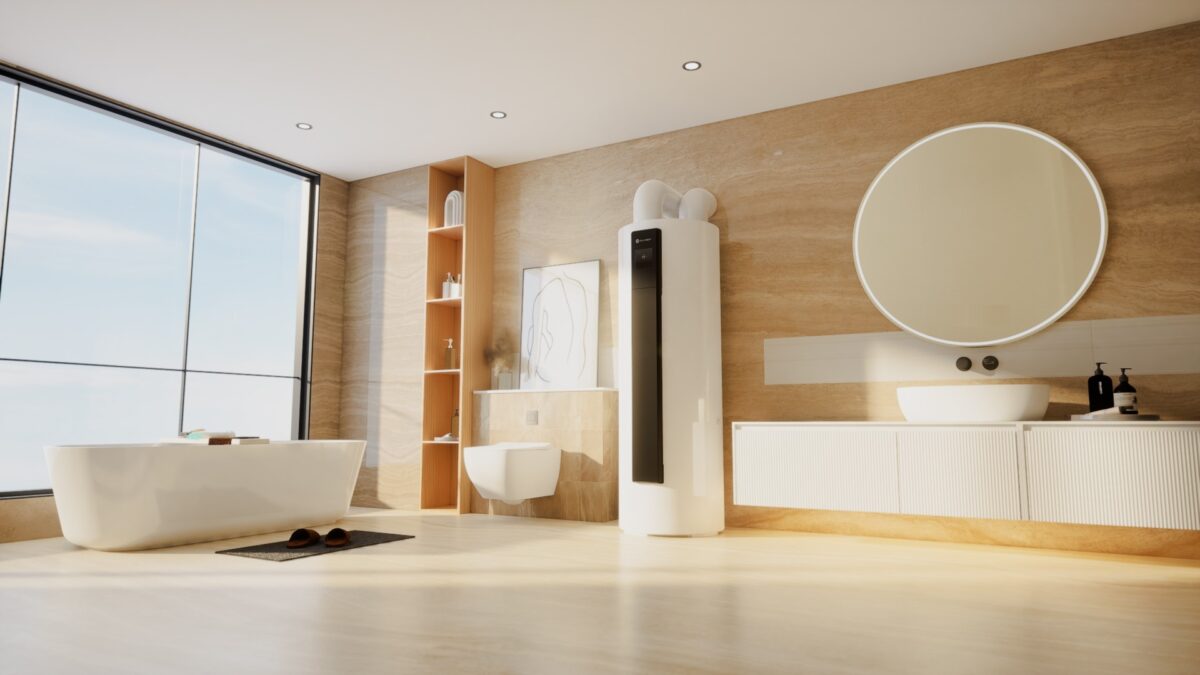





Italian heat pump producer Clivet has introduced a new residential heat pump system designed for domestic hot water production.
The Aqua F series is available in three versions, with storage capacities of 100 L, 190 L, and 300 L. Up to eight units can be cascaded to meet even the highest hot water demand, the company said in a statement.
The system uses propane (R290) as the refrigerant and incorporates an electronic anode as well as photovoltaic contacts.
“Thanks to the electronic anode and an automatic malfunction detection system, there is no need to periodically drain the water in the heat pump to check the anode’s condition,” the company explained. “Maintenance is therefore limited to filter inspections, allowing for quick, economical, and non-invasive interventions.”
The smallest unit provides 1.95 kW of power with a coefficient of performance (COP) of up to 5.31, while the largest offers up to 2.4 kW with a COP of up to 5.17. Noise levels range from 55 dB(A) to 56 dB(A).
The heat pump can deliver hot water at temperatures of up to 70 C and operates within an ambient temperature range of –20 C to 46 C.
According to Clivet, the system captures renewable energy from the air and converts it into heat to raise the water temperature in the storage tank, with minimal electricity consumption.
“The Aqua F is four times more efficient than a traditional electric boiler, resulting in a 75% reduction in electricity costs for the same amount of thermal energy delivered,” the company said.
Clivet is majority-owned by China's Midea and is headquartered in Feltre, in the Italian northern province of Belluno. It also produces boilers, chillers, and air-handling units.
This content is protected by copyright and may not be reused. If you want to cooperate with us and would like to reuse some of our content, please contact: editors@pv-magazine.com.


By submitting this form you agree to pv magazine using your data for the purposes of publishing your comment.
Your personal data will only be disclosed or otherwise transmitted to third parties for the purposes of spam filtering or if this is necessary for technical maintenance of the website. Any other transfer to third parties will not take place unless this is justified on the basis of applicable data protection regulations or if pv magazine is legally obliged to do so.
You may revoke this consent at any time with effect for the future, in which case your personal data will be deleted immediately. Otherwise, your data will be deleted if pv magazine has processed your request or the purpose of data storage is fulfilled.
Further information on data privacy can be found in our Data Protection Policy.