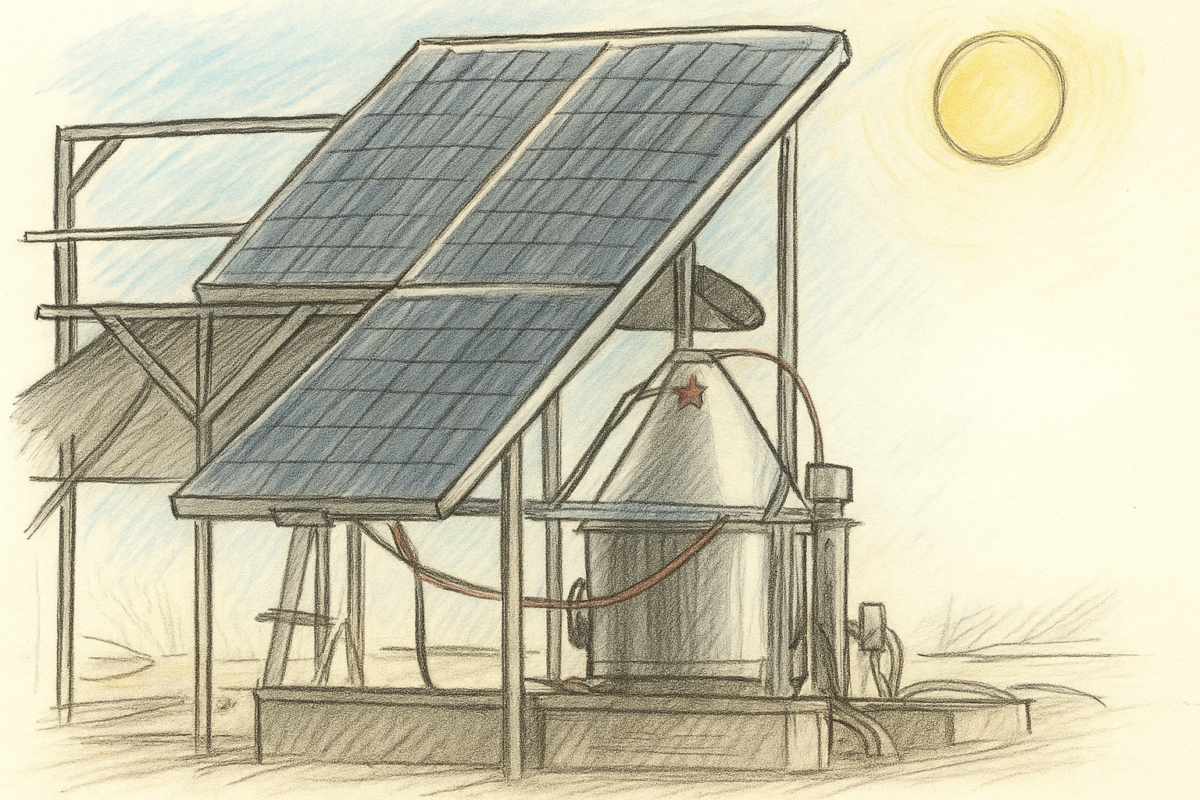





A group of scientists from China’s Yunnan Normal University and Yunnan Provincial University has developed a PV-powered rapid-cycling sorption-based atmospheric water harvesting (SAWH) system.
“To enhance the practicality and scalability of our previous system, an innovative photovoltaic (PV)-powered rapid-cycling SAWH system is proposed for sustainable off-grid water harvesting,” the group explained. “A PV energy supply system was designed to meet the energy requirements of continuous water harvesting: during daylight hours, PV panels power electrical components directly, with excess energy stored in batteries; at night or under insufficient sunlight, batteries discharge to maintain operation.”
SAWH (sorption-assisted water harvesting) is a technology that uses hydrophilic, hygroscopic materials to capture atmospheric moisture and recover water through desorption and condensation.
At the core of the SAWH unit are two pieces of commercial activated carbon fiber felt (ACFF) stacked between electrodes and clamped to form a single adsorbent module. This module is placed inside an enclosed structure consisting of an adsorption bed at the bottom and a condensation module on top. The ACFF at the bottom captures moisture from ambient air and serves as a resistor to generate heat for vapor release, while the top section cools and condenses the vapor into liquid water.
The SAWH enclosure is powered by two 300 W PV panels connected in parallel and two 12 V/200 Ah batteries connected in series. An auxiliary system, comprising a 200 W PV panel and a 12 V/80 Ah battery, is also integrated and operates in three of the four condensation modes. In water-cooling mode, a pump circulates water; in fan-assisted cooling, a fan is powered; and in semiconductor refrigeration, a semiconductor module is activated. The auxiliary system is not required in the fourth mode, natural convection.
The system was tested in both laboratory and outdoor environments using the four condensation modes. It was also evaluated under three adsorption time schedules: Model 1 (9 h, 3 h, 3 h, 3 h), Model 2 (6 h, 3 h, 6 h, 3 h), and Model 3 (four equal intervals of 4.5 h). Outdoor testing took place in Kunming, southern China, between January and March 2025.
“Results showed that the fan-assisted water-cooling condensation mode was the most energy-efficient option, maintaining a daily water production (DWP) of 0.96 kg water/kg ACFF/day and a specific energy consumption (SEC) of 2.59 kW·h/kg water,” the team reported. “The equal adsorption duration mode (4.5 h × 4) exhibited the best overall performance, achieving a DWP of 0.50 kg water/kg ACFF/day and an SEC of 4.86 kW·h/kg water. This mode increased PV power generation efficiency to 14.2%.”
Based on the optimized strategy for six days of outdoor operation, the PV panels provided on-demand power with an efficiency of 15%–20%, and the power supply efficiency reached approximately 90%. “Additionally, the system achieved an energy payback time of 6.72 years and a lifecycle CO₂ emissions reduction of 35.84 tons,” the group concluded.
The scientists presented the system in the study “A photovoltaic-powered rapid-cycling sorption system for sustainable off-grid atmospheric water harvesting,” published in Energy Conversion and Management.
This content is protected by copyright and may not be reused. If you want to cooperate with us and would like to reuse some of our content, please contact: editors@pv-magazine.com.

By submitting this form you agree to pv magazine using your data for the purposes of publishing your comment.
Your personal data will only be disclosed or otherwise transmitted to third parties for the purposes of spam filtering or if this is necessary for technical maintenance of the website. Any other transfer to third parties will not take place unless this is justified on the basis of applicable data protection regulations or if pv magazine is legally obliged to do so.
You may revoke this consent at any time with effect for the future, in which case your personal data will be deleted immediately. Otherwise, your data will be deleted if pv magazine has processed your request or the purpose of data storage is fulfilled.
Further information on data privacy can be found in our Data Protection Policy.