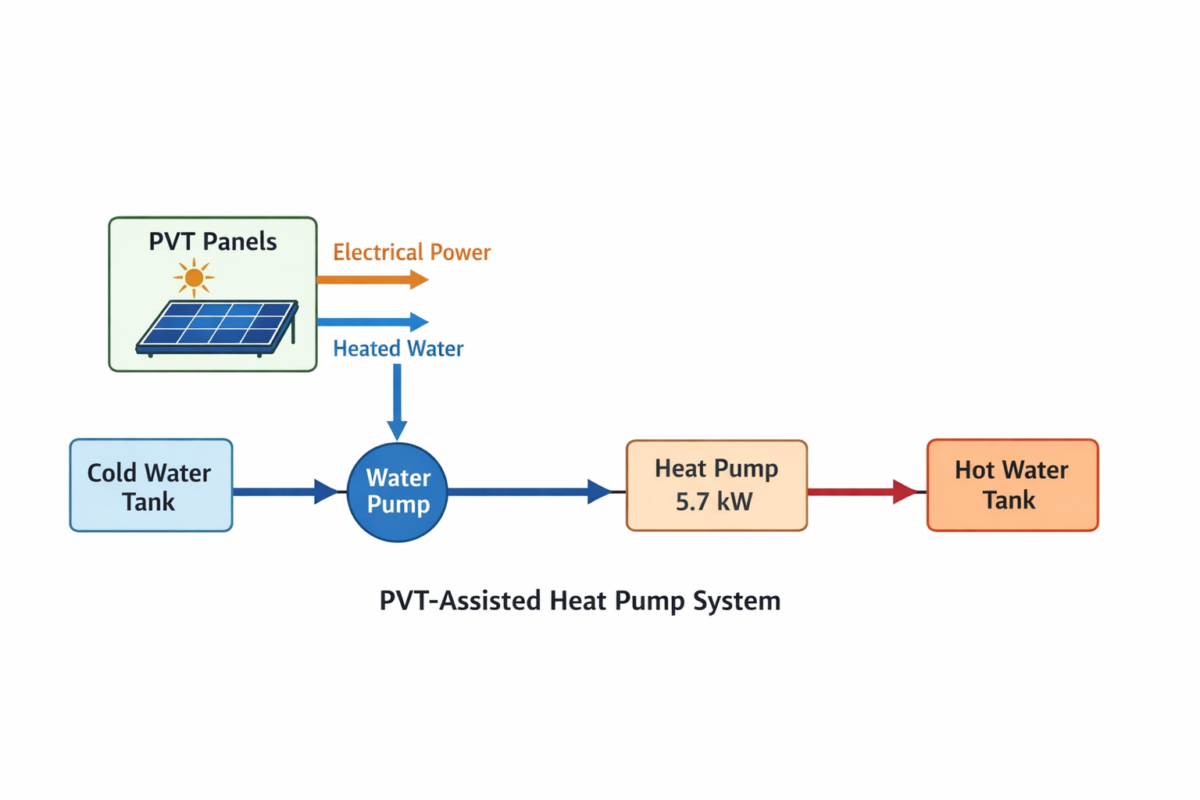





Researchers at Chiang Mai University in Thailand have evaluated the performance of an indirect-expansion photovoltaic-thermal-assisted heat pump (IDX-PVT-AHP) system designed for hot-water production in the tropical climate of Chiang Mai.
“The application of the IDX-PVT-AHP system in the Chiang Mai tropical climate presents a notable challenge due to the region's high humidity, which can lead to moisture accumulation on PVT panels,” the team said. “To mitigate this issue, it is essential to regulate the cold water temperature and determine the optimal cold water storage tank size to prevent excessive cooling, while also identifying the appropriate number of PVT modules.”
The system operates by circulating water through the PVT modules, absorbing heat before entering the cold-water storage tank. Inside the tank, a coil serves as a heat-pump evaporator, transferring heat from the plate heat exchanger, which functions as the condenser, to the hot-water storage tank. In addition, the PVT modules generated electricity to power the heat pump compressor, water pump, and auxiliary heaters. When the electricity generated by the PVT modules is insufficient, the system draws additional power from the grid.
In the first simulation experiment, the system configuration comprised 1,000 L of hot-water storage and 1,500 L of cold-water storage, connected to three PVT modules. Using monocrystalline cells, it achieved a maximum power of 550 W and an efficiency of 21.3%, with a thermal peak of 1,436 W. The compressor had a cooling capacity of 5.7 kW and used R-134 Refrigerant. Four cases for the minimum cold-water temperature in the tank were tested under the 2023 climatic conditions for Chiang Mai: case 1 at 18 C, case 2 at 21 C, case 3 at 24 C, and case 4 at the real dew point. Dew point temperature is the temperature at which condensation begins to form in the air.
“The lowest energy consumption was achieved when the cold water storage tank setpoint was at 18 C; this condition induced an excessive number of hours that caused water vapor condensation (302 h/y), potentially accelerating PVT module degradation,” the results showed. “Among the evaluated scenarios, maintaining the cold water storage tank at the dew point temperature provided the most favorable trade-off between minimizing electricity consumption and reducing the risk of water vapor condensation on the PVT modules.”
In a second experiment, the temperature of the cold water in the tank was kept constant at the real dew point, while the number of PVT modules and the size of the cold water tank were varied. As for the PVT, they were the same monocrystalline 550 W modules, connected in pairs or triples. The water tank size was set to 500 L, 750 L, 1,000 L, or 1,500 L. This optimization aimed to find the size that yielded the shortest payback period for heating 1,000 L of water to 60 C.
The academics also found that increasing the number of PVT modules improved system performance and decreased dependence on auxiliary heaters, whereas enlarging the cold water storage tank slightly enhanced thermal buffering but lengthened the payback period.
They concluded that the optimal configuration consisted of three PVT modules, a 1,000 L hot-water storage tank, and a 1,500 L cold-water storage tank, effectively balancing energy efficiency, reliability, and economic return in tropical conditions. They also noted that by using a dew point temperature setpoint, the water vapor condensation duration was reduced to only seven hours per year, while annual electricity consumption remained low at 7,315.5 kWh, and the payback period was 3.36 years.
The system was presented in “Evaluation of cold water temperature and tank size impacts on a PVT-assisted heat pump system performance for hot water applications,” published in Case Studies in Thermal Engineering.
This content is protected by copyright and may not be reused. If you want to cooperate with us and would like to reuse some of our content, please contact: editors@pv-magazine.com.

By submitting this form you agree to pv magazine using your data for the purposes of publishing your comment.
Your personal data will only be disclosed or otherwise transmitted to third parties for the purposes of spam filtering or if this is necessary for technical maintenance of the website. Any other transfer to third parties will not take place unless this is justified on the basis of applicable data protection regulations or if pv magazine is legally obliged to do so.
You may revoke this consent at any time with effect for the future, in which case your personal data will be deleted immediately. Otherwise, your data will be deleted if pv magazine has processed your request or the purpose of data storage is fulfilled.
Further information on data privacy can be found in our Data Protection Policy.