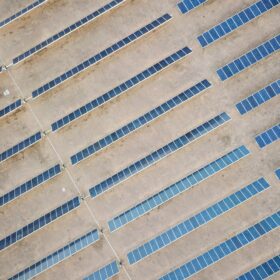
Solar set to become South Korea’s most cost-competitive energy source
A research team based at Lawrence Berkeley National Laboratory says that solar could have the lowest levelized cost of energy (LCOE) of all energy sources in South Korea by the early to mid-2030s.

Fraunhofer ISE creates startup for agrivoltaics
The Fraunhofer Institute for Solar Energy Systems ISE (Fraunhofer ISE) has launched Diveo GmbH to plan and construct different kinds of agrivoltaic facilities without focusing on specific technologies.
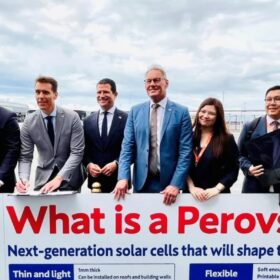
Sekisui, TNO exploring perovskite solar PV collaboration
Japan’s Sekisui Solar Film and the Netherlands’ TNO have signed a letter of intent to explore collaborations related to flexible perovskite solar PV. Talks will be initiated on a potential perovskite module factory in Brabant and the exchange of relevant information.
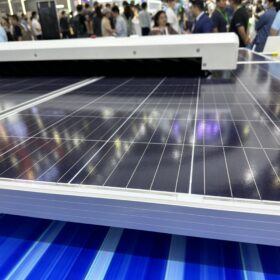
Turkey opens anti-dumping probe into Chinese PV frames, junction boxes
The Turkish authorities claim to have found evidence of dumping practices by Chinese PV junction boxes and frames manufacturers, which allegedly caused substantial damage to domestic producers.

Luxembourg adopts series of solar measures
Tenders for agrivoltaics and the commercial and industrial (C&I) market, simplified permitting procedures, and financial aid for solar installations are among a series of proposals the government of Luxembourg has adopted to accelerate the rollout of renewable energy technologies.
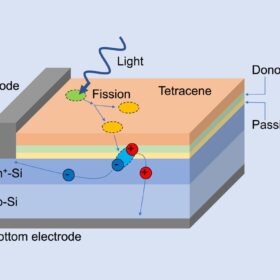
MIT scientists developing silicon solar cell based on singlet exciton fission
Scientists in the United States have designed a microwire solar cell that could reportedly enable the coupling of singlet fission with silicon. Key to their achievement was an interface that transfers the electrons and holes sequentially into silicon instead of both at once.
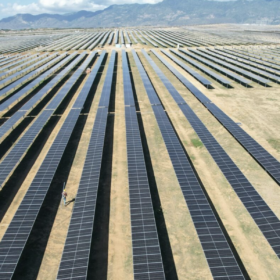
Indian state approves 2.6 GWp solar project
Hyderabad-based Bondada Engineering has secured the development of a 2.6 GWp solar project in outhern India.
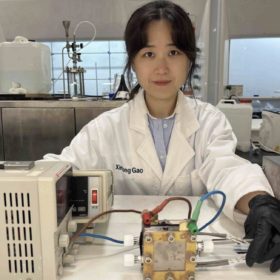
Australian researchers turn to urine to cut hydrogen costs
Australian researchers have developed electrolysis systems that use urea sourced from urine and wastewater to generate hydrogen at “significantly lower” energy costs than traditional water-splitting methods.
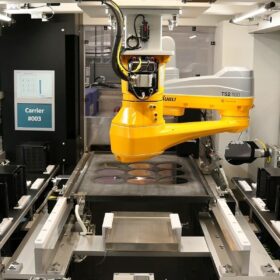
Vision-assisted robotics for space solar cell manufacturing
German automation specialist Acp systems developed an advanced robotics solution integrating image processing to handle a range of wafer sizes and tolerances within a vapor deposition process for a manufacturer of space solar cell technologies. The requirements included a compact design, precsion within 0.1 mm and automated wafer handling quality control.

EU updates Photovoltaic Geographical Information System
The EU Joint Research Centre (JRC) has updated the core technologoy of the Photovoltaic Geographical Information System with the aim of reflecting the dominance of crystalline silicon solar technologies over thin-film counterparts in the global energy market.
