




Poland installed 3.6 GW of solar in 2025, according to data collected by Agencja Rynku Energii (ARE) on behalf of the country’s Ministry of Energy. The figure is down on the 4 GW of solar added in 2024 and takes cumulative solar capacity to 24.8 GW.
Separate data collected by Poland’s lone transmission system operator, Polskie Sieci Elektroenergetyczne (PSE), says total solar capacity was as high as 25.5 GW by the end of last year. Grzegorz Wisniewski, founder and director of the Institute for Renewable Energy (IEO), explained to pv magazine that the discrepancy is likely caused by some large PV farms that were connected to the grid in December being included in PSE’s figures, while ARE’s data will account for them in 2026.
“This is supported by the relatively low share of PV farms above 10 MW connected to the high-voltage grid, which covers only 0.7 GW, whereas the number of projects with a capacity above 50 MW being connected to the PSE grid is rapidly increasing,” Wisniewski said.
ARE’s data finds that over half of last year’s additions were solar installations between 50 kW and 10 MW in capacity, encompassing both C&I applications as well as large PV farms connected to the medium- and high-voltage grids. In contrast, the prosumer market of less than 50 kW slowed in 2025, according to ARE’s figures, installing just under 1 GW compared to 1.3 GW in 2024.
Wisniewski said the development of large-PV farms in Poland started ten years ago and is still booming. At the end of 2025, IEO’s project database noted 7,703 projects with issued grid connection permits with a total capacity in excess of 33 GW. Of this total, 5,895 projects, totaling 13.8 GW, have concluded a contract with the grid operator.
According to data from ENTSO-E, PV installations in Poland fed 19.2 TWh of energy into the grid last year, accounting for 12.5% of Polish electricity, but over 1 TWh of solar and wind was curtailed.
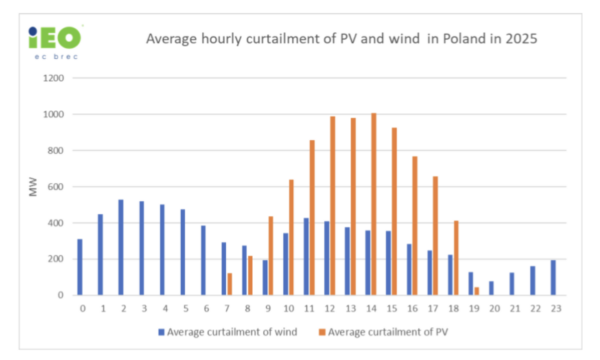
Image: IEO
While hybrid solar-plus-storage and solar-plus-wind systems are being considered as a key way to mitigate curtailment in Poland, Wisniewski noted a new trend in the absorption of excess renewable generation in the summer by district heating companies through power-to-heat (P2H) technologies and seasonal thermal storage.
“According to IEO analysis, the installed capacity of electric sources available for green electrification of district heating systems might follow the planned capacity of non-prosumer photovoltaic sources, reaching, according to the National Renewable Energy Action Plan, 23.4 GW in 2035 and 45 GW in 2040,” Wisniewski explained. “The level of district heating electrification is expected to grow from 23% in 2025, through 46% in 2030 then to 82% in 2040.”
Several Polish district heating companies are currently developing P2H investments, Wisniewski added, supported with long-term thermal storage for purchasing PV generation on a power purchase agreement basis.
Wisniewski concluded that while the next few years will be challenging for investors and developers, there are a lot of opportunities related to new models of project development.
“In Poland there is still huge potential PV for investment and new transactions in 2026 and beyond. The curtailment and impact of negative power prices could be mitigated by hybrids, sector coupling and ancillary services (additional potential stream of revenues),” he said. “The future belongs to the innovative developers, who will use the potential of new opportunities, like P2H in district heating systems, therefore reducing the project financial risk and securing bankability.”
Poland’s seventh renewables auction took place in July, with solar accounting for 178 of the 181 successful bids. In September, the government delivered a record budget in the sixth round of its residential solar and storage rebate scheme after receiving over 121,000 applications.
This content is protected by copyright and may not be reused. If you want to cooperate with us and would like to reuse some of our content, please contact: editors@pv-magazine.com.



By submitting this form you agree to pv magazine using your data for the purposes of publishing your comment.
Your personal data will only be disclosed or otherwise transmitted to third parties for the purposes of spam filtering or if this is necessary for technical maintenance of the website. Any other transfer to third parties will not take place unless this is justified on the basis of applicable data protection regulations or if pv magazine is legally obliged to do so.
You may revoke this consent at any time with effect for the future, in which case your personal data will be deleted immediately. Otherwise, your data will be deleted if pv magazine has processed your request or the purpose of data storage is fulfilled.
Further information on data privacy can be found in our Data Protection Policy.