Datang plans 14.6 GW renewables cluster in China

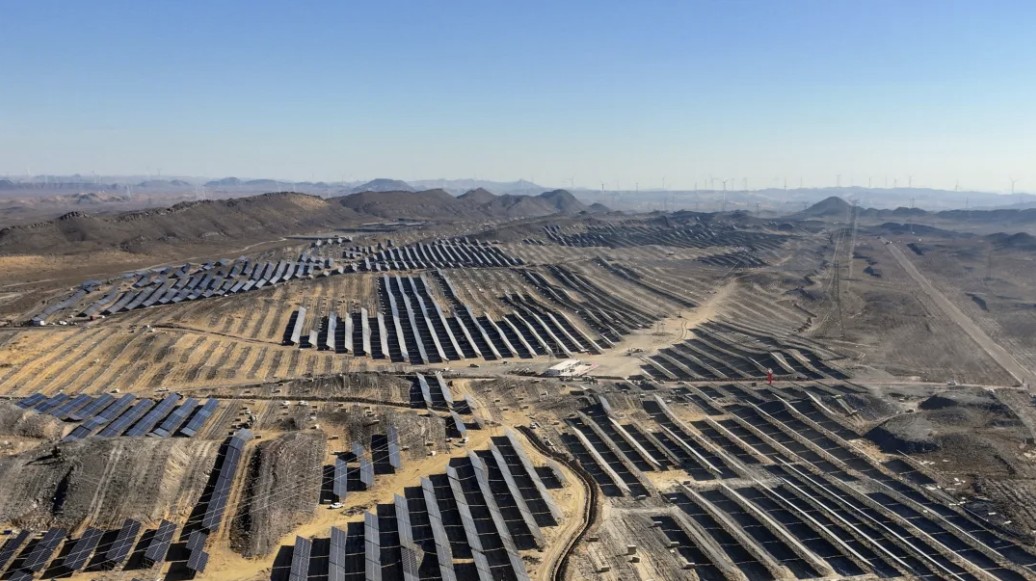
Datang International Power Generation Co., Ltd, the energy unit of China Datang Corp, has signed an agreement with Jiangsu Guoxin Group and Ordos New Energy Development and Utilization Co., Ltd. to establish a joint venture for the development of the “Meng-Su Power Transmission” project.
The project is planned as a large-scale cross-provincial power base linking generation resources in Inner Mongolia with electricity demand in China’s eastern coastal Jiangsu province. Datang Power said the project is still at an early development stage and has not yet completed the required approval procedures.
The joint venture, Datang (Ordos) Energy Development Co., Ltd., will have registered capital of CNY 10 billion ($1.47 billion). Datang Power will contribute CNY 5.1 billion for a 51% stake, Jiangsu Guoxin Group CNY 3.4 billion for 34%, and Ordos New Energy Development and Utilization Co., Ltd. CNY 1.5 billion for a 15% stake. All three parties will make their contributions in cash.
The planned project has a total installed capacity of 14.64 GW, including 8 GW of solar, 4 GW of wind, and 2.64 GW of coal-fired power. It will also include 2.04 GW/8.16 GWh of energy storage. Total planned static investment is about CNY 58.1 billion.
The associated transmission line is designed as a 800 kV ultra-high-voltage direct current (UHVDC) line with a rated transmission capacity of 8 GW. It will run from a converter station in Hanggin Banner, Ordos, Inner Mongolia, to a converter station in Jiangning District, Nanjing, Jiangsu province. The route is expected to pass through Shanxi, Hebei, Shandong, Henan, and Anhui provinces, with a total length of about 1,886 km.
The project is designed as an integrated wind-solar-coal-storage energy base. In this configuration, coal-fired units and battery storage are intended to provide balancing capacity for large-scale renewable generation and improve utilization of the long-distance UHV transmission channel, which Datang says will reduce renewable curtailment to below 1%, compared with an average of around 10% in the region.
According to the project plan, construction is expected to run from 2026 to 2030 under a phased development model. Wind, solar, and storage facilities are scheduled to begin full-scale construction in the third quarter of 2026, while coal-fired supporting units are expected to begin construction in September. The UHV transmission corridor is targeted for approval and construction launch by the end of 2026.
The first batch of about 5 GW of wind and solar capacity is expected to be connected to the grid in 2027. The first coal-fired unit is scheduled to enter operation in November 2028, with the full wind-solar-storage base, all four coal units, and the transmission corridor targeted for completion by the end of 2029. Once fully operational in 2030, the project is expected to deliver more than 40 TWh of electricity to Jiangsu annually, with renewable power accounting for more than 60% of the total.
This content is protected by copyright and may not be reused. If you want to cooperate with us and would like to reuse some of our content, please contact: [email protected].

Please login to comment