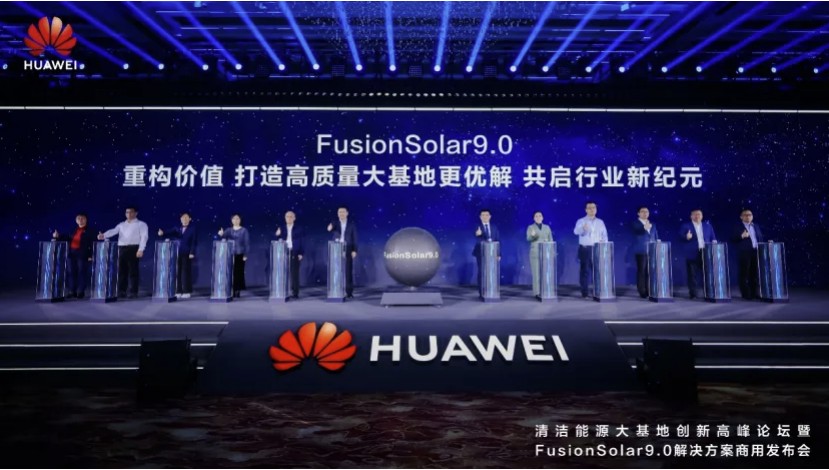





Chinese conglomerate Huawei has launched FusionSolar 9.0, its latest integrated platform for solar-plus-storage generation, enhanced by smart energy management.
The solution was first announced in June at the SNEC exhibition in Shanghai, China, and is now being rolled out for large “new energy base” projects both domestically and overseas.
FusionSolar 9.0 integrates four core components: a 460 kW smart string inverter, a sub-array controller, a plant-level controller, and an integrated PV management system. Together, these elements are designed to transform solar plants from simple power producers into active grid-support assets, reflecting Huawei’s shift from “scale expansion” to “value refinement.”
FusionSolar 9.0 relies on three flagship innovations highlighted by the company.
The first is a kilovolt-class AC system that lifts plant-side AC voltage above conventional 800 V designs. Huawei says this reduces cable losses by about 30%, cuts cable investment by roughly 15% and allows fewer inverters per site, helping to lower initial capex for large ground-mounted projects.
The second is what Huawei calls a grid-forming smart string inverter. Building on its experience in storage systems, the company has extended grid-forming functions to PV and PV-plus-storage, enabling inverters to emulate key characteristics of synchronous generators. The new platform supports short-circuit current contribution, virtual inertia, wide-band oscillation damping, fast primary frequency response, minute-scale black start and seamless on/off-grid transitions, aimed at improving stability in weak grids with high shares of renewables.
The third pillar is FusionSolar Agent, an “edge-to-cloud” AI layer that transforms inverters and other field devices from passive hardware into self-optimizing assets. The system performs real-time state analysis, fault prediction, and component-level maximum power point tracking, while supporting digital management across the full project lifecycle, from planning to decommissioning.
At the device level, the 460 kW smart string inverter offers a peak conversion efficiency exceeding 99%, IP66 protection, and an operating temperature range of –25 C to 60 C, making it suitable for harsh desert and high-altitude environments. The sub-array controller provides granular maximum power point tracking (MPPT) and string-level fault localization, while the plant-level controller coordinates “source-grid-load-storage” optimization and interfaces with utility control systems.
Further technical details about the new solution were not disclosed.
This content is protected by copyright and may not be reused. If you want to cooperate with us and would like to reuse some of our content, please contact: editors@pv-magazine.com.


By submitting this form you agree to pv magazine using your data for the purposes of publishing your comment.
Your personal data will only be disclosed or otherwise transmitted to third parties for the purposes of spam filtering or if this is necessary for technical maintenance of the website. Any other transfer to third parties will not take place unless this is justified on the basis of applicable data protection regulations or if pv magazine is legally obliged to do so.
You may revoke this consent at any time with effect for the future, in which case your personal data will be deleted immediately. Otherwise, your data will be deleted if pv magazine has processed your request or the purpose of data storage is fulfilled.
Further information on data privacy can be found in our Data Protection Policy.