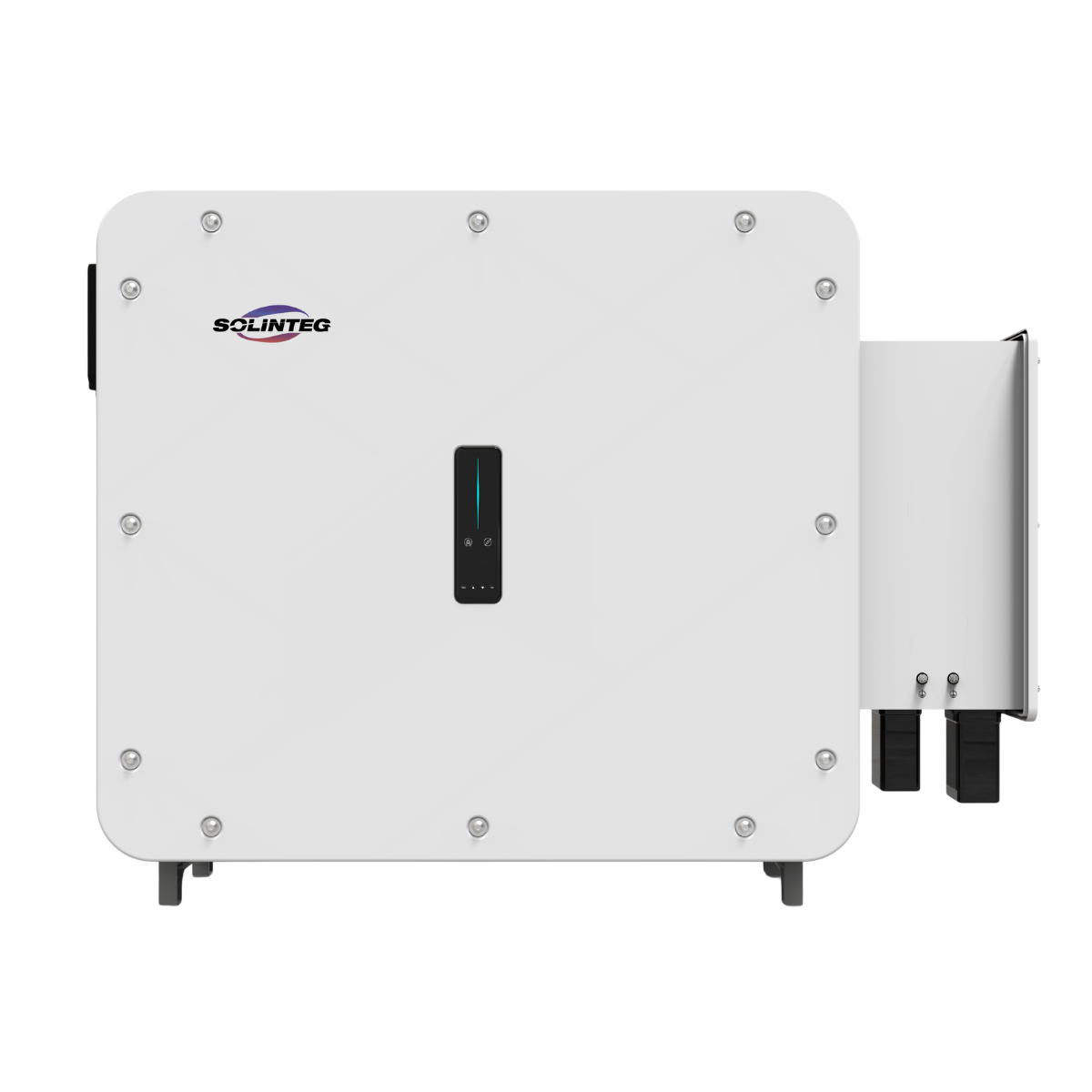





Chinese energy storage solution company Solinteg has released a new series of hybrid inverters, designed for the commercial and industrial (C&I) market.
Named M2HT, the series offers outputs of 75 kW, 80 kW, 99 kW, 100 kW, and 125 kW, marking the company’s first entry in the 125 kW power class. It features a 200% PV oversizing capacity, with corresponding solar inputs of 150 kW, 160 kW, 200 kW, 200 kW, and 250 kW.
“At the core of the new platform is a 300 A charge/discharge capability, paired with two independent battery inputs,” the company said. “The system is engineered to support large-format lithium cells such as 314 Ah and 628 Ah units. Each battery input is managed by its own battery management system (BMS), allowing the inverter to accommodate phased capacity expansion and enabling battery modules of different brands or specifications to operate in parallel without interdependence.”
All systems in the series feature six maximum power point trackers (MPPTs). The 75 kW, 80 kW, and 99 kW models support two strings per MPPT, while the 100 kW and 125 kW models support three strings per MPPT. Across all models, the MPPT operating range is 160 V to 950 V. A built-in energy-management system offers time-of-use scheduling, peak shaving, and dynamic pricing integration, with optional PV-generation forecasting.
“To ensure continuity of supply, the inverter supports 100% three-phase unbalanced loads, half-wave loads, and sub-20 ms transitions from grid power to backup mode. On the backup side, it can deliver 150% overload for ten seconds, enabling it to absorb the inrush current of motor-driven and inductive equipment,” Solinteg added. “Additional features include diesel-generator auto-control and smart load management, designed for environments with mixed-energy sources or irregular demand patterns. The enclosure is rated IP66 and incorporates a 330 A contactor, with an optional AFCI module.”
The inverters measure 122.6 cm x 93.2 cm x 35.6 cm and weigh 168 kg. They operate in temperatures from -30 C to 60 C and up to 100% humidity, with a maximum operating altitude of 3,000 m. The company notes that the series is adaptable to a wide range of distributed-energy scenarios, from industrial and commercial operations with variable demand to agricultural facilities with seasonal consumption, as well as emerging microgrids requiring coordinated control of PV, storage, and diesel resources.
This content is protected by copyright and may not be reused. If you want to cooperate with us and would like to reuse some of our content, please contact: editors@pv-magazine.com.


By submitting this form you agree to pv magazine using your data for the purposes of publishing your comment.
Your personal data will only be disclosed or otherwise transmitted to third parties for the purposes of spam filtering or if this is necessary for technical maintenance of the website. Any other transfer to third parties will not take place unless this is justified on the basis of applicable data protection regulations or if pv magazine is legally obliged to do so.
You may revoke this consent at any time with effect for the future, in which case your personal data will be deleted immediately. Otherwise, your data will be deleted if pv magazine has processed your request or the purpose of data storage is fulfilled.
Further information on data privacy can be found in our Data Protection Policy.