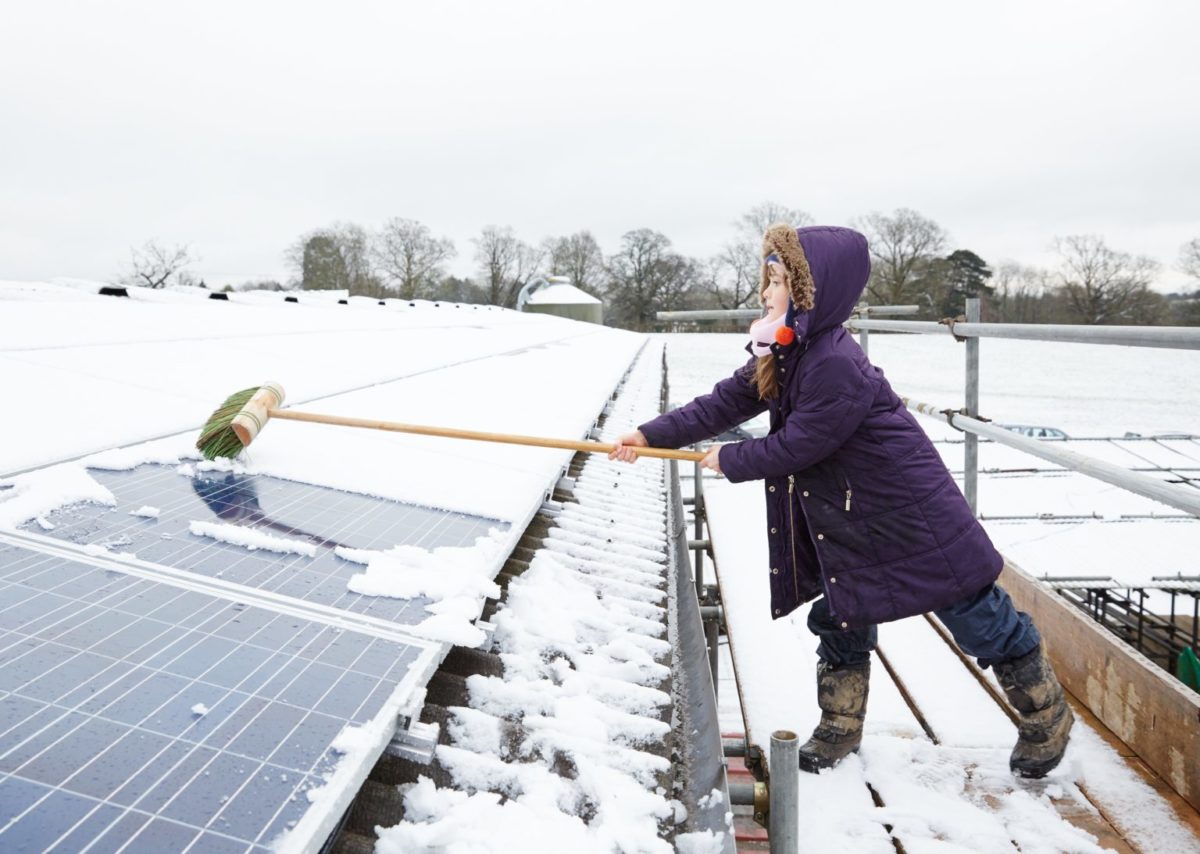





An international research team has conducted a techno-economic analysis for urban bifacial PV in high-latitude areas and has found that bifacial systems could generate up to 12% more power than monofacial counterparts under snow conditions.
The scientists explained that, due to the complexity of snow effects, the scientific literature still lacks a detailed analysis of bifacial performance in high-latitude regions.
“To fill this research gap and solve the technical challenge, we developed a novel techno-economic optimal PV installation model for bifacial PV systems by considering snowfall and its melting effects as well as two operation models – home model and park model,” corresponding author Wujun Wang told pv magazine. “Furthermore, in this optimizing model, we considered both installation angle and interrow space, which makes it capable of optimizing both small-scale rooftop PV systems and large-scale PV farms.”
The group has focused on the case study of Hammarby, an urban district in Sweden’s capital, Stockholm. Data on the grid network, including substations and loads, were obtained from the grid operator. Weather data were obtained from the Solcast dataset and the Swedish Meteorological and Hydrological Institute. This included, among others, irradiance data, air temperature, and snow depth.
The open database of Stockholm City provided building data, represented as simplified prismatic models. In total, 277 buildings have roof areas exceeding 226,000 m2. The buildings are connected to 19 different substations, and each substation may serve different numbers of buildings and other types of consumers. All roofs are assumed to be flat, and the PV systems are installed with a fixed tilt angle. Interrow space shading is also considered.
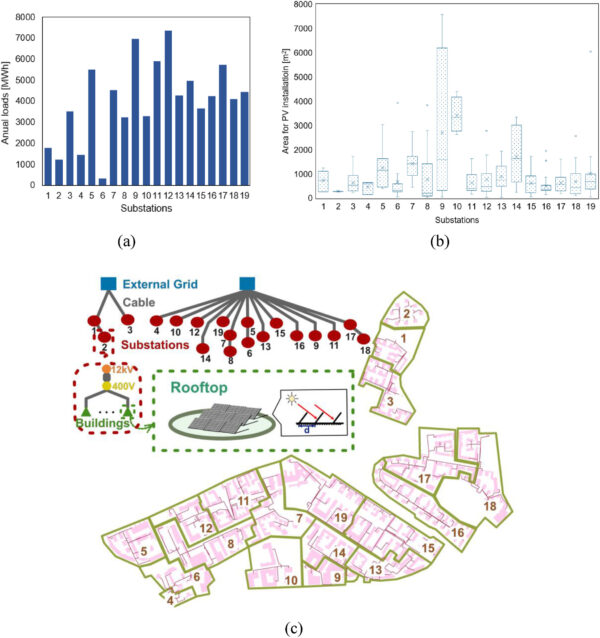
Image: KTH Royal Institute of Technology, Renewable Energy, CC BY 4.0
The bifacial panels considered have a maximum power of 575 W with a bifaciality factor of 0.8. Reference monofacial models were also considered, with a power of 575 W and no bifaciality factor. They were all installed at a fixed tilt angle, facing south, with a 10% total loss allowance accounting for factors such as soiling, wiring, and availability. The price per bifacial panel was set at SEK 948 ($102.4), while monofacial panels were priced at SEK 920.
The simulations considered three electricity price levels, namely SEK 221/MWh, SEK 672/MWh, and SEK 1,379/MWh, and two real discount rates – 2% and 5%. It evaluated two operation modes: home mode, in which electricity is produced for own use and any excess is sold to the grid; and park mode, in which electricity is made entirely for the grid.
“Several results were very impressive,” Wang said. “First, compared to monofacial PV systems, bifacial PV systems can produce 9.1-12.8% more electricity with snow conditions, and most of this increase occurs during the winter season (December to February). Second, bifacial PV could achieve a lower levelized cost of electricity (LCoE) by 8.8 – 9.7% on average than monofacial PV. Third, discount rate plays an important role in the economic performance of both bifacial PV and monofacial PV systems, including LCoE and payback periods.”
The analysis also showed that self-sufficiency and self-consumption for a bifacial PV system are pretty similar, with an approximately two percentage-point difference. In addition, although it may be profitable over its lifetime, net present value (NPV) and payback period are highly sensitive to market conditions, such as electricity prices, discount rates, and subsidies.
“In this study, we assume all PV panels project towards south, but this assumption might not work for all real PV farms due to local limitations, such as topography, electrical price policy, infrastructure, and so on,” Wang noted. Therefore, we are modifying this model to enable it to optimize PV systems oriented in directions other than south. In addition, we are also working on improving the snow model and integrating an accurate PV soiling model to make this techno-economic optimal PV installation model more applicable.”
The research work was presented in “Techno-economic analysis of urban bifacial PV in high-latitude area,” in Renewable Energy. Researchers from Sweden’s KTH Royal Institute of Technology and China’s Zhejiang University of Technology have participated in the study.
This content is protected by copyright and may not be reused. If you want to cooperate with us and would like to reuse some of our content, please contact: editors@pv-magazine.com.

By submitting this form you agree to pv magazine using your data for the purposes of publishing your comment.
Your personal data will only be disclosed or otherwise transmitted to third parties for the purposes of spam filtering or if this is necessary for technical maintenance of the website. Any other transfer to third parties will not take place unless this is justified on the basis of applicable data protection regulations or if pv magazine is legally obliged to do so.
You may revoke this consent at any time with effect for the future, in which case your personal data will be deleted immediately. Otherwise, your data will be deleted if pv magazine has processed your request or the purpose of data storage is fulfilled.
Further information on data privacy can be found in our Data Protection Policy.