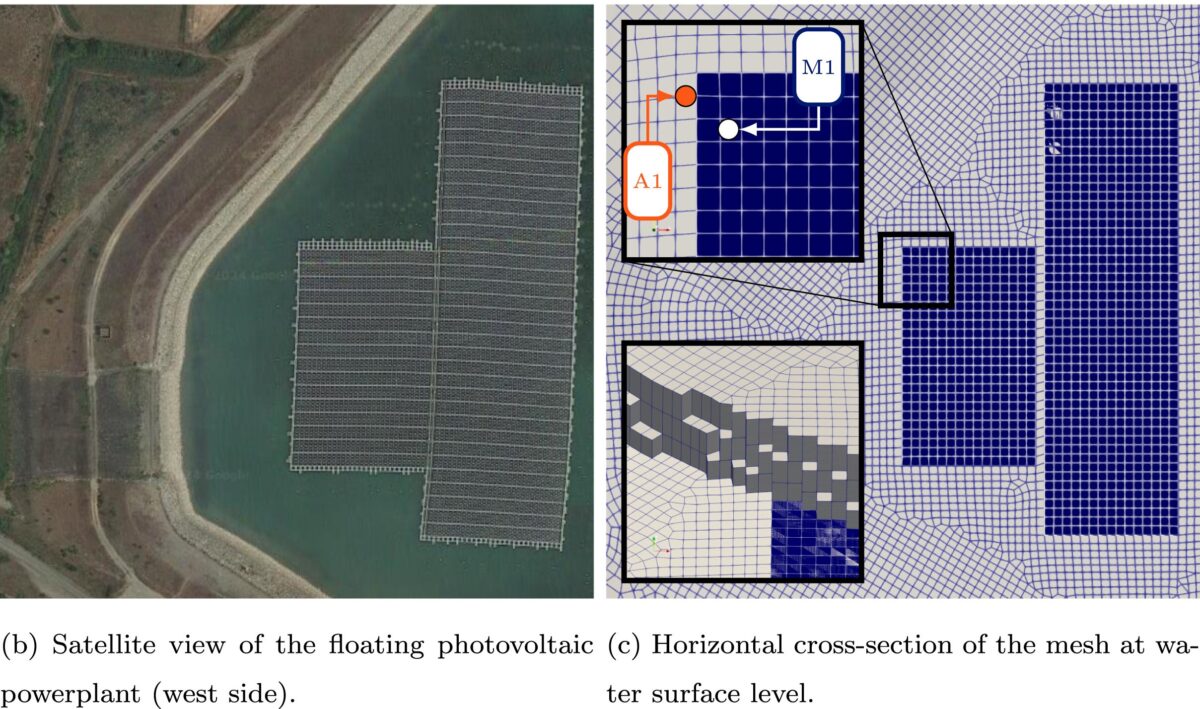





French researchers have developed a framework to model microclimate effects of large-sized floating PV systems.
The new model can be used to determine wind-dependent convective heat transfer coefficients (CHTC), ambient temperatures, and to estimate evaporation patterns in partially covered bodies of water based on a variety tilt angles, module heights, and pitch distances.
“The main novelty of this work lies in the numerical methodology we developed, specifically an upscaling method to quantify panel-atmosphere interactions at the module scale then model the micrometeorology at the power plant scale with a relatively fine resolution of about 4 meters,” Baptiste Amiot, corresponding author of the research told pv magazine, adding that the resolution is significantly higher than others in this field.
“Applying this methodology enables us to map the thermal performance across utility-scale installations and to provide insights into local environmental effects, such as evaporative losses,” he said.
The precursor model is geometrically adaptable: tt can handle various tilt angles, mounting heights, and inter-row spacings, according to Amiot. “It is particularly well-suited for large-scale installations exposed to sufficiently windy conditions,” Amiot added.
The researchers used a computational fluid dynamics (CFD) precursor model, a microclimate CFD model supporting the PV parameterization, and an experimental survey. A wind-tunnel setup typical of a land-based application was used to confirm accuracy of altitude-based wind profiles.
In addition, a geometrical layout of a commercial floating PV (FPV) installation was used for the atmosphere boundary layer parameters. The wind direction effects were assessed using the microclimate CFD model that reproduced the localized conditions of the commercial FPV array.
“The atmospheric component is fundamentally similar to regional climate models (RCMs) but deploying it within a CFD framework offers advantages in terms of surface element parameterization and the spatial discretization we can achieve,” said Amiot.
Some of the findings included temperature gradients range between 1.3 C/km and 5.8 C/km; headwinds and tailwinds relative to the front surface of the PV modules generate the greatest turbulence levels. Furthermore, the team was able investigate how turbulent flows influence water-saving gains based on PV coverage of the water surface.
Assessing the results, the researchers noted that the precursor method “readily determines” heat transfer coefficient correlations as a function of wind speed and direction. “This is essential to obtain the thermal U-values that govern panel cooling,” added Amiot.
The model can be extended to model large ground-mounted systems and agrivoltaics, including dynamic configurations where panels adjust orientation throughout the day, according to Amiot. It is suitable for inland and nearshore FPV, but not offshore FPV.
The work is detailed in “Boundary-layer parameterization for assessing temperature and evaporation in floating photovoltaics at the utility-scale,” published in Renewable Energy. Research participants include Ecole nationale des ponts et chaussees, Electricité de France RD, and Université Claude Bernard.
The researchers are currently focused on developing CFD models to predict both the energy output and environmental trade-offs of dual-use photovoltaics systems and FPV evaporation research at finer spatial scales, coupled with in-situ measurements. It is also working on an agrivoltaics CFD-plant model to predict crop response below PV canopies.
This content is protected by copyright and may not be reused. If you want to cooperate with us and would like to reuse some of our content, please contact: editors@pv-magazine.com.


By submitting this form you agree to pv magazine using your data for the purposes of publishing your comment.
Your personal data will only be disclosed or otherwise transmitted to third parties for the purposes of spam filtering or if this is necessary for technical maintenance of the website. Any other transfer to third parties will not take place unless this is justified on the basis of applicable data protection regulations or if pv magazine is legally obliged to do so.
You may revoke this consent at any time with effect for the future, in which case your personal data will be deleted immediately. Otherwise, your data will be deleted if pv magazine has processed your request or the purpose of data storage is fulfilled.
Further information on data privacy can be found in our Data Protection Policy.