




A research team from Austria has systematically investigated the chemical, optical, thermal, and thermo-mechanical properties of commercially available coextruded ethylene vinyl acetate–polyolefin–ethylene vinyl acetate (EPE) encapsulant films. EPE encapsulant is part of the industry's transition to TOPCon, HJT, and tandem solar cells, as it is considered to have superior electrical insulation and a moisture barrier.
“The novelty of our work is that we deliberately challenged the current narrative around EPE,” corresponding author Nikolina Pervan told pv magazine. “Rather than focusing on efficiency or cost advantages, we examined EPE at the material level and treated it as a complex multilayer system. Our results suggest that evaluating EPE purely as a drop-in replacement risks overlooking critical reliability questions.”
“EPE grew from a 5% share in 2019 to 38% in 2024, while ethylene vinyl acetate (EVA) held 42% of the market share, indicating that EPE is already challenging EVA in the market,” she went on to say. “Manufacturers are already using EPE widely. While science is often slower in catching up with industry, and material-level data remain relatively scarce, EPE is already an industrially accepted encapsulant, as reflected by its market share. However, the long-term effects of this encapsulant remain to be seen.”
Pervan added that his team was surprised to discover, in tests, that four encapsulants marketed under the same EPE label showed substantially different material behavior and levels of technological maturity. “This indicates that EPE is not a single solution for all PV module designs, but rather a broad classification that currently groups systems with fundamentally different material behaviour and reliability potential,” she said.
“In this context, we may be repeating a situation similar to early polyolefin development, where different formulations under one label led to very different performance outcomes,” she further noted.
For their study, the researchers acquired four commercially available EPE encapsulants and tested them in both their uncured and cured (laminated) states. Lamination was performed by placing the encapsulant between two glass plates, using a non-stick Teflon mat between the glass and encapsulant layers. Ethylene vinyl acetate (EVA) and polyolefin elastomer (POE) were tested as reference materials.
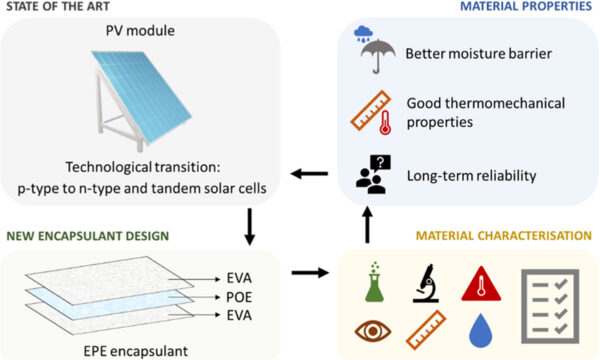
Image: Polymer Competence Center Leoben GmbH (PCCL), Solar Energy Materials and Solar Cells, CC BY 4.0
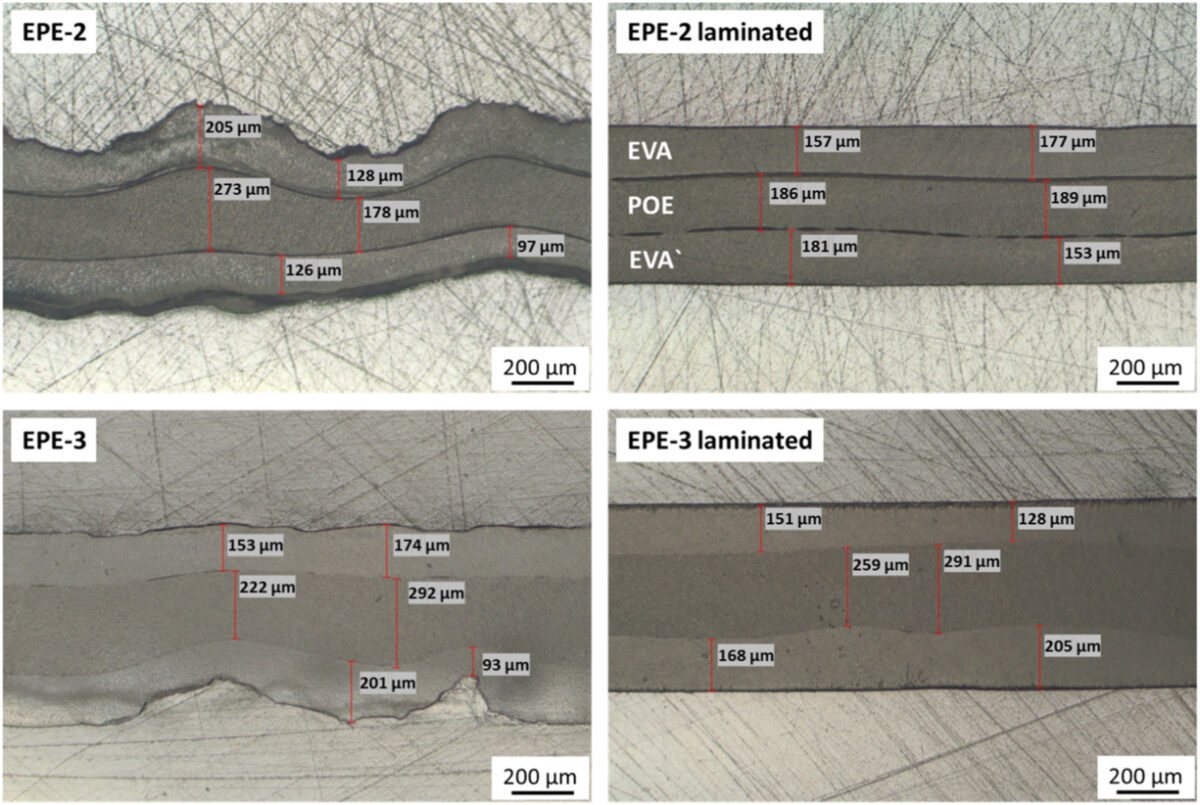
The first set of tests has considered the material identification of the encapsulants and included infrared spectroscopy, ultraviolet-visible-near infrared (UV-Vis-NIR) spectroscopy, and light microscopy on cross-sections of the foils and mini-PV modules. After the materials were identified, the team moved on to analyze the encapsulant's performance, including its water vapor transmission rate (WVTR) and thermal and thermo-mechanical properties.
According to the results, the outer EVA layers of all EPE encapsulants were comparable, with only slight differences in vinyl acetate (VA) content. However, noticeable differences were in the inner polyolefin layer: while EPE-1 has an ethylene acrylate copolymer inner layer, EPE-2, EPE-3, and EPE-4 consist of ethylene α-olefin copolymer core layers, with different side groups and/or varying comonomer contents.
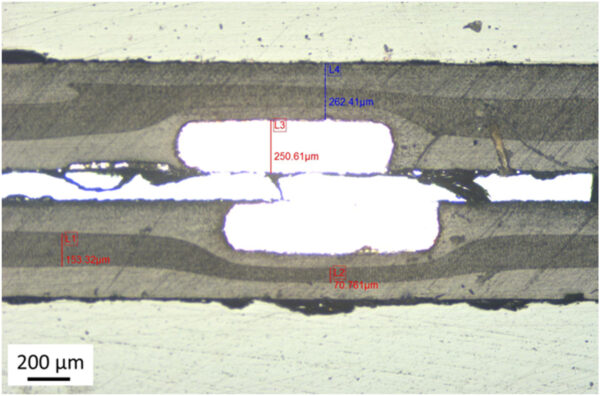
Image: Montanuniversität Leoben, Solar Energy Materials and Solar Cells, CC BY 4.0
“Differences in the crosslinking behavior were evident from the differential scanning calorimetry (DSC) analysis. EPE-1 was the only sample with a non-crosslinking inner polyolefin layer, whose high crystallinity reduced visible-light transmission but also enhanced barrier to water vapor,” the research team said. “The presence of a polyolefin layer improved the thermal resistance of the encapsulant. The co-extrusion process appeared to improve the dimensional stability of EPE-2, EPE-3, and EPE-4 compared to pure EVA film, whereas the non-crosslinking polyolefin in EPE-1 led to higher shrinkage and expansion.”
The analysis also showed the WVTR of all EPEs was significantly lower than that of single-layer EVA. The layer distribution and uniformity of the tested EPE films were comparable, and complete wetting of the interconnections was achieved with all four EPE encapsulants.
“Our follow-up research will focus on crosslinking kinetics and thermo-mechanical behaviour, particularly the coefficient of thermal expansion compared to EVA and polyolefins, as these parameters directly drive stress development in PV modules,” concluded Pervan. “In parallel, we will investigate aging and additive migration to assess how these multilayer systems evolve over decades. If EPE is to become a true long-term solution, these fundamental questions must be addressed systematically.”
The research work was presented in “Is EPE the future of PV encapsulation? A comprehensive material-level assessment,” published in Solar Energy Materials and Solar Cells. Scientists from Austria's Polymer Competence Center Leoben (PCCL), the University of Leoben, and the Austrian Research Institute for Chemistry and Technology (OFI) have participated in the research.
This content is protected by copyright and may not be reused. If you want to cooperate with us and would like to reuse some of our content, please contact: editors@pv-magazine.com.

By submitting this form you agree to pv magazine using your data for the purposes of publishing your comment.
Your personal data will only be disclosed or otherwise transmitted to third parties for the purposes of spam filtering or if this is necessary for technical maintenance of the website. Any other transfer to third parties will not take place unless this is justified on the basis of applicable data protection regulations or if pv magazine is legally obliged to do so.
You may revoke this consent at any time with effect for the future, in which case your personal data will be deleted immediately. Otherwise, your data will be deleted if pv magazine has processed your request or the purpose of data storage is fulfilled.
Further information on data privacy can be found in our Data Protection Policy.