




There is a shortfall of around 120 GW between planned renewables expansion and available grid capacity across the majority of EU member states, according to a new report from energy analysts Ember.
The “Crossed wires: Grid capacity could block EU energy security” report says more than one in every two EU countries face bottlenecks at the transmission level where large-scale solar and wind projects are connected.
The biggest constraints are in Austria, Bulgaria, Latvia, the Netherlands, Poland, Portugal, Romania and Slovakia, where available grid capacity accommodates less than 10% of the renewables planned before the end of the decade.
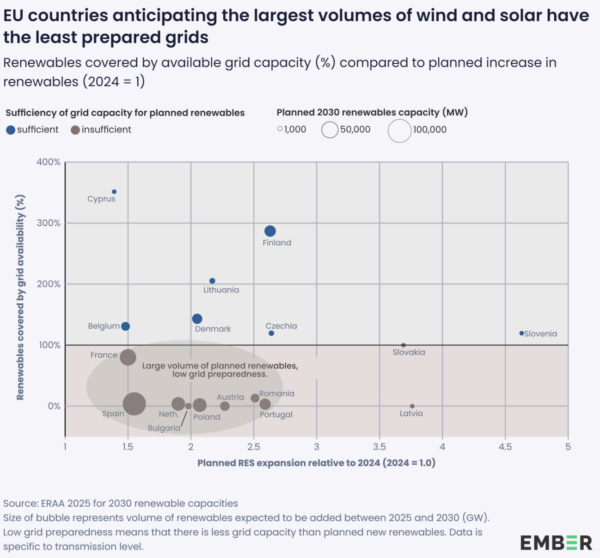
Image: Ember
Ember’s report also warns that the issue across the EU is likely even larger than reported as some of the bloc’s most mature renewables markets, such as Germany and Italy, do not publish grid capacity data.
“This is not a long term risk that can afford long term solutions. Comparing available grid capacity to even nearer-term renewable deployment expectations for 2028 shows that the grid capacity crunch is likely to become very apparent soon,” the report says. “This includes countries beyond the Netherlands, which is already experiencing impacts. Nine of 17 reporting countries are expected to face a grid capacity crunch by 2028.”
The problem is not just impacting larger, utility-scale solar projects. Ember’s report adds that limited capacity in Europe’s distribution network risks slowing the rollout of rooftop solar.
Findings from 13 countries that publish grid capacity data for distribution networks found six with insufficient headroom for anticipated small-scale solar growth, putting at least 16 GW of planned rooftop solar at risk.
Ember says this could impact up to 1.5 million households, with the risk most pronounced in Slovenia and Denmark, where insufficient grid capacity could impact 32% and 19% of all households, respectively.
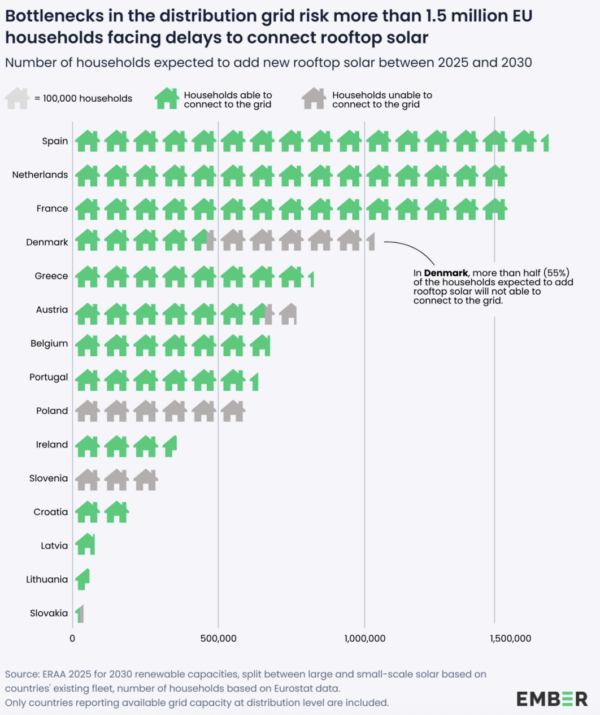
Image: Ember
Grid bottlenecks across Europe are also compounded by huge connection queues in some countries, meaning new applicants are likely to face long delays. Across 10 EU countries – Finland, Italy, Germany, France, Netherlands, Spain, Austria, Poland, Belgium and Lithuania – there are almost 700 GW of renewables already in the queue for grid connection, according to Ember's report.
The report explains that the underlying issue is pace, with grid developments not keeping up with the speed of the energy transition and networks unprepared for renewed industrial investment.
Elisabeth Cremona, senior energy analyst at Ember and report author, told pv magazine that two parallel actions are required.
“Firstly, implementing fast-to-deploy solutions that can rapidly unlock capacity on the existing grid, which will allow new generators and consumers to connect even before new wires are built,” Cremona said. “As Europe faces its second fossil price shock in four years, it is critical to ensure that households seeking to protect themselves from volatile prices by installing rooftop solar do not face the barrier of limited grid capacity.”
“Secondly, we must step up investment in the power grid – both expanding the physical network and upgrading existing equipment – to truly address this problem.”
Recommendations highlighted in the report include non-wire solutions such as grid-enhancing technologies and non-firm connection agreements, which the International Energy Agency has previously estimated could unlock up to 185 GW of capacity across Europe. Ember's analysis adds that national regulators in 15 EU member states had already introduced enabling frameworks for non-firm agreements by November last year.
Cremona also told pv magazine that the onus is entirely on national actors, rather than the EU, to remedy the issues outlined by the report.
“Grid investments are a national level issue, therefore action to address capacity constraints resulting from historically insufficient investment must come from the national grid operators and regulator, with the support of local policy-makers,” Cremona explained. “This is good news because it means remedial actions can be implemented now, without waiting for legislation from Brussels.”
This content is protected by copyright and may not be reused. If you want to cooperate with us and would like to reuse some of our content, please contact: editors@pv-magazine.com.



By submitting this form you agree to pv magazine using your data for the purposes of publishing your comment.
Your personal data will only be disclosed or otherwise transmitted to third parties for the purposes of spam filtering or if this is necessary for technical maintenance of the website. Any other transfer to third parties will not take place unless this is justified on the basis of applicable data protection regulations or if pv magazine is legally obliged to do so.
You may revoke this consent at any time with effect for the future, in which case your personal data will be deleted immediately. Otherwise, your data will be deleted if pv magazine has processed your request or the purpose of data storage is fulfilled.
Further information on data privacy can be found in our Data Protection Policy.