




Belga Solar, formerly Evocells, began life as an installation company in 2007 before deciding to invest in its own production unit in 2012. The company transitioned to the Belga Solar brand in 2022, and in 2024 secured a €3 million ($3.51 million) capital increase to help accelerate its technological transition. The company’s current financial structure includes public financial institution Wallonie Entreprendre, private investors, and the company's managing directors, Frédéric Conrads and Sébastien Mahieu.
Today, Belga Solar’s manufacturing facility, located in Baillonville, central Wallonia, is where all the company’s solar panels are designed and manufactured. The facility has an annual capacity of 100 MW, equivalent to around 200,000 modules.
Belga Solar refers to itself as a mission-driven company whose core ambition is to ‘be the best for the world, rather than just the best in the world.’ It says this mission is defined by three strategic axes of the European energy transition, Belgian reindustrialization and Europe’s PV sovereignty.
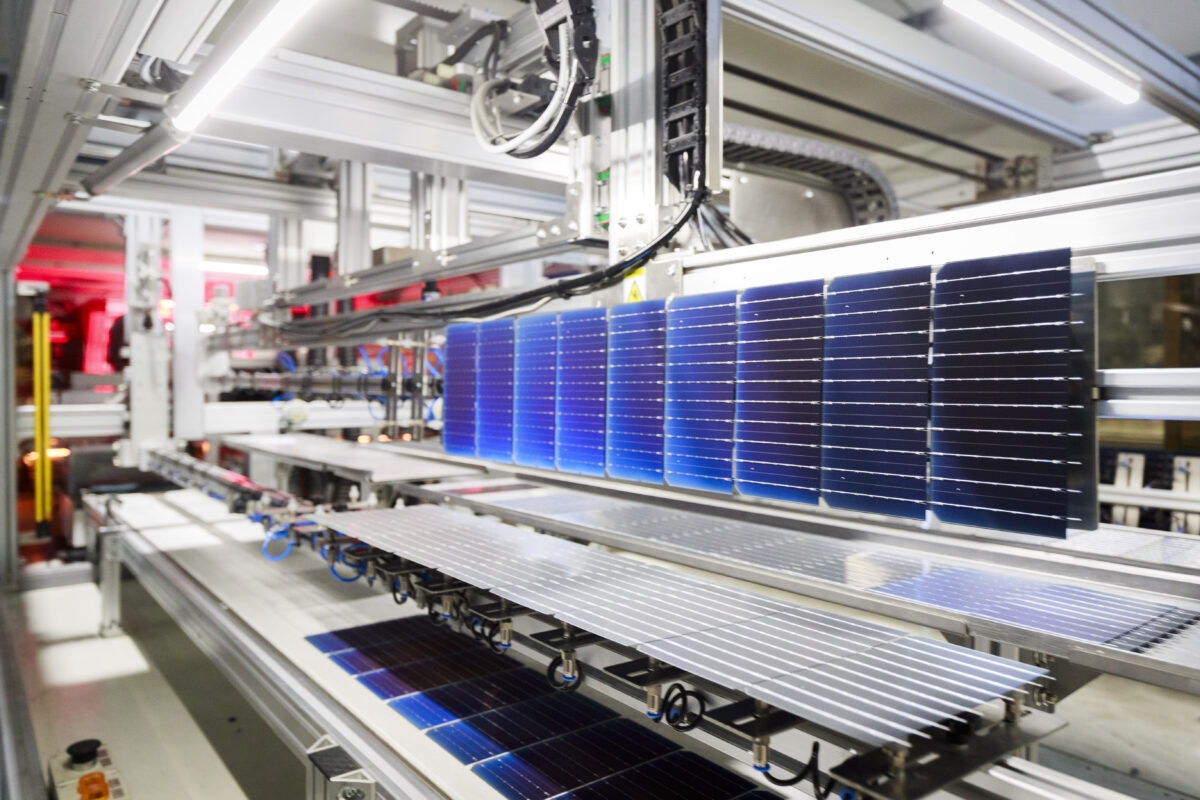
Its production line, designed as an integrated vertical model, utilizes equipment from Italian PV equipment manufacturer EcoProgetti. Mahieu told pv magazine that the company chose to acquire EcoProgretti machines when growing the factory capacity to align its aim of supporting Europe's PV industry. “We believe it doesn’t make sense to just have Chinese panels on our rooftops,” he explained. “We also have to have European workers and we also have to have European prosperity.”
Work on Belga Solar’s production line begins with high-precision cell soldering, followed by automated cell positioning and circuit assembly. The production line also completes electroluminescence testing, lamination testing, framing and finishing. Each panel undergoes six stages of control testing in total before being put to market, helping to offer 25-year performance and product guarantee.

Image:Geoffroy Libert/Belga Solar
Belga Solar has fully transitioned its production line from passivated emitter and rear cell (PERC) technology to tunnel oxide passivated contact (TOPCon) technology. Its core products include its Design range of black solar panels of 425-430 Wc, aimed at residential and architectural projects, alongside its Performance range of panels for agricultural and commercial and industrial customers with 450 Wc output. Both series feature half-cut M10 cells and a 35 mm black aluminium frame.
The company also produces a number of specialty modules at its facility, including panels for agrivoltaics and building-integrated photovoltaics. Belga Solar is also responsible for the local manufacturer of Wattway modules, a patented PV road surfacing technology developed by French transportation infrastructure company Colas in partnership with the National Institute of Solar Energy (INES), which is laid directly onto existing road surfaces.
Belga Solar’s production line also produces the company’s SkySafe modules, a new innovation that Mahieu said the company has started its first orders and deliveries of this year. SkySafe is a 490 Wc anti-glare black panel specifically designed for airport environments that has already been deployed at Brussels International Airport.
Mahieu told pv magazine that it was important to keep flexibility in the production line, as it enables the company to work on its diverse product range.
“We didn’t want a fully automatic production line because when you have such a production line, you still need the same amount of people working on the line, but they are just changing small things and robots do the work, and they can begin to lose their knowledge. It’s better to have them actively working on the product to keep their knowledge,” Mahieu explained. “The flexibility also allows us to produce specific products like the Wattway. It's very specific, there’s no glass in it, for example.”

Belga Solar targets both the residential and commercial and industrial market segments, Mahieu added, emphasizing the local supply chain it offers its customers across both market segments. While working primarily in the Belgian market, Belga Solar is also growing its European and international footprints, with partnerships in France and an installation at Ecuador’s Universidad Estatal Amazónica inaugurated last year. “That was one of the big projects last year in Ecuador, and we want to continue growing over there too,” Mahieu said.
Belga Solar became the world’s first B-Corp certified solar panel manufacturer, an accolade awarded for meeting a range of social, environmental and accountability standards for its customers. The company has committed to reducing its carbon footprint across its operations through a range of methods including a 70% reduction in cardboard packaging through eco-friendly packaging to the use of fluorine-free backsheets and frames without screws or silicone to facilitate recycling. Up to 95% of its panels are recyclable, with each panel installed on a private home financing the planting of four trees through a partnership with Belgian NGO Graine de Vie.
The first article in pv magazine‘s new series on solar manufacturing facilities around the world covered United Solar's polysilicon factory in Oman.
This content is protected by copyright and may not be reused. If you want to cooperate with us and would like to reuse some of our content, please contact: editors@pv-magazine.com.



By submitting this form you agree to pv magazine using your data for the purposes of publishing your comment.
Your personal data will only be disclosed or otherwise transmitted to third parties for the purposes of spam filtering or if this is necessary for technical maintenance of the website. Any other transfer to third parties will not take place unless this is justified on the basis of applicable data protection regulations or if pv magazine is legally obliged to do so.
You may revoke this consent at any time with effect for the future, in which case your personal data will be deleted immediately. Otherwise, your data will be deleted if pv magazine has processed your request or the purpose of data storage is fulfilled.
Further information on data privacy can be found in our Data Protection Policy.