
Chinese PV Industry Brief: Longi, Trina Solar report losses
Longi says its 2025 revenue and losses declined year on year, while Trina Solar reports deeper full-year losses and margin pressure across its core module business.

20-month field tests show tracker-based bifacial PV outpeforms fixed tilt counterparts with 13.5% higher ouput in desert enviroments
Qatari researchers found that bifacial 2P horizontal single-axis tracking PV systems in desert conditions produced up to 13.5% more electricity than fixed-tilt systems over long-term field testing in Qatar. The study also showed strong seasonal and technology-dependent performance, with tracker advantages varying with irradiance and weather conditions.
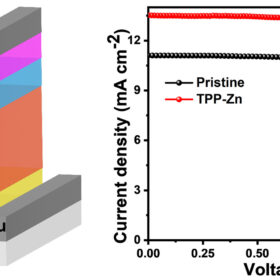
Inorganic perovskite solar cell based on tetraphenyl-porphine zinc interlayer achieves 82% fill factor
An international research team has proposed a perovskite solar cell architecture incorporating a thin tetraphenyl-porphine zinc interfacial layer to enhance surface potential, passivate defect states, and improve charge transport. The strategy leads to improved device efficiency and operational stability, enabling power conversion efficiencies exceeding 13%.

Australian researchers develop vapour-based manufacturing process for lead-free perovskite solar
Researchers at the University of Queensland have developed a scalable, lead-free perovskite solar cell manufacturing process that achieves record indoor-light efficiency while avoiding toxic materials and enabling flexible consumer electronics applications.
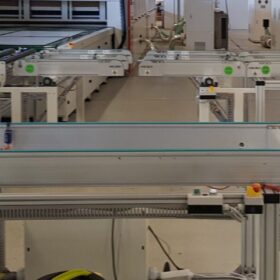
German solar module maker Soluxtec files for insolvency
Soluxtec has entered provisional insolvency proceedings as declining module prices and international competition continue to pressure European solar manufacturers. The company said it plans to restructure operations, maintain module deliveries, and preserve jobs while seeking investors.

Solar Manufacturing USA 2026 – production and technology at the heart of US solar
The upcoming Solar Manufacturing USA 2026 conference in Austin will focus on real U.S. solar manufacturing progress, shifting attention from capacity announcements to actual production, costs, yields, and technology choices across the full value chain. It will also examine how policy changes and tariffs are driving domestic expansion in ingots, wafers, cells, and modules, while highlighting competing technologies like back contact, heterojunction and TOPCon.

Scientists discover why lead-halide solar perovskites work efficiently despite being structurally ‘messy’
Researchers in Austria found that unusually high photovoltaic efficiency in lead-halide perovskites can be explained by internal electric fields generated at strain-induced domain walls, which separate charge carriers and enable long-range transport. Their experiments indicated that these effects arise from mesoscopic structural inhomogeneities rather than a uniform crystal structure, providing a general mechanism for charge separation in these materials.
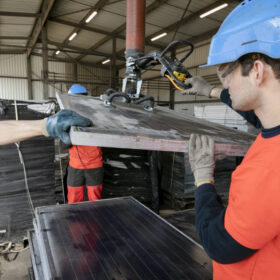
Rosi to build PV module recycling plant in Spain
Rosi has raised more than €20 million in a Series B funding round to scale its photovoltaic module recycling business and build a new 10,000-tonne-per-year facility in Teruel, Spain. The company uses pyrolysis-based technology to recover high-purity materials including silver, silicon, copper, aluminium and glass from end-of-life solar modules.
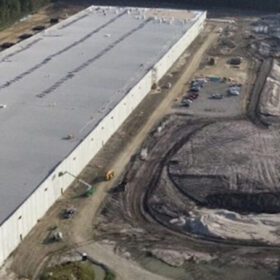
Boviet Solar sells U.S. PV module factory to Indian manufacturer Inox Solar
The divestment, already partially secured via escrow, reflects regulatory pressure from U.S. FEOC policy changes. Boviet Solar also continues negotiations to sell a separate U.S. cell project.
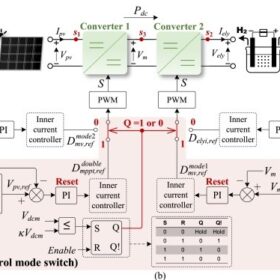
Low-power ride-through tech keeps green hydrogen flowing in standalone PV–electrolyzers
A UNSW-led research team proposed two low-power ride-through strategies for standalone PV–electrolyzer systems to maintain stability during sudden solar power fluctuations without using battery storage.
