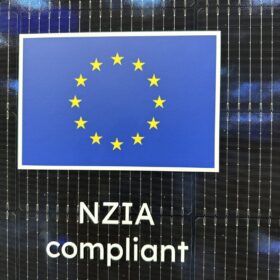
Will we finally buy European PV modules?
In a new monthly column for pv magazine, the Becquerel Institute explains why Europe’s solar manufacturing outlook is shifting from decline to cautious opportunity, driven by rising energy uncertainty and new regulations like the Net-Zero Industry Act that create fragmented, nationally defined markets with partial protection for domestic producers. While demand and policy support are strong, complexity, uneven implementation, and competition risks mean success will depend on how quickly and strategically industry players navigate this narrow window.

Trina Solar TOPCon patents invalidated in US ruling involving Canadian Solar
The U.S. Patent and Trademark Office has invalidated all claims of two TOPCon solar cell patents previously asserted by Trina Solar against Canadian Solar subsidiaries.

Cyber threats for PV: What are supply chain attacks and how do they work
Supply chain attacks compromise PV systems by targeting trusted vendors, software, or hardware components, allowing attackers to infiltrate systems indirectly through legitimate channels. These attacks can disrupt operations, introduce hidden vulnerabilities, and impact multiple assets at once, making vendor security and system validation critical for resilience.
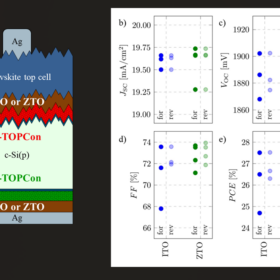
Perovskite–silicon tandem solar cells using zinc-doped tin oxide achieve comparable performance to indium tin oxide counterparts
Fraunhofer ISE-led researchers demonstrated zinc-doped tin oxide (ZTO) as an indium-free alternative to indium tin oxide (ITO) for recombination layers in fully textured perovskite–silicon tandem solar cells. ZTO delivers comparable device efficiencies of 27–28% under current-matching conditions, offering a scalable, indium-free pathway for high-performance tandem photovoltaics without efficiency loss.
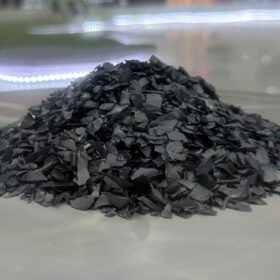
Chinese PV Industry Brief: JinkoSolar, Hoshine Silicon posts significant losses for 2025
Hoshine Silicon reported 2025 revenue of CNY 20.499 billion ($2.82 billion) and a CNY 2.991 billion net loss driven by PV disruption and impairments. Meanwhile, polysilicon and wafer prices continued to decline in mid-April amid high inventories and weak demand.

Switzerland to fund research on PV module, battery, heat pump recycling
The Swiss federal government has launched a funding call for research projects on energy and resource-efficient industrial processes, including the circular economy related to solar modules, batteries, heat pumps and electrolyzers. The deadline to submit pre-proposals is June 30.
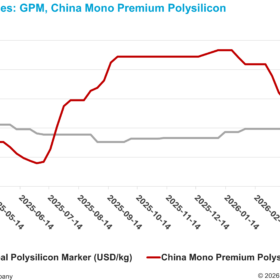
China polysilicon hits cost floor as producers curb output amid weak demand
In a new weekly update for pv magazine, OPIS, a Dow Jones company, provides a quick look at the main price trends in the global PV industry.
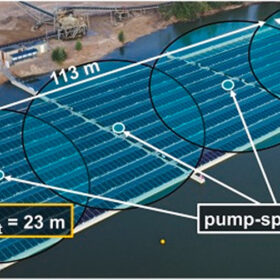
Spray cooling for floating PV
A research team in Germany developed a dynamic model of spray cooling for floating PV systems that couples thermal behavior, electrical performance, and active cooling, and validated it against a 750 kW installation. Simulations across four climates showed that spray cooling reduces module temperatures by up to 42% and improves energy yield by up to 3.8%, with benefits strongly dependent on local conditions.
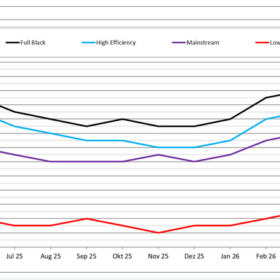
PV module prices continue to rise unabated
Photovoltaic module prices have risen for the fourth consecutive month, driven by strong demand for energy independence despite falling upstream costs such as polysilicon. At the same time, production cuts in China and tighter supply conditions are limiting availability, reinforcing price increases across all technologies.

Philippines registers solar module maker targeting EU export market
The Philippine Economic Zone Authority (PEZA) has formally registered Genuine Renewable Energy and Eco-Friendly Energy Network Corp. (GREEENC) as an ecozone enterprise to manufacture and export PV modules, with the European Union as the primary target market.
