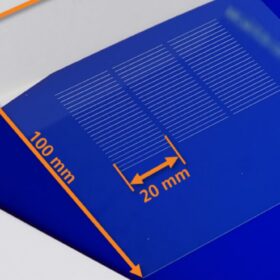
Improving solar cell performance with narrower contact fingers
Fraunhofer ISE researchers have developed a new metallization process that can produce ultra-fine line contacts for solar cells. The proposed technique is based on the so-called LIDE technology and can reportedly help increase overall PV device efficiency.
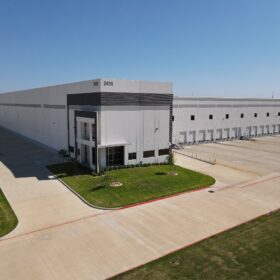
Waaree’s 1.6 GW solar factory in Texas starts commercial production
Waaree Solar Americas has started commercial production at its 1.6 GW solar module factory in Brookshire, Texas. It plans to expand the facility’s capacity to 3 GW by fiscal 2026 and 5 GW by fiscal 2027.
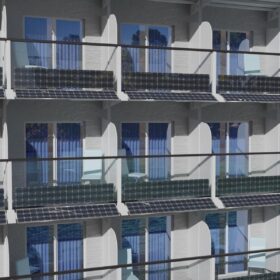
Balcony PV systems for cruise ships
Scientists have simulated the installment of PV modules on the balconies of cruise ship cabins. They tested the systems with three DC configurations and simulated them while cruising in the Caribbean and along the Norwegian and Danish coasts.
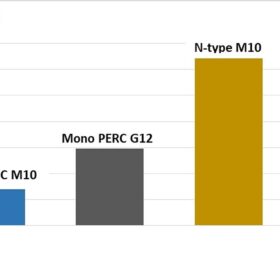
Solar wafer price rebound nears its limit
In a new weekly update for pv magazine, OPIS, a Dow Jones company, provides a quick look at the main price trends in the global PV industry.

Roofit.Solar releases new BIPV panels with narrow roof coverage
Estonia’s Roofit.Solar has developed new building-integrated photovoltaic (BIPV) panels with an effective width of 470 mm, offering power outputs of 120 W or 180 W.

Floating solar could reach LCOE of $0.053/kWh in Saudi Arabia
Scientists in Saudi Arabia have assessed the techno-economical feasibility of floating PV plants at three different dams and have found that such projects could have a return on investment of 12 to 13 years.

‘Oversupply is still there’
At the World Future Energy Summit in Abu Dhabi, pv magazine spoke with two OPIS analysts about the current and projected price trajectory in the global supply chain. According to their analysis, overcapacity remains difficult to be kept in control, which makes an increase in solar module prices very unlikely, at least in the near future.
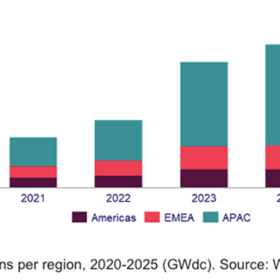
Wood Mackenzie predicts solar growth will stagnate in 2025
Wood Mackenzie’s latest report forecasts that 493 GW (DC) of solar will be added throughout the world this year, compared to 495 GW in 2024. Solar module prices are expected to rise this year as manufacturers aim to recover profit losses from the past two years.
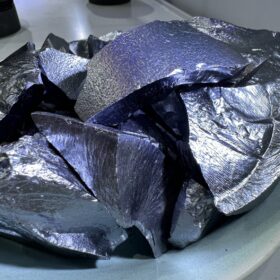
GCL cuts granular silicon production costs by 15%
GCL Technology cut granular silicon production costs by 15% to CNY 28.17 ($3.87)/kg in the fourth quarter of 2024, down from CNY 33.18 in the previous quarter.
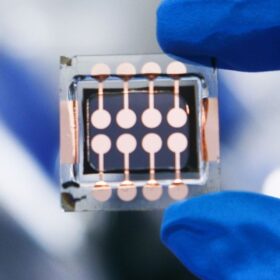
All-perovskite tandem solar cell based on wide bandgap perovskite achieves 29.1% efficiency
An international team researching wide bandgap perovskite films announced an effective technique to control the crystal orientation without compromising charge transport. The new approach was demonstrated in an all-perovskite tandem solar cell with an open-circuit voltage of 2.21 V and certified power conversion efficiency of 29.1%,
