
Australian startup scaling up printed solar technology
Kardinia Energy has secured AUD 2.15 million from the Australian government’s Industry Growth Program to scale up its flexible, low-cost printed solar technology from university proof-of-concept to pilot manufacturing.
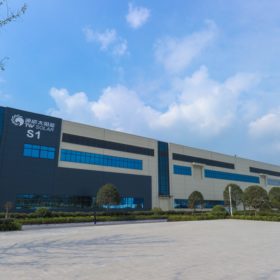
Tongwei plans to acquire polysilicon competitor Qinghai Lihao
Shanghai-listed polysilicon producer Tongwei says it intends to acquire 100% of Qinghai Lihao through a share-and-cash transaction, as consolidation in China’s polysilicon sector increasingly shifts toward mergers and acquisitions.
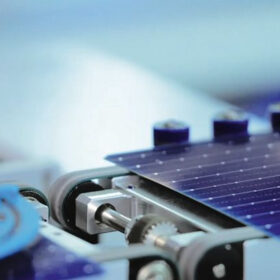
JinkoSolar achieves record-breaking 26.66% efficiency for TOPCon solar cell based on M10-size wafer
The Chinese manufacturer claims the new efficiency result sets a world record for industrial-scale TOPCon solar cells on M10-size wafers. The achievement was verified by an undisclosed independent third-party organization in China.
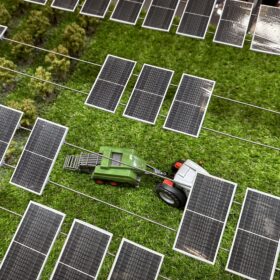
Survey finds 85.8% of Canadians support agrivoltaics
Canadian researchers conducted the first nationwide survey on public attitudes toward agrivoltaics, finding strong support across provinces with 85.8% of respondents in favor, although preferences varied by configuration. Opposition mainly stemmed from resistance to change, aesthetic concerns, and lack of awareness, highlighting the need for public education and updated policy frameworks to enable wider adoption.
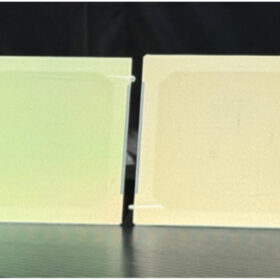
Japanese scientists build near-white heterojunction solar cell for BIPV applications
The lab-scale, near-white heterojunction solar cell uses nanoclay-based scattering layers combined with dielectric multilayer films to preserve power conversion efficiency while enhancing visual appeal. The researchers report optical losses of less than 1% at a 50% clay volume fraction, which are significantly lower than those observed with textured glass.

U.S government sets preliminary countervailing duties on solar imports from India, Indonesia and Laos
The U.S. Department of Commerce has issued preliminary findings that solar manufacturers in India, Indonesia and Laos benefited from government subsidies, paving the way for countervailing duties of up to 143.30%.

First Solar announces licensing agreement with Oxford PV, alleges new TOPCon patent infringements
The U.S. thin-film solar module manufacturer’s stock price fell more than 12% in extended trading following the earnings announcement, partly due to lower-than-expected guidance for 2026 sales and revenue.
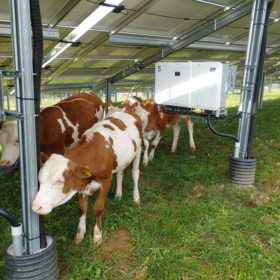
How to protect animals from lightning in agrivoltaics
Researchers in Germany assessed lightning risks in livestock-integrated agrivoltaic systems, identifying key injury mechanisms and establishing safe step and touch voltage limits. Their simulations showed edge strikes and conductive structures pose the highest hazards, highlighting the need for livestock-specific earthing designs and mitigation strategies.
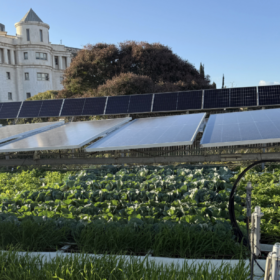
Israel approves rules for agrivoltaics
A zoning masterplan for agrivoltaics in Israel specifies solar panel coverage must not exceed 30% of the cultivated area. The lower edge of panels must be at least 1.5 m above the ground for field crops, increasing to 4.5 meters for orchards and other crops.

When hail hits PV: New research maps damage, testing, and mitigation
A new review examines the impact of large hail on PV systems, covering damage, testing methods, and mitigation strategies. Researchers highlight risks across Europe and the U.S. and explore ways to improve module resilience.
